
How Much Does It Cost to Build an Indoor Sports Court in Indonesia?
Construction, Sports, Stadium
May 11, 2026
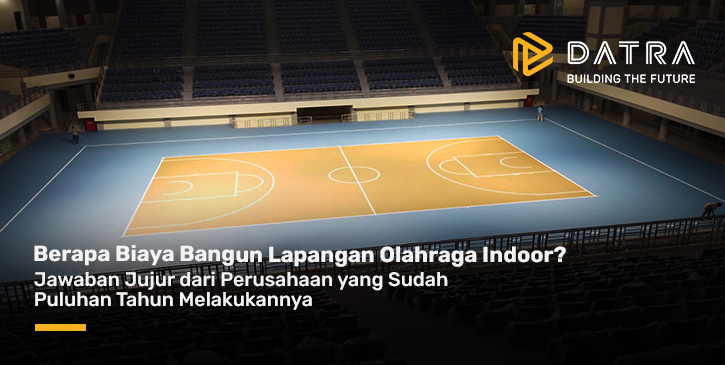
A no-nonsense guide from specialists who have built everything from school gyms to international arenas — including Indonesia Arena for the FIBA World Cup.
If you've searched for this question and found only vague answers, you're not alone. Most cost guides online are written by people who have never actually built a sports facility. This one isn't. The numbers, warnings, and lessons in this post come from 40+ years of hands-on experience designing, supplying, and constructing indoor sports facilities across Indonesia — from school halls in regional cities to international-standard arenas that have hosted FIFA World Cups and FIBA championships.
Let's get into it.
The First Question Isn't "How Much?" — It's "What For?"
Before any honest number can be put on the table, you need to answer one foundational question: what is the business objective of this facility?
This sounds obvious. It rarely is. Too many developers, architects, and owners go straight into solution mode — drawn to renderings and product catalogues — before clarifying what they actually need the venue to do.
A venue designed to host international competitions must comply with federation standards (FIBA, FIFA, BWF, World Athletics) so that official records can be recognised and events can be sanctioned. This affects not just the field of play and the surface, but also seating configurations, safety clearances, sightlines, structural load calculations, and smart systems infrastructure.
A multi-purpose indoor arena — one that hosts basketball on Tuesday and a corporate exhibition on Friday — requires a fundamentally different flooring strategy than a dedicated competition court.
A school gym needs to serve a very different utilisation pattern than a commercial sports club trying to generate revenue and justify its Capex.
Once the objective is clear, two other things become essential: total available budget and realistic timeline. Developers are often reluctant to share these upfront. That reluctance costs them — because without those parameters, no specialist can design the right solution. You end up over-built, under-built, or, most commonly, stuck mid-project when funds run dry.
The Real Cost Ranges: What to Expect at Each Scale
These are real-world figures from active projects in Indonesia, expressed in IDR. They are ranges, not quotes — every project is different. But they give you a genuine calibration point that most sources won't.
School Gymnasium / Small Community Sports Hall
IDR 1 billion – 2 billion
This is effectively the minimum threshold for a facility worth building. Below this, the compromises on structural quality, surface specification, and installation begin to undermine the very purpose of the space. Even at the school level, you are building something people will use every day for years — it deserves to be built properly.
Mid-Scale Indoor Arena (5,000–6,000 seats)
- Renovation / upgrade: IDR 10 billion – 20 billion
- New build: IDR 30 billion – 60 billion
This is the category where most regional government and municipal projects fall. The range is wide because scope varies significantly — a renovation that addresses flooring, seating, and equipment looks very different from one that also involves structural strengthening, civil works, and smart systems.
International-Standard Multi-Purpose Indoor Arena
IDR 500 billion – 1 trillion+
This is the tier of Indonesia Arena (Gelora Bung Karno, Senayan) — a 16,000-capacity multi-purpose venue built to host the FIBA World Cup 2023. At this scale, every element must meet global federation requirements without compromise.
Why Two Projects with the Same Brief Can Have Very Different Price Tags
This is where most cost conversations go wrong. Clients often treat sports facility products as commodities. They are not. The range of quality, durability, and certification is enormous — and choosing poorly is far more expensive than choosing well.
1. Flooring: The Single Most Consequential Decision
For indoor sports, you have three main flooring categories:
Permanent polyurethane is the workhorse of multi-purpose indoor venues. Durable, low-maintenance, suitable for basketball, badminton, volleyball, and futsal on one surface. Cost-effective when properly specified and installed.
Engineered wooden flooring (e.g. Junckers from Denmark, the global FIBA sponsor) is the gold standard for serious competition and club environments. Properly installed and maintained, a Junckers floor lasts 40–50 years. Improperly treated cheap wooden flooring can rot within 1–2 years in Indonesia's climate. The premium is real; so is the long-term return.
Lay-on / modular systems (vinyl, portable wood panels, interlocking mats) require an exceptional concrete sub-base underneath — smooth, level, properly sloped for drainage, and fully waterproofed. This is where projects most commonly fail. Developers who choose a lay-on surface to save money often discover their concrete sub-base is inadequate, and the remediation cost exceeds what they saved.
On product origin: Solutions come from Indonesia, Southeast Asia, China, and Europe. European brands — particularly in flooring and seating — carry established federation certifications, superior durability guarantees, and decades of proven performance. Yes, they carry a premium due to currency weakness, shipping, and import duties. But they also invest heavily in their reputation, and a developer who chooses a European-certified surface benefits from that credibility. More premium products also require less maintenance — a calculation Indonesian buyers routinely undervalue.
2. The Concrete Sub-Base: The Hidden Variable That Breaks Projects
Poor concrete base work is one of the leading causes of sports facility failure in Indonesia. The consequences are severe: surfaces delaminate, running tracks fail adhesion, wooden floors absorb moisture and warp. What should be a 5–10 year asset becomes a 1.5 year liability.
One case: a significant facility chose to economise on its running track, the sub-base preparation, and the contractor. Within 18 months, the track had to be completely replaced because the slope was incorrect and adhesion had failed. They paid for the track twice. A product that should have lasted a decade was gone before the second year.
This is not rare. It is common enough to be considered a pattern.
The rule is simple: invest in the right concrete base first, before anything goes on top of it. When a reputable specialist tells you the base needs to be redone, believe them.
3. Underestimating Infrastructure Costs
Developers building large indoor arenas frequently focus budget attention on the exterior architectural statement — the facade, the roof form, the public realm. Meanwhile, they under-budget for the structural and MEP requirements that make the interior function at scale.
A common example: a venue envisions a large indoor LED scoreboard or ceiling-hung display. The structural loading requirement for that element — and the roof structure needed to support it — is significant. Discover this after the structure is built, and you are looking at expensive remediation or a permanent compromise on your operational vision.
Other frequently underestimated items: air circulation and temperature control (critical for player performance and spectator comfort), waterproofing of the roof membrane, rain splash management, and emergency egress.
Five Planning Mistakes That Cost Developers Dearly
These are the patterns seen across projects that struggled or failed before construction even began.
- Building for "wouldn't it be cool" instead of the economics
Indonesia's sports economy is still developing, and purchasing power is highly geographic. Before breaking ground, build a proper financial model: realistic utilisation rates, honest revenue projections, accurate maintenance cost assumptions (almost always underbudgeted), and a clear return-on-investment timeline. Too many venues are beautiful and empty.
- Ignoring location
Sports facilities are a property game. People do not travel far for regular training and recreation. Location relative to the catchment population is a primary determinant of commercial success — often more important than the quality of the facility itself.
- Choosing a general contractor who doesn't understand sports facilities
General contractors typically subcontract specialist sports works. Their incentive is to maximise margin on the building envelope — the exterior structure they control — while minimising cost on the specialist interior works they outsource. This is exactly inverted from what a venue owner needs. The field of play, the flooring, the seating, the equipment — these are what visitors experience every visit. They are the main dish. The exterior is the container.
There is also a real fraud problem in Indonesia's contracting market. Substituting inferior products inside branded casings, shaving adhesive quantities, reducing surface material thickness — these are documented practices. The only protection is working with contractors whose reputation depends on not doing these things.
- Underestimating the timeline
A properly built indoor sports facility does not come together in two months. Planning, design, material procurement (especially for imported products), construction, and finishing typically require 6 months at minimum. Complex, large-scale projects take 1–2 years. Over-optimistic timelines create pressure that leads directly to quality compromises.
- Not securing financing before starting
Projects that begin without confirmed, accessible financing routinely take 3–6 times longer than planned. Relationships with contractors and suppliers break down. Materials sit. Workers disperse. What should be a one-year project becomes a six-year saga of accumulated operational losses and reputational damage. Secure your Capex before turning a single shovel.
What's Driving Demand Right Now?
Multi-sport courts remain the highest-value investment for Indonesian venue owners. A single court that accommodates basketball, badminton, futsal, and volleyball — and can be reconfigured for non-sports events — maximises utilisation and revenue potential. This is the format that makes the most economic sense for most operators.
Wooden flooring is making a comeback, driven by owners who understand the lifecycle economics. Properly installed and maintained, a quality engineered wood floor is an asset that outlasts most other investments in a facility by decades.
Padel and Pickleball have seen explosive interest in Indonesia, and while the opportunity is real, investors should approach with clear eyes. Padel in particular is showing signs of market saturation in major cities. The boom phase is passing. A venue built entirely around padel without a diversified model carries real risk. That is not a reason to avoid these sports — it is a reason to design facilities that can pivot.
Broader investment context: with limited traditional investment options, sports facilities are attracting serious attention from property developers and family offices. Done right, a sports facility adds long-term property value, creates ongoing commercialisation options, and — as AI-driven productivity gains give people more discretionary time — sits in a growing market for physical activity.
A Proof Point: Indonesia Arena and the FIBA World Cup 2023
When Indonesia was confirmed as a host for the FIBA World Cup 2023, the timeline was non-negotiable. Indonesia Arena, a 16,000-capacity multi-purpose indoor arena in Senayan, had to be ready.
Datra was given a multi-scope mandate: civil works and concrete levelling, 12,705 arena seats, one of the largest retractable telescopic seating systems in Asia (2,968 seats in an oval building — a significant engineering challenge), and the FIBA-certified Junckers wooden basketball floor. Junckers, the Danish manufacturer and global FIBA sponsor, had appointed Datra as their official partner in Indonesia.
When the FIBA inspection team arrived, they assessed the floor as world-class quality. The arena was completed on time. President Joko Widodo personally visited the site mid-construction and tested the telescopic seating himself.
This project, alongside the GBK restoration for the 2018 Asian Games (77,187 seats, multi-scope specialist works across 13 venues), Jakarta International Stadium (79,000 seats, FIFA-certified), Stadion Internasional Banten (where PSSI Chairman Erick Thohir expressed his surprise and pride at the quality of the result), and the Jakarta International Wall Climbing Park (the largest IFSC-certified facility in Southeast Asia), represents the range and depth of what serious sports facility contracting looks like in Indonesia.
How to Choose the Right Partner for Your Project
Not every project needs the same level of engagement. The right question is: what level of accountability, compliance, and technical depth does your project require?
For projects above IDR 5 billion — regional arenas, government facilities, military installations, commercial sports complexes — you need a contractor with ISO certification, proven compliance processes, auditable documentation, and a track record of delivering tepat mutu, tepat waktu (right quality, on time). Government and public sector clients in particular need full auditability. State funds require accountability that a low-overhead general contractor simply cannot provide.
For smaller projects — school courts, club facilities, corporate sports halls, padel courts — the calculus is different. Speed and accessibility matter more. What remains constant is the need for validated products, certified installation, and a partner who won't disappear after the contract is signed.
The most dangerous contractor in Indonesia's sports facility market is the one who wins on price and makes up the margin by cutting what you can't easily see: the adhesive, the sub-base preparation, the product specification inside the casing. The protection against this is working with specialists who understand that their long-term business depends on buildings that perform.
Ready to Start the Conversation?
If you're planning an indoor sports facility — whether a school gym, a regional arena, or a full international-standard venue — the most valuable thing you can do right now is get clear on your objectives before you talk to anyone about products or budgets.
Datra (operating under Datra Internusa for large and complex projects, and Datra Sports for smaller, faster-turnaround needs) offers complimentary initial consultations to help owners and developers think through their objectives, realistic cost parameters, and the right approach for their context.
Visit www.datra.id or reach out directly at sales@datra.id | 0811 1061 6565.
We don't bite the hands that feed us. We help you build something worth coming back to.
Datra has delivered sports facility projects across Indonesia since 1981, including Gelora Bung Karno, Jakarta International Stadium, Indonesia Arena, Stadion Internasional Banten, and Jakarta International Wall Climbing Park — the largest IFSC-certified climbing facility in Southeast Asia. Clients include national government ministries, regional governments, PSSI, TNI, and leading private corporations.
Related Blogs
FIBA-Standard Basketball Flooring: Why Wood Is the Standard, and How Junckers Meets It
Construction, Sports, Stadium
October 14, 2026
World Athletics Standard Running Track: The Complete Guide to Specifications, Construction, and Certification
Construction, Sports
July 22, 2026
Complete Volleyball Court Guide: FIVB & PBVSI Standards for Indoor and Outdoor Courts
Construction, Sports
July 16, 2026
