
How to Design a Multi-Sport Facility for Schools: A Complete Space Planning Guide
Construction, Sports
May 13, 2026
By the Datra team — Indonesia's specialist in sports facility design, construction, and installation, with 40+ years of experience delivering school gyms, national arenas, and everything in between.
Most school facility projects start with the wrong question. The conversation usually goes something like this: a principal or facilities manager says "we want a basketball court," or "we need a place for PE." And then everyone moves straight into talking about products — flooring samples, renderings, budget numbers — before the most important question has been answered.
That question is: what do you actually need this space to do?
Not which sports. What the space needs to do — for students every day, for school events a few times a year, for the community on weekends, and for the next 20 to 30 years of use. Getting that answer right at the beginning is what separates a facility that genuinely transforms a school's sports culture from one that gets built, underused, and quietly regretted.
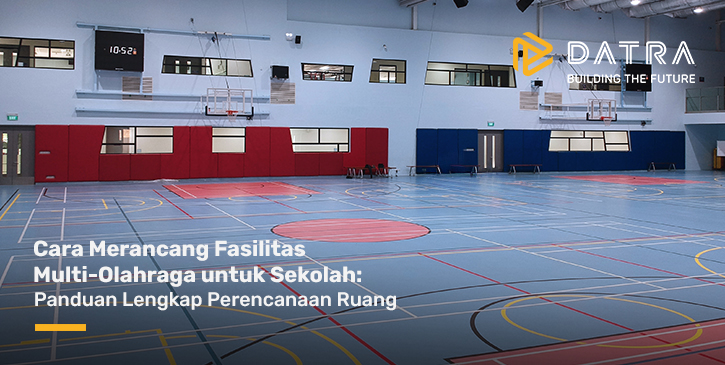
This guide is written from firsthand experience designing and building multi-sport facilities for schools across Indonesia — from international schools in Jakarta like The British School Jakarta and Sekolah Pelita Harapan to government youth sports training centres like the Pusat Pelatihan Olahraga Pelajar (PPOP) at Ragunan, which Datra delivered as a world-class complex housing halls for basketball, badminton, wrestling, pencak silat, judo, boxing, table tennis, weightlifting, and gymnastics. The principles here apply whether you are planning a modest single-hall school gym or a more ambitious multi-facility sports complex.
The First Design Decision: What Is the Anchor Sport?
Before any dimensions are drawn, every multi-sport facility needs an anchor sport — the single discipline that will set the physical envelope of the main hall. Everything else gets designed around that anchor, because sport spaces have different and sometimes competing dimensional requirements.
In Indonesian schools, the anchor sport is almost always badminton or basketball, and the choice between them is more consequential than most people realise.
A standard badminton court is 13.4 metres long by 6.1 metres wide, and the minimum ceiling clearance for competitive play is 9 metres above the court surface. This is not a guideline — it is a hard requirement. A shuttlecock travels in a steep arc and any structural element, lighting fixture, or exposed beam below 9 metres will compromise the game and, more importantly, create a safety hazard. In practice, because badminton is Indonesia's national sport and a core subject in PE curricula across every level of schooling, this ceiling requirement drives the structural design of more school gyms than almost any other single factor.
A full basketball court (28 metres by 15 metres per FIBA standard) has a lower ceiling clearance requirement of around 7 metres to the nearest obstruction, but its floor footprint is substantially larger than a single badminton court. Where badminton wins space back is in its ability to tile: four badminton courts can fit within the approximate footprint of a full basketball court, giving a school that prioritises badminton far more utilisation options for the same building envelope.
The practical answer for most Indonesian schools is to design around four to six badminton courts, which automatically provides enough floor area for a full basketball court, two volleyball courts, and a futsal court — all marked on the same floor surface. This is the format that Datra consistently recommends for school projects in the IDR 1 billion to 5 billion range, and it delivers the broadest possible utility from a single investment.
Dimensions and Clearances That Matter
Space planning for a multi-sport school hall is an exercise in fitting competing requirements into a finite envelope. These are the numbers that actually govern the design.
For a hall accommodating four badminton courts oriented in a single direction, the internal floor dimensions need to be at least 30 metres by 20 metres — and 32 by 22 is significantly more comfortable. The difference between those numbers is the buffer zones: the space between the sideline of the outermost court and the wall, and the space between the back lines and the end walls. These buffers are not wasted space. They are where players lunge, change direction, dive, and occasionally collide with walls. A buffer of less than 1.5 metres on each side is inadequate for safe play. Two metres is the minimum for a school environment; three metres is where comfort begins.
Ceiling height of 9 metres is, as noted, the minimum for badminton. But the ceiling in a sports hall is not just about shuttlecock clearance — it is also where your lighting, basketball ring infrastructure, and ventilation systems need to live. A school that plans 9 metres of clear height and then discovers that the chosen lighting system drops 400 mm into that space, with basketball backboards folded flush to the ceiling consuming another 300 mm, is suddenly at 8.3 metres of usable clearance. That is below the badminton threshold, and it is a mistake that cannot be fixed without structural intervention. Design to a minimum finished clear height of 9.5 metres to account for everything that hangs from the ceiling.
For basketball, the key dimension to get right is the run-off behind each backboard. A minimum of 2 metres of clear space beyond each end line is required for safety at school level; 2.5 metres is strongly preferred. If the basketball court is oriented across the width of a badminton hall — a common configuration — be careful to check that the end-line run-offs do not push players directly into a wall. This is a planning oversight that appears in more school gyms than it should.
Volleyball courts (18 by 9 metres) share the basketball footprint comfortably and add minimal complexity. Futsal (40 by 20 metres for full size, often reduced to 32 by 18 for school use) is the sport most likely to strain a tightly dimensioned hall. If full-size futsal is a priority, design around it explicitly rather than hoping a badminton-dimensioned hall will accommodate it.
The Line Marking Strategy
A multi-sport floor marked for basketball, badminton, volleyball, and futsal simultaneously can become visually chaotic — a tangle of coloured lines that makes it difficult to orient on any individual court. This is a real operational problem, not just an aesthetic one. Students and teachers should be able to identify their court instantly, and referees in inter-school competitions should be able to read the boundary lines without ambiguity.
The solution is colour coding done properly. Basketball lines are typically painted white or yellow — high-contrast, dominant lines. Badminton lines run in a contrasting colour (red or blue are common) and are drawn at a slightly narrower width than the basketball lines to create a visual hierarchy. Volleyball lines, which overlap significantly with basketball, are often in green. Futsal lines are added last, typically in a fourth colour, and where possible the futsal sidelines are designed to coincide with existing court boundaries to reduce the total number of lines competing for visual attention.
The colour coding only works if the base floor colour is chosen strategically. A medium grey or mid-tone blue base floor makes all four line colours legible. A very dark floor creates high contrast for some colours but makes others invisible. A white or very light floor reflects light, reduces line contrast, and tends to show scuff marks rapidly. Datra's project teams specify the base floor colour and line palette together, as an integrated design decision rather than separate choices made at different stages of the project.
Flooring: The Most Consequential Single Decision
In a school sports facility, the floor will be used every day — by hundreds of students, in shoes of varying quality, across activities of varying intensity, in a climate that combines heat with humidity and occasional water ingress from rain or cleaning. The floor will outlast most of the equipment in the facility. And the cost of replacing a poorly chosen floor — in both money and disruption — is substantially higher than the cost of getting it right the first time.
For multi-sport school halls in Indonesia, there are three main flooring systems worth serious consideration.
Permanent polyurethane (SPU/PU) is the most practical choice for most school applications. It is seamless, durable, easy to clean, resistant to Indonesia's tropical humidity, and compatible with basketball, badminton, volleyball, and futsal on a single surface. A well-installed polyurethane floor in a school hall should last 15 to 20 years with proper maintenance. The Herculan MF system, which Datra supplies and installs, is a point-elastic polyurethane that provides good shock absorption for multi-sport use and is suitable for both recreational and competitive play. For schools that want a reliable, cost-effective surface that requires minimal ongoing care, this is the specification to start with.
Vinyl sports flooring is the right choice for schools where badminton is the primary sport and competition quality matters. Mondo and Datra Sports vinyl systems are BWF-approved for badminton and provide the consistent surface response that serious badminton training and competition demands. Vinyl also provides a degree of cushioning that polyurethane cannot match in a thin-layer application, which matters for a sport involving as many sudden direction changes and lunging movements as badminton. The tradeoff is that vinyl is a lay-on system — it sits on top of the concrete subbase rather than bonding to it — and the quality of that subbase is therefore absolutely critical.
Engineered wooden flooring is the premium choice, appropriate for international schools or schools with a genuine competitive programme where the facility will host inter-school or city-level competitions. Junckers, the Danish manufacturer of which Datra is the official partner in Indonesia, produces a solid hardwood sprung floor system (the Unobat series) certified to FIBA Level 1 that has a documented lifespan of 40 to 50 years with proper maintenance. The same system that Datra installed at Indonesia Arena for the FIBA World Cup 2023 is available in school configurations. It is more expensive upfront and requires a maintenance programme involving periodic refinishing, but the lifecycle economics can be compelling for schools that are investing in a long-term facility.
The critical warning across all three systems is the subbase. In Indonesia, the most common cause of premature floor failure is not the flooring product — it is the concrete beneath it. A concrete subbase for a school sports hall must be level to within 3 mm over any 3-metre span, must be properly waterproofed against rising damp, must be correctly sloped for drainage, and must be fully cured before any flooring installation begins. Schools that attempt to save money by installing a vinyl or lay-on floor over a subpar concrete slab routinely discover the problem within 12 to 18 months, when the floor bubbles, de-bonds, or cracks — and the cost of remediation often exceeds the cost of doing the subbase correctly at the beginning.
The Equipment Layer: What Actually Goes In
A well-planned hall with no equipment is an empty room. The equipment layer is where the facility becomes functional, and it deserves the same level of specification rigour as the floor.
Basketball systems in a school hall are almost always wall-mounted or ceiling-mounted, with backstop boards that fold flush when not in use. For a hall that hosts both basketball and badminton, the basket rings need to retract fully clear of the badminton court airspace — a technical requirement that is sometimes missed in the planning phase, resulting in fixed-position rings that obstruct play. The folding mechanisms need to be robust enough for daily use by non-specialist operators, and the ring and backboard specifications should be chosen to match the level of play the school expects to host. A school running an inter-school league programme has different requirements from one using the facility purely for PE classes.
Badminton posts should be specified as portable systems that are anchored into purpose-built floor sockets when in play and stored when the hall is configured for another sport. The floor sockets must be positioned precisely according to the court layout before the flooring is installed, because retrofitting them afterwards requires cutting through the finished surface. This is a sequencing error Datra encounters regularly in schools that manage these elements separately — floor installed by one contractor, posts specified later by a different one, and the socket locations never properly coordinated.
Volleyball and futsal posts share the same portable post approach. The storage of all portable equipment — posts, nets, referee stands, ball pumps, cones, mats — requires a dedicated equipment room adjacent to the hall, ideally accessible from the floor without crossing through a changing room or corridor. A 20 to 30 square metre storeroom with proper shelving and a wide door for moving post systems in and out is not an optional luxury. It is the difference between a well-operated facility and one where equipment ends up stacked in corners, damaged, and eventually not used.
Bleacher or telescopic seating along one side of the hall transforms the space from a training environment into a venue capable of hosting school events, inter-school competitions, graduation ceremonies, and community gatherings. For school halls in the 30 by 20 metre range, telescopic seating of 100 to 300 seats along one wall is both practical and transformative. Datra supplied telescopic seating for Global Jaya School (92 seats), and the same technology — rows of seating that fold flat against the wall when not in use and deploy manually or mechanically in minutes — is available at a range of scales and specifications. It is worth noting that for schools with low or complex roof structures, the ceiling ring mounting for basketball systems and the engineering for retractable seating both require careful coordination with the structural engineer. Datra's team at the Aim High Sports Hall navigated exactly this challenge — low ceiling, complex roof structure — by designing a custom ceiling ring system that worked within the available space.
Beyond the Main Hall: What Most Schools Forget to Plan For
The main court area gets almost all the attention in the planning process. The support infrastructure gets almost none. This mismatch is where many school sports facilities fall short of their potential.
Changing rooms are the most commonly undersized or underfunded element. A school hall that serves 600 students across a full school day needs male and female changing rooms with a minimum of 8 to 10 lockers each, shower facilities, and separate toilet access that does not require students to pass through the changing room. The minimum area per changing room is 25 square metres; 35 to 40 square metres is more functional. Shared or combined changing rooms are not appropriate in school contexts.
Acoustic performance of the main hall is often an afterthought that becomes a problem the moment the hall is in use. Hard concrete walls in a rectangular room produce reverberation times that make teacher instructions inaudible during active PE sessions. Simple acoustic treatment — panel absorbers on the upper wall surfaces, a mineral fibre ceiling if structurally feasible, rubber flooring in corridors — reduces reverberation and makes the space genuinely usable for instruction. The cost is modest relative to the total facility investment; the impact on daily usability is significant.
Lighting specification is governed by the activities the hall will host. For recreational PE, an even illuminance of 300 lux at floor level is adequate. For inter-school competition, 500 lux minimum is required, and the uniformity ratio matters as much as the average level — dark patches on a badminton court are a genuine safety issue. LED systems are now the standard choice for school halls: energy-efficient, long-lifespan, capable of precise zoning. The positioning of light fixtures must be coordinated with the badminton court layout because fixtures located directly above the net centreline create glare for players looking up to track the shuttle.
Natural ventilation and humidity management deserve explicit design attention in Indonesia's climate. A sealed hall without adequate airflow becomes uncomfortable within minutes of active use, and chronic high humidity accelerates the degradation of wooden flooring, sports equipment, and electrical systems. Louvred ventilation panels high on the end walls, combined with ceiling fans and cross-ventilation, are the minimum viable approach for schools without the budget for air conditioning. Where AC is planned, the unit placement and airflow direction must be coordinated with the court layout — direct airflow onto a badminton court will affect shuttle flight and cannot be corrected after installation.
Adding a Second Activity Zone: Wall Climbing and Outdoor Areas
A genuinely excellent school sports facility goes beyond the main court hall. The schools that get the most from their sports infrastructure are those that think in zones — a main indoor hall for court sports, a secondary zone for different physical challenges, and an outdoor space for gross motor activity and unstructured play.
Wall climbing has emerged as one of the most compelling additions to school facilities in Indonesia. It develops problem-solving, upper body strength, coordination, and focus in a way that no court sport replicates — and it is inherently engaging for students who may not respond to team sport environments. Recreational wall climbing structures can be built at heights suitable for primary and secondary school use, and when positioned along an exterior wall of the main building or as a freestanding structure in the school grounds, they add significant visual impact and programme value. Datra has built recreational wall climbing structures for schools in Jakarta and is the contractor behind the Jakarta International Wall Climbing Park — the largest IFSC-certified climbing facility in Southeast Asia — giving the team deep technical capability at every scale.
Outdoor playground equipment, when specified and installed correctly, provides a safe and engaging environment for younger students. The critical specification here is the surface beneath and around the equipment. A rubber playground safety surface — Datra Sports Safescape Playground is the relevant product — needs to cover the entire fall zone around each piece of equipment, and its thickness must correspond to the maximum fall height of the structure above. Installing playground equipment on bare concrete or ceramic tile is a liability risk and a safety failure, however common it may be. The rubber surface must be installed before the equipment is anchored, not as an afterthought around the base posts.
Budget Calibration for Indonesian Schools
There is no standard answer to "how much does a school sports hall cost" that is honest without context. But there are reference points that help set realistic expectations.
For a basic school gymnasium — a single hall accommodating four badminton courts on a polyurethane floor, with portable basketball and volleyball equipment, basic lighting, and adequate ventilation but no seating, minimal storage, and simple changing rooms — the realistic budget in Indonesia is IDR 1 billion to 2 billion for the fit-out (flooring, equipment, line marking, basic infrastructure), assuming the building shell is already in place or being handled separately.
A more complete facility — the same floor area with telescopic seating, fully specified lighting for competition use, a playground area, and quality equipment across all sports — runs IDR 2 billion to 5 billion for the fit-out scope. Adding wall climbing, a jogging track, or outdoor court areas extends this further.
Where budgets consistently run over initial estimates is in the subbase and civil works. If the building shell is being designed or renovated alongside the sports fit-out, it is essential that the structural engineer, architect, and sports facility specialist collaborate from the beginning — not sequentially. A concrete slab designed without input from the sports flooring specialist will almost always require expensive remediation before any surface can be laid. A ceiling structural system designed without input on the basketball and lighting loads will need engineering changes at exactly the moment when schedule pressure is highest.
The most expensive mistake in school sports facility projects in Indonesia is not choosing the wrong flooring product. It is starting construction without a coordinated technical brief that covers the interdependencies between structural, mechanical, electrical, and fit-out works.
Choosing a Partner: What to Look For and What to Avoid
A school sports facility is a long-term asset. The contractor who builds it will ideally still be in business in five years when a floor needs refinishing, a basketball ring mechanism needs servicing, or the school wants to add a wall climbing structure to the existing building. The ability to maintain a relationship over time — to call someone who actually knows the project — is worth factoring into the partner selection.
The risks to watch for are familiar in Indonesia's construction market. A contractor who wins on price by specifying cheaper subbase materials, using off-brand adhesive instead of the manufacturer's recommended product, or thinning the applied coating of a polyurethane floor below the specified thickness is not saving the school money. They are deferring problems that will emerge when the floor starts peeling, bubbling, or cracking within the first few years — and those problems are the school's problem, not the contractor's.
For school-scale projects, the right questions to ask a prospective partner are straightforward: can you show me comparable school projects you have completed, and can I speak with the facilities manager? What is your product specification and can I verify it against the manufacturer's data sheet? Who will do the installation — your own certified team or subcontractors? What is your response if there is a product or installation defect within the warranty period?
For multi-scope school projects — those combining flooring, seating, equipment, wall climbing, and outdoor areas — working with a single specialist partner rather than separate contractors for each element significantly reduces coordination risk. The British School Jakarta project, where Datra delivered the multipurpose hall flooring, bleacher seating, basketball equipment, playground, line marking, and civil works as a single integrated scope, is a representative example of what integrated delivery looks like in practice.
A Checklist Before You Start
Pulling a multi-sport school facility from concept to completion requires discipline at the planning stage. These are the decisions that must be locked in before design begins — not discovered mid-construction.
The anchor sport must be identified, along with the secondary sports and their dimensional requirements. The ceiling height must be confirmed against the most demanding sport's requirements, with explicit allowance for all suspended elements. The subbase specification must be agreed with the sports flooring specialist before the structural drawings are finalised. The court layout — including line colours, socket positions for portable posts, and basketball ring mounting locations — must be defined before the floor is installed. The storage and equipment room must be sized and positioned adjacent to the hall, not retrofitted from whatever space is left over. Changing room areas must be calculated against peak daily user numbers, not minimum regulatory requirements. Lighting, ventilation, and acoustic performance specifications must be set against the facility's intended use — recreational PE requires different performance levels from inter-school competition.
And before any of that, the fundamental question must be answered: what do you want this facility to do for your students, your school, and your community over the next 20 years? The answer to that question is worth more than any product catalogue.
Ready to Plan Your School's Sports Facility?
Datra has designed, supplied, and built sports facilities for schools across Indonesia — from international schools to government youth sports training centres — since 1981. Through PT Datra Internusa, the team handles complex, multi-scope projects with full accountability and ISO-certified processes. Through Datra Sports, smaller and faster-turnaround projects get accessible, product-first support.
If you are planning a new school sports hall, renovating an existing one, or trying to understand what a budget will actually get you, the most useful starting point is a conversation — not a product catalogue. Datra's team can help you clarify your objectives, map the dimensional requirements, and understand what a realistic budget should include before you commit to any design.
Visit www.datra.id or contact the team directly at sales@datra.id or 0811 1061 6565.
Datra has delivered sports facility projects across Indonesia since 1981, including Indonesia Arena (FIBA World Cup 2023), Gelora Bung Karno, Jakarta International Stadium, the Jakarta International Wall Climbing Park (the largest IFSC-certified climbing facility in Southeast Asia), The British School Jakarta, Sekolah Pelita Harapan Kemang, Global Jaya School, and the Pusat Pelatihan Olahraga Pelajar Ragunan complex. Clients include national government ministries, regional governments, international schools, and leading private institutions.
Related Blogs
FIBA-Standard Basketball Flooring: Why Wood Is the Standard, and How Junckers Meets It
Construction, Sports
October 14, 2026
World Athletics Standard Running Track: The Complete Guide to Specifications, Construction, and Certification
Construction, Sports
July 22, 2026
Complete Volleyball Court Guide: FIVB & PBVSI Standards for Indoor and Outdoor Courts
Construction, Sports
July 16, 2026
