
Why Pickleball Is the Future of Sports in Indonesia - And How to Build Your Own Court
Construction, Sports
June 17, 2026
By Benson Kawengian, Owner and Group CEO, PT Datra Internusa & Datra Sports
Indonesia is a racket sports country. We have known this for decades. Badminton is woven into our national identity in a way that few sports are in any country we don't just play it, we've been world champions at it. Tennis has been here for generations. And when padel arrived, we adopted it fast, because the instinct for racket sports is already in us.
So when I say that pickleball is the next sport this country needs to get serious about, I'm not talking about chasing a trend from abroad. I'm talking about a sport that fits Indonesia our culture, our climate, our community instincts, and our economics - better than almost anything that's come before it.
I've been building sports facilities professionally for over 40 years. I co-founded Planet Futsal in 2004, Indonesia's first commercial futsal operation, and I've watched sport after sport find its footing here. I know what a genuine opportunity looks like, and I know what a FOMO cycle looks like. Pickleball is the former.
Here's what I think you need to understand - whether you're an investor, a school principal, a hotel GM, a property developer, or just someone with a flat surface and the right instincts.
What Pickleball Actually Is (And Why Indonesians Will Love It)
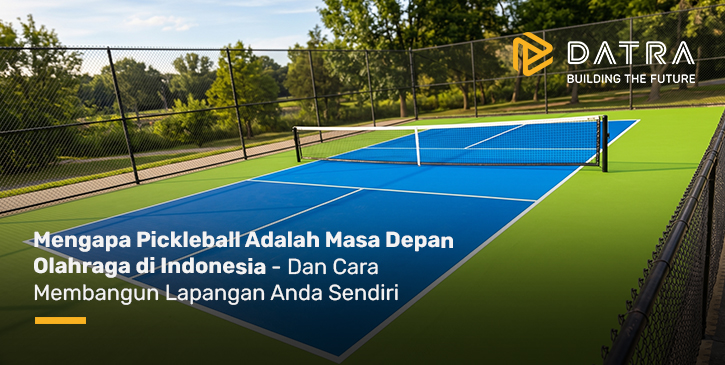
Pickleball is a paddle sport that combines elements of tennis, badminton, and table tennis. It's played on a small rectangular court roughly the same dimensions as a badminton doubles court with a perforated plastic ball and solid paddles. The net is lower than a tennis net, the court is smaller, and the game is designed around placement and strategy rather than raw power.
A regulation pickleball court measures 6.1 meters wide and 13.4 meters long. The court is divided into two halves by a net, with a total playing area of approximately 9.1 meters by 18.3 meters including the recommended buffer zones on all sides. That compact footprint is one of the sport's most powerful practical advantages, something I'll come back to throughout this article.
People misunderstand pickleball, especially Indonesians who haven't played it yet. They assume it's a scaled-down version of padel, or a simpler form of tennis. It's neither. The game is slower than padel in its movement demands, but tactically nuanced. The learning curve is short enough that a complete beginner can have a genuinely fun rally within thirty minutes of picking up a paddle. But the depth keeps experienced players engaged for years.
Most importantly, pickleball is one of the only sports in the world that works well across generations. A grandfather can play competitively against a teenager. Kids can play alongside their parents. A corporate team outing becomes genuinely inclusive rather than a session that only the athletic younger employees enjoy. This cross-generational quality is not a minor feature - it's a fundamental differentiator that no other racket sport in Indonesia currently offers at this price point.
Why Indonesia Is Ready for This
Four things tell me Indonesia's pickleball moment has arrived.
- First, we're a racket sports nation. The technical familiarity is already there. Badminton technique transfers to pickleball - the wrist control, the court awareness, the serve-and-volley instincts. Indonesians who've spent years on a badminton court will find pickleball intuitive from the first session. This is a genuine advantage that markets without deep racket sports culture simply don't have.
- Second, padel's post-boom correction has opened the door. Padel grew at extraordinary speed in Indonesia, and that growth was real. But in Jakarta's premium districts, we're now seeing what comes after every FOMO cycle: correction. Courts that were built on enthusiasm rather than community strategy are struggling. Some are closing. What padel's experience has established, however, is infrastructure appetite. Indonesian sports investors now know what a boutique court experience looks like. Pickleball captures that same energy at a fraction of the investment and with a dramatically wider addressable market. Padel is, and will remain, a middle-to-upper segment sport. Pickleball is genuinely for everyone.
- Third, Malaysia is showing us exactly what's coming. I've seen what pickleball looks like when it finds its rhythm in a Southeast Asian Muslim-majority country with cultural overlap with Indonesia. In 2024, Malaysia had fewer than 10 dedicated pickleball courts. By mid-2025, there are hundreds of courts nationwide - in Kuala Lumpur, Penang, Selangor, Johor, and even Sabah, with the country recording over 140,000 active players. Malaysia now has the third-largest number of players on DUPR - the global pickleball rating platform - behind only the USA and Canada. Courts are in schools, in malls, in neighborhoods, alongside F&B and music events. It's become part of daily community life. Indonesia has every condition Malaysia has, with a population four times larger.
- Fourth, the global momentum is undeniable. Growth of pickleball across Asia has spiked at a 60% rate year-on-year, with 62% of respondents to a major UPA Asia survey learning about pickleball within the last two years. Indonesia already has competitive credentials at the international level - the national team won gold and silver at the World Pickleball Championship in Thailand in 2024, just four years after the sport was introduced in Indonesia. The competitive infrastructure is forming. The community awareness is building. The investment window - the period where being early still matters is open right now, but it won't stay open indefinitely.
The Economics That Make Pickleball Exceptional
The single most important thing to understand about pickleball as an investment opportunity is that it breaks the correlation between sports quality and sports cost.
Padel requires a full enclosed glass-and-steel structure. The court kit alone - before civil works, roofing, supporting facilities, or any kind of community space - runs from IDR 450 million to IDR 800 million per court. A viable commercial padel facility in Jakarta needs IDR 6 to 12 billion or more to be taken seriously.
Pickleball requires a flat surface, a net, a surface coating, and lines.
The investment for a complete pickleball court in Indonesia sits between IDR 140 million and IDR 200 million for a mid-range standalone setup, and considerably less for a conversion from an existing court or surface. Equipment - paddles, balls, a portable net is among the most affordable of any racket sport. There's no cage, no glass, no enclosed structure requirement.
This affordability doesn't mean cutting corners. It means the economics of pickleball are structurally different from padel. You can build a community-focused, financially sound pickleball venue without needing to charge Jakarta premium pricing to recover your investment. You can make it free. You can charge modestly. You can run it as an amenity that adds value to a property, school, or corporate campus without needing it to generate standalone returns.
That flexibility is rare in sports facility economics, and it's one of the reasons I believe pickleball will ultimately reach further into Indonesian society than padel ever will.
Who Should Build a Pickleball Court Right Now
The honest answer is: almost anyone with a flat surface and a budget.
- Property developers and mall operators. An underutilized parking bay area, a rooftop, an internal atrium space - pickleball can activate these spaces with minimal structural intervention. A vinyl surface installation indoors can serve as a temporary or seasonal activation. An outdoor surface conversion creates a permanent amenity that differentiates a property and drives foot traffic.
- Schools. Any school with a flat court surface - concrete, asphalt, an existing basketball or badminton area can add pickleball lines and nets at very low cost. It's a cross-age sport, which means it works in mixed PE classes and in school events where students of different ages play together. It's also genuinely safe at the recreational level, which matters for school environments.
- Hotels and resorts. A tennis court with extra lines becomes a multi-sport asset overnight. For properties that want to offer a distinctive experience to guests - particularly family groups and corporate events a pickleball court with a covered area and adjacent F&B is a premium amenity at a non-premium investment. Premium surfaces like silica polyurethane (SPU) with a proper hospitality area transforms it into a genuine lifestyle feature.
- Corporate campuses. Cross-generational, inclusive, skill-accessible, and inherently social pickleball fits corporate wellness objectives better than almost any sport. It doesn't exclude older employees or less athletic colleagues. It creates genuine interaction across hierarchies. The setup cost is trivial relative to the culture value.
- Community developers and housing estates. A pickleball court in a cluster development or perumahan is a stronger community anchor than most amenities. Unlike a swimming pool - high maintenance, high liability, used by few - a pickleball court is low maintenance, lower liability, and usable by residents of every age.
- Individuals with space. A flat concrete area at home, a covered garage floor, a terrace - if it's level and large enough (roughly 9 x 18 meters for the minimum total area), you can build a personal pickleball court. The surface preparation is the most important cost. Everything else is relatively straightforward.
How to Actually Build a Pickleball Court
This is where most guides leave you behind. I want to fill that gap here, because I genuinely believe that spreading the knowledge of how to build a good pickleball court serves Indonesia better than keeping it proprietary. If more people build good courts, more people play. And if more people play, the market grows for everyone.
Step 1: Understand the dimensions
A regulation pickleball court measures 6.1 meters wide by 13.4 meters long, with a net height of 91.4 centimeters at the sidelines and 86.4 centimeters at the center. The total recommended playing area including buffer zones is approximately 9.1 meters by 18.3 meters.
One of pickleball's most practical features is how efficiently it uses space. You can fit four pickleball courts within the footprint of a single tennis court, and the dimensions are almost identical to a badminton doubles court. This means that if you already have a tennis court, you already have enough space for two to four pickleball courts. If you have a badminton hall, you have a court that needs only new net specifications and a few extra line markings to become a pickleball court.
The key markings are the baseline, sidelines, the non-volley zone (called "the kitchen" - a 2.1-meter zone on each side of the net where volleying is not permitted), and the centerline dividing each side into two service boxes. Lines should be 5 centimeters wide, typically in white.
Step 2: Get the sub-base right - this is where most mistakes happen
The most common and most costly error in pickleball court construction is neglecting the sub-base. A beautiful surface coat over a poorly prepared base will fail within years cracking, bubbling, pooling water, and eventually becoming unplayable. Getting the sub-base right the first time is dramatically cheaper than fixing it later.
For outdoor courts, the sub-base should be either reinforced concrete or asphalt over a compacted aggregate base. Concrete is the more durable long-term option. Asphalt is lower cost and can perform well if properly laid. The critical requirement for either material: the surface must slope correctly for drainage. A slope grade of between 0.83% and 1% in one consistent direction is the correct specification - this channels water off the playing surface and away from the court without affecting play. In Indonesian conditions - tropical rainfall, potential standing water this drainage slope is non-negotiable.
Even a well-built court can fail early if drainage isn't handled correctly from the start. What I've seen happen repeatedly in Indonesian sports construction is that people pay attention to what they can see the surface, the color, the lines - and underinvest in what they can't: the leveling, the slope, the drainage channels. The surface is replaceable. A compromised base structure is expensive to fix and impossible to ignore.
For indoor courts, a smooth, flat, structurally sound concrete slab is the starting point. The slope requirement is less critical indoors, but levelness is essential.
Step 3: Choose your surface
This is where you have genuine choices, and the right answer depends on your use case, budget, and whether the court is indoor or outdoor.
Acrylic surface (outdoor or indoor) is the most widely used and most accessible option. It's applied in multiple coats over your concrete or asphalt base a bonding coat, color coat body layers, and a topcoat with aggregate for friction and anti-slip performance. Acrylic provides the correct surface texture for consistent ball bounce and player traction. For a basic outdoor pickleball court, a good multi-coat acrylic system is both cost-effective and durable.
If you want better cushioning and joint protection - particularly for older players or high-intensity use a cushion acrylic system adds rubber-infused buffer layers beneath the finish coat. This reduces impact on knees and ankles noticeably, and is particularly worth considering for community courts where elderly players are regular users.
Silica Polyurethane (SPU) is the premium option, and what we supply through Datra Sports as the Multisport SPU system. SPU is a seamless, poured surface applied from primer through buffer coat to topcoat, with superior shock absorption, weather resistance, and a longer effective lifespan than acrylic. It performs exceptionally well in Indonesia's tropical climate - UV stable, resistant to moisture, and durable under high foot traffic. This is the right specification for hotel courts, premium residential developments, and any venue where the court is a brand statement as much as a sporting surface.
Vinyl flooring (indoor only) is an option for covered or air-conditioned indoor facilities where the court will be used intensively. If you have a badminton hall or existing indoor sports facility, a vinyl overlay system can convert the space to pickleball use with minimal structural work.
Modular tiles (PP interlocking) offer a portable, reversible option for temporary setups mall activations, events, corporate venues that need flexibility. These can be assembled and disassembled and don't require permanent adhesion to the sub-base.
Step 4: Equipment
The net system is the only structural element specific to pickleball. The net is lower than a tennis net and mounted on portable or fixed posts set at the sideline positions. You can start with a portable net system - adequate for community and recreational play or install permanent posts for a more professional setup.
Paddles and balls are available at every price point. The ball used outdoors is different from the one used indoors - outdoor balls have smaller, more numerous holes for wind resistance. This equipment choice belongs to the players, not the facility builder, but good venues stock a few sets of each for casual and rental use.
Fencing or perimeter barriers are recommended to keep balls in play and provide a clear spatial boundary. For outdoor courts, a chain-link or similar fence at 3 to 4 meters height works well. For indoor or covered courts, wall surfaces typically serve this function.
The Tennis Court Conversion Opportunity
If you're sitting on an existing tennis court, this section is specifically for you.
Converting a tennis court to pickleball or adding pickleball to an existing tennis court is one of the most cost-effective sports facility upgrades available. One standard tennis court accommodates two pickleball courts side by side with adequate buffers, or up to four courts if the tennis use is discontinued.
The conversion process depends on the condition of the existing surface. If the surface is structurally sound no major cracking, good drainage, no significant level variation - the work involves cleaning, patching minor imperfections, applying a fresh top coat of acrylic or SPU, and adding pickleball lines in a contrasting color. The net posts are repositioned or supplemented with pickleball-specific posts. This can be completed in days rather than weeks.
If the surface shows more significant wear - areas of standing water, visible cracking, or delamination of existing coatings - the correct approach is surface preparation: patchwork, leveling, a full base coat, then the new topcoat and lines. This adds cost but is still dramatically less expensive than new construction.
I've been doing versions of this conversion for decades. When I was building Planet Futsal's early venues, we converted tennis courts to futsal courts. The same principle applies here. Existing infrastructure, intelligently repurposed, delivers excellent value.
One recommendation: if you're converting and planning to run pickleball and tennis on the same surface, keep the line colors clearly distinct. Tennis lines in white, pickleball lines in a contrasting color - yellow, blue, or another clear differentiator so neither sport's markings become visually confusing during play.
What Luxury Pickleball Looks Like
Pickleball doesn't have to be a community-grade, low-budget proposition. The same sport can be configured as a genuinely premium facility.
For a hotel resort, premium residential development, or high-end sports club, a luxury pickleball setup means: a silica polyurethane surface in a curated color scheme, permanent professional-grade net posts, LED sports lighting to a competition standard, perimeter seating with shade, and seamless integration with hospitality a place to sit, eat, and recover within the venue footprint. The court itself is compact enough that it doesn't require a large footprint to feel premium, and that compactness actually works in its favor for high-value real estate.
The complete package - premium surface, lighting, shade structure, hospitality integration - is still substantially more affordable than a padel installation of equivalent quality. That differential represents margin that either goes back to the developer's pocket or funds a better surrounding experience.
The Lesson from Futsal, Applied to Pickleball
When I built Planet Futsal in 2004, it was Indonesia's first commercial futsal operation. The sport was nascent, the business model was unproven, and everyone asked whether Indonesians would pay for an hour of futsal when they could play football on the street for free.
The answer was yes - but only if the experience justified the investment. The courts had to be right. The operations had to be professional. The community had to be built around the facility rather than assuming the facility would generate its own community automatically.
Two decades later, futsal is everywhere in Indonesia. There are hundreds of venues. The category that was once an experiment is now infrastructure.
Pickleball is at that same moment now. Not the padel moment padel's post-FOMO correction is a different story. The futsal moment. The moment where the sport is genuinely good, genuinely accessible, and genuinely suited to the country, and where being early still means something.
The same operational discipline applies, regardless of whether you're building a commercial venue or a community court: don't overinvest in physical infrastructure relative to your proven demand. Get the surface right. Understand your maintenance requirements from day one. Know who your users are and design the operation around them.
The most resilient pickleball venues - in Malaysia, in the US, and in the Indonesian venues already operating well are those built around communities, not around hype cycles. If you build for a community and that community plays, you're in a good position for a long time.
A Final Word
If you're reading this and you have a flat surface a parking lot, an old tennis court, a concrete area at your school, a hotel courtyard, a corporate campus corner - I want to say something directly.
Don't overthink it. Build a pickleball court.
The investment is lower than you think. The process is simpler than you've probably been led to believe. The sport is genuinely fun, genuinely cross-generational, and genuinely suited to Indonesia. And the window to be an early adopter - to be the venue that people in your area associate with this sport before it becomes ubiquitous - is still open.
You can do it yourself with local tradesmen if you understand the basics. You can buy the surface materials and equipment independently. You can get as much or as little help as you need.
And if you want to talk to someone who has spent four decades building sports surfaces in this country - from community courts to national stadiums and international arenas the Datra Sports team is there for exactly this conversation. We'll tell you what you need, point you toward what you don't, and help you make the right call for your specific project.
This is an easy win. Indonesia just needs more people to take it.
Benson Kawengian is the Owner and Group CEO of PT Datra Internusa and Datra Sports, Indonesia's foremost sports engineering, procurement, and construction company with over 44 years of history. Datra's project references include Indonesia Arena (FIBA World Cup 2023), Gelora Bung Karno (Asian Games 2018), and Jakarta International Stadium.
For pickleball court surface materials, equipment packages, and installation support across Indonesia, contact Datra Sports at sales@datra.id or visit datra.id to enquire via WhatsApp.
Related Blogs
FIBA-Standard Basketball Flooring: Why Wood Is the Standard, and How Junckers Meets It
Construction, Sports
October 14, 2026

World Athletics Standard Running Track: The Complete Guide to Specifications, Construction, and Certification
Construction, Sports
July 22, 2026
Complete Volleyball Court Guide: FIVB & PBVSI Standards for Indoor and Outdoor Courts
Construction, Sports
July 16, 2026
