
World Athletics Standard Running Track: The Complete Guide to Specifications, Construction, and Certification
Education, Construction, Sports
July 22, 2026
By Datra Internusa. Experienced in the installation of sports surfaces and running tracks across a wide range of facilities in Indonesia, from national-scale venues and commercial arenas to educational institutions and public sports facilities.
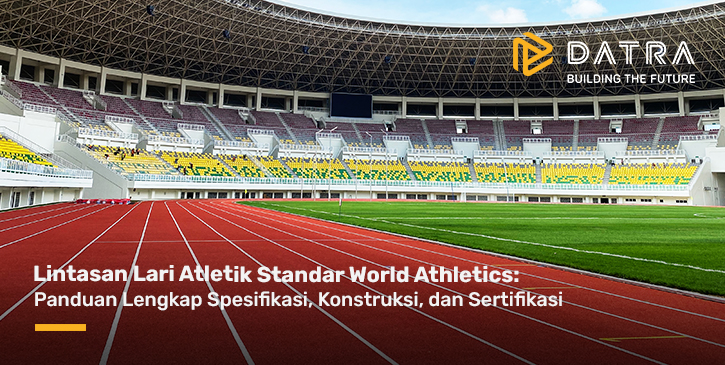
A running track is not just an oval strip of synthetic material. Every dimension, gradient, marking, and material property is governed down to the millimeter by World Athletics (formerly IAAF). Get the planning wrong and the consequences stack up fast: the track fails certification, any records set on it can't be ratified, and the facility loses its shot at hosting official competition.
This guide walks through what actually matters when building to the World Athletics standard: track geometry, surface performance, certification rules, and the construction mistakes that quietly turn a "certified track" into a facility that can't host a real meet. It's written for stadium developers, school and university administrators, contractors, and anyone weighing a running track investment.
Datra Internusa has spent more than four decades building sports facilities across Indonesia, including running track work on Banten International Stadium, the Indonesian Army Headquarters (Mabes TNI AD), and Stadion Perkasa Cilangkap. That track record shapes everything below, from surface selection to how we flag the mistakes worth avoiding. Browse more completed projects on Datra's portfolio page, Proyek Kami.
Why World Athletics Is the Benchmark
World Athletics is the sport's global governing body, and it defines every technical requirement for an athletics facility, from track geometry to synthetic surface performance, in two documents: the Track and Field Facilities Manual and the Technical Rules.
Indonesia's national federation, PB PASI, follows the same rulebook as a World Athletics member. Build to the standard, and a facility automatically clears the bar for national competition, with a clear path to hosting bigger events later.
Two things follow from that:
- Competition eligibility. Only a standard-compliant, properly certified track can host official meets where the results and records actually count.
- Athlete protection and performance. Force reduction and vertical deformation, two surface parameters covered below, exist to protect joints while still returning enough energy for fast times.
Outdoor Track: The 400m Standard
Every new outdoor track should be built as a 400m Standard Track: a 400-meter oval with fixed geometry. It's the default for good reason. The construction is straightforward, the straight-to-bend ratio gives athletes a comfortable rhythm, and the infield comfortably fits every throwing event. Yes, a football pitch technically fits inside the oval too, but fitting isn't the same as ideal; combining a track with a football pitch brings its own trade-offs for throwing events and surface choice, which we cover separately in Datra's article on multi-purpose athletics stadiums.
Here's the core geometry, straight from the Track and Field Facilities Manual:
Parameter | World Athletics Requirement |
Nominal track length | 400 meters (measured on lane 1) |
Length of each straight | 84.39 meters (both sides) |
Bend radius (two semicircles) | 36.50 meters, to the outer edge of the kerb |
Number of lanes | 8, 6, or 4 (4 lanes are not used for international competition) |
Width of each lane | 1.22 meters, ± 0.01 meters |
Width of lane markings | 0.05 meters (5 cm), white |
Direction of running | Counter-clockwise |
A few details planners routinely miss:
- Lane 1's measurement line sits 0.30 meters outside the kerb. Every other lane is measured 0.20 meters from the outer edge of the line inside it.
- The line on the right side of each lane, in the running direction, counts as part of that lane's width.
- The kerb needs to be roughly 50 mm in height and width, or replaced by a 50 mm white line where a physical kerb isn't used.
- For certification, World Athletics sets kerb radius limits between 33.50 and 41.26 meters for a 400-meter oval.
Land requirements. A full 8-lane track with safety zones needs roughly 177 by 92 meters of usable space, around 1.6 to 1.8 hectares once support areas are included. The exact figure shifts with jump and throw layout, grandstand placement, and any dual-use function like an infield football pitch. The Facilities Manual has detailed tables for these mixed-use configurations.
Surface gradient. World Athletics caps two gradients to keep racing fair:
Type of gradient | Maximum limit |
Lateral (across the track, toward the inside) | 1:100 (1%) |
Longitudinal (in the running direction, downhill) | 1:1000 (0.1%) |
The lateral gradient doubles as part of the drainage system, so gradient design and the perimeter drainage channel need to be planned together, not separately.
Indoor Track: The 200m Standard
Indoor facilities follow a different template: the 200m Standard Oval Track, with two parallel straights and two bends that can be banked.
The construction specs, per the official marking plan:
Parameter | Requirement |
Nominal length | 200 meters |
Bend construction radius (including kerb) | 17.20 meters |
Lane 1 measurement line radius | 17.496 meters (0.30 meters outside the kerb) |
Banking angle | 10 degrees |
Length of each straight | 35.688 meters |
Inner border | Kerb of approximately 50 mm, or a 50 mm white line |
An indoor facility also needs a straight track of at least 60 meters for sprint and hurdle events. Indoor construction costs considerably more than outdoor, largely because of the banked-bend structure, which is why certified indoor tracks are still rare across Southeast Asia.
Surface Performance: What World Athletics Actually Tests
Geometry is half the standard. The other half is how the synthetic surface performs, governed by the Track and Runway Synthetic Surface Testing Specifications:
Parameter | What It Measures |
Imperfections | No damage, bubbling, or delamination |
Evenness | Surface flatness, tested with a straightedge |
Thickness | Installed thickness against the absolute thickness in the Product Certificate |
Shock absorption / force reduction | How well the surface absorbs foot-strike impact |
Vertical deformation | How much the surface compresses under load |
Friction | Grip, including in wet conditions |
Tensile properties | Tensile strength and elongation |
Colour | UV and weathering resistance |
Drainage | How well the surface sheds water |
Two of these define how a track actually feels underfoot: force reduction and vertical deformation. Together they set the trade-off between joint comfort and energy return. Thickness matters too, and it isn't negotiable: any area running more than 10% below the Product Certificate's stated thickness can't exceed 10% of total surface area, and high-load zones like start areas, the steeplechase water jump, and jump runways need extra thickness built in from the start.
Every threshold for these parameters lives in World Athletics' official testing documents, and gets verified by accredited labs, both on product samples before installation and in-situ once the track is built.
Product Certificate vs. Facility Certificate: Know the Difference
"World Athletics standard" and "World Athletics certified" get used interchangeably all the time, but they're not the same claim, and the difference has real budget and competition implications.
Product Certificate. Awarded to a surface material after it passes lab testing at a World Athletics-accredited facility. It's attached to the product, not your track. World Athletics maintains a regularly updated public list of Certified Track Surfacing Products.
Facility Certificate. Awarded to a completed track. There are two classes:
Class | Core Requirements | Used For |
Class 2 | Certified surfacing plus a verified geometry measurement report | Official national and select international competitions |
Class 1 | Everything in Class 2, plus in-situ surface performance testing | Major international competitions |
What the certificate actually covers. A facility certificate confirms the track's surface and geometry meet the standard. It says nothing about whether the rest of the venue is complete or competition-ready; the separate Technical Regulations for a given event still apply on top of it.
No certificate for incomplete facilities. A facility that's incomplete or below international standard doesn't get Class 1 or Class 2. It gets a different document entirely: a Confirmation of Compliance. So a "Class 1" or "Class 2" claim should only ever apply to a facility that's genuinely complete for its Construction Category.
Certificates expire. Since 2019, every facility certificate runs for a maximum of five years, scaled to the surface's age at the time of application: a new surface gets the full five years, an older one gets less, and anything over eight years old can't be certified at all. Renewal means retesting. "Was certified" and "is certified" are two different sentences.
The Certificate Covers the Track, Not the Whole Facility
This is where the most expensive misunderstanding happens on site. Buyers assume a certified track means a competition-ready facility. It doesn't, and the gap between the two is usually the first thing to get cut when budgets tighten.
World Athletics splits equipment into two categories with very different rules:
Category | Examples | Status |
Removable equipment | Hurdles, steeplechase barriers on the straight, landing mats, starting blocks, stop boards, relay gear, timing systems, cage superstructure (posts and netting) | Not fixed. Inspected before each meet. Not part of facility certification. |
Fixed / ground equipment | Long jump pit and take-off board, embedded pole vault box, steeplechase water jump ditch, shot put circle base, discus and hammer circles with cage foundations, javelin runway, bolted inner kerb with distance markers | Embedded in the structure. Mandatory under the applicable Construction Category. Goes in during the civil/asphalt phase, before the rubber surface. |
One clarification worth flagging: the cage is only used for discus and hammer throw. Javelin uses a runway and landing sector, no cage.
The rubber surface always goes down last, bonded directly onto a finished asphalt base. Everything else, cage foundations and sockets, the pole vault box and post footing, the shot put and discus circle rims, the jump pit structure with its take-off board tray, the kerb, has to be built first, during the civil and asphalt phase.
This isn't a nice-to-have. World Athletics requires the pole vault footing to sit flush with the asphalt beneath the surface, and explicitly bans expanding anchors driven into asphalt after the fact. Throwing circle rims must be locked in place while the concrete is poured and vibrated around them. The take-off board sits in a built-in metal tray embedded in the runway. Once the rubber goes on top, that foundation work is sealed in, permanently, and adding it later means tearing up a track that's just been finished.
The part buyers need to internalize: it's the buried infrastructure that's permanent, not the visible hardware. Boards, posts, and crossbars can genuinely be added later, as long as the tray, socket, and foundation went in on schedule. If that foundation was never built, there's no "later." The gap is permanent.
Why does this keep happening? Because budgets often stretch to cover the track and nothing else. Ground equipment and the event site are usually the first line items cut. That's the trap: a project gets marketed as a "certified track," which is technically true for the surface, while the buyer never realizes there's nowhere to run the field events. They think they bought a competition facility. What they actually bought is a certified running track.
Reading a "Class 1" or "Class 2" Claim Correctly
Don't stop at "is it certified?" Push further with these questions:
- Is this a Product Certificate (surface material) or a Facility Certificate (the built track)? They're not interchangeable.
- If it's a facility certificate, complete for which Construction Category? Is the full event site, jump pits, throwing circles, runways, cage foundations, actually built?
- Was the fixed/ground equipment installed during the asphalt phase, or is it missing entirely?
- Is the certificate still within its five-year validity window?
- Can the certificate number be checked against World Athletics' official register?
Synthetic Track Construction: Four Systems, Different Trade-offs
Synthetic track surfaces, built from polyurethane and rubber, come in a handful of construction types. Knowing the difference helps you read a contractor's proposal without taking the marketing at face value.
Full PU (full pour). Every layer poured on-site from polyurethane, producing an impermeable surface with the most consistent performance of any system. The default for world-class main stadiums.
Sandwich. Rubber granules bound with PU as the base layer, sealed, then topped with a PU wear layer scattered with EPDM granules. Waterproof, close to full-PU performance, at a more efficient cost. This is the workhorse system for national and international competition venues.
Spray coat. Same rubber-and-PU base, but the surface gets sprayed with a PU-and-EPDM mix instead of a poured top layer. Porous, either permeable or semi-permeable depending on the exact system. The most budget-friendly option, common in schools and community facilities, though the thinner wear course means lower durability than sandwich or full PU.
Prefabricated. Factory-made vulcanized rubber sheets, extremely consistent in thickness and quality, bonded on-site. Premium prefab, like Mondo's Olympic-grade products, sits at the top of the market; economy prefab is common in schools and recreational settings.
Whichever system you choose, the base layer decides whether it lasts. Synthetic surfaces sit on asphalt or concrete with tight flatness tolerances, backed by perimeter drainage. In practice, track failures trace back to a bad base or poor drainage far more often than to the surface material itself.
Running Track Solutions From Datra
No two track projects need the same thing. Some are chasing national certification, some are optimizing for budget, and some just need a solid surface for school training. Datra Sports builds for all three:
Datra Sports Sandwich Running Track. A World Athletics standard sandwich system for competition venues. It delivers a waterproof surface with a strong balance of force reduction and energy return, a good fit for athletics stadiums, regional training centers, and facilities aiming to host official championships.
Datra Sports Spray Coat Running Track. A World Athletics standard spray coat system built for cost efficiency without giving up performance or durability. It suits universities, regional government sports complexes, and athlete development facilities that need a proper standard track on a tighter budget.
Datra Sports Prefab Running Track. A prefabricated system for schools, recreational facilities, neighborhood jogging tracks, and training environments. This one is not built to World Athletics standard and isn't intended for certified competition, it's designed for fast installation, low maintenance, and everyday usability where certification was never the goal.
For projects chasing the highest competition tier, Datra also installs internationally certified systems:
MondoTrack Ellipse Impulse. World Athletics certified prefabricated system, Olympic-class, best-in-class consistency and energy return.
Mondo Sportflex Super X K39. Premium World Athletics certified competition surface, used at elite competition and training facilities that demand speed and durability.
Herculan SR Sprint. High-performance World Athletics certified sandwich system, for stadiums that want an in-situ (site-poured) build at international quality.
There's no universally "best" system here. The right pick comes down to four questions: what competition level you're targeting, what performance your athletes actually need, how much maintenance the facility can realistically sustain, and what budget is real. A school doesn't need Olympic-grade performance, and a national-championship venue can't afford a non-standard system. Datra Sports can help work through these trade-offs from the feasibility stage onward.
Mistakes That Cost the Most to Fix
These show up again and again on real projects, and they're expensive precisely because they surface late:
- Geometry not verified by a competent surveyor upfront. Radius or length errors often surface only during certification measurement, by which point fixing them means tearing up finished construction.
- Base and drainage treated as an afterthought. Standing water and a cracked base will ruin even the most expensive surface material.
- Material chosen without checking the Product Certificate. A brochure claiming "international standard" means nothing if the product isn't on World Athletics' official Certified Track Surfacing Products list.
- Installed thickness below spec. Uneven or under-spec thickness fails certification testing outright and shortens the track's usable life.
- No competition target set from day one. A track built without a clear target often ends up either overbuilt for its actual use or unfit for the competition it later hopes to host.
- Ground equipment left out of the plan. Since embedded equipment has to go in during the civil/asphalt phase, skipping it locks the facility into being permanently half-finished. The track can be built and certified, but without a complete event site, it still can't host real athletics competition.
Frequently Asked Questions
How long is a standard athletics running track? A World Athletics standard outdoor track runs 400 meters nominal, with two 84.39-meter straights and two semicircular bends at a 36.50-meter radius. The indoor standard is 200 meters nominal.
How wide is a running track lane? 1.22 meters, ± 0.01 meters, including the 5 cm white marking on the right side in the running direction.
Does a school track need to meet the World Athletics standard? Not if it's not hosting official competition. For training and recreational use, a non-standard system like prefab is usually the more cost-efficient choice.
What's the difference between Class 1 and Class 2 certification? Both are World Athletics facility certificates. Class 2 needs certified surfacing and a verified geometry report; Class 1 adds in-situ performance testing and is required for major international competitions.
How thick should a synthetic track surface be? There's no single number across all products. Installed thickness is measured against the absolute thickness stated in that product's Product Certificate, and no more than 10% of the surface can fall more than 10% below that figure. High-load zones like start areas and jump runways get built thicker.
Does a certified track mean the facility is ready for competition? Not necessarily. The facility certificate covers the track's surface and geometry, full stop. Removable equipment gets inspected separately before each meet, and the event site, jump pits, throwing circles, runways, cage foundations, needs to already be complete for the relevant Construction Category, built in from the asphalt phase. A certified track without that completeness is a running track, not a competition-ready facility.
Planning a Track Project? Talk to Datra
A running track is a long-term investment, and the outcome is decided at the planning stage: the right system, precise geometry, a base and drainage plan that actually holds up, and material matched to your real competition target.
Contact us via email at sales@datra.id or WhatsApp for further consultation.
Related Blogs
World Athletics Standard Running Track: The Complete Guide to Specifications, Construction, and Certification
Education, Construction, Sports
July 22, 2026
Complete Volleyball Court Guide: FIVB & PBVSI Standards for Indoor and Outdoor Courts
Education, Construction, Sports
July 16, 2026
7 Things You Must Know Before Building a Tennis Court
Education, Construction, Sports
July 14, 2026
