
7 Things You Must Know Before Building a Tennis Court
Education, Construction, Sports
July 14, 2026
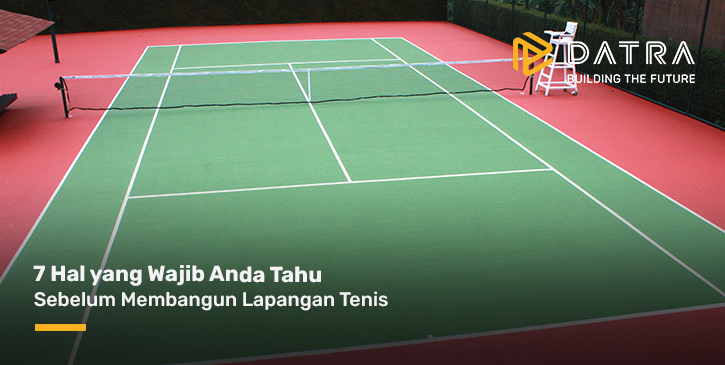
By Datra Internusa — Based on experience building tennis courts in apartments, hotels, corporate offices, and public sports facilities.
The interest in tennis continues to grow, whether in schools, universities, sports clubs, residential areas, or commercial sports facilities. However, before starting a construction project, many facility owners share the same questions: how much land is required, what type of surface is most suitable, and how much budget needs to be prepared.
PT Datra Internusa has handled various tennis court projects with diverse needs and scales, ranging from public facilities to residential areas, hotels, and corporate sports areas. You can view some of our implementations on our project portfolio page.
Armed with this experience, this article summarizes the seven most frequently asked questions regarding tennis court construction along with their answers. If you are considering building a tennis court, the following guide can serve as a reference before starting your project.
1. What is the standard size of a tennis court?
Tennis court dimensions follow international standards applicable worldwide. The playing area has a length of 23.77 meters—applicable for both singles and doubles. The width of the court is 8.23 meters for singles matches and 10.97 meters for doubles matches, with the service line located 6.4 meters from the net.
However, what is often overlooked during planning is the clear space (run-off area) surrounding the court. The ITF standard distinguishes two tiers of run-off space requirements:
- Competitive Facilities: A minimum of 6.4 meters behind the baseline and 3.7–4.6 meters on the sides is required.
- Recreational or Club Level: The requirement behind the baseline can be reduced to 5.5 meters.
It is crucial to determine early on what level your facility will be used for, as this will directly impact the total land requirement. This means the total land you need is significantly larger than the size of the playing court itself. Not to mention if you are planning spectator areas, locker rooms, circulation paths, or other supporting facilities.
Other technical standards to pay attention to include playing line positions, service areas, net installation, and post placement. The standard net height is 0.91 meters in the center and 1.07 meters at the posts, with the posts placed outside the doubles court lines.
Key Point: When planning your land, do not just calculate the size of the playing court. Calculate the total requirement, including the run-off area, fencing, circulation, and supporting facilities.
2. Is it better to build an indoor or outdoor tennis court?
The choice between an indoor and outdoor tennis court depends on the intended use, project location, target users, and available budget. Both offer different playing experiences and have their respective advantages.
- Indoor Tennis Courts: Offer more consistent playing conditions because they are unaffected by rain, wind, or sun. Lighting, temperature, and court surface conditions can be kept more stable year-round, allowing training and matches to proceed without weather disruptions. Therefore, indoor facilities are often the choice for tennis clubs, academies, or institutions requiring high court utilization rates.
- Outdoor Tennis Courts: Provide a more natural playing experience. Environmental factors like wind, sunlight, and temperature changes create distinct challenges in every match, helping players develop adaptability and game control. Additionally, playing outdoors provides extra benefits such as natural sunlight exposure, better air circulation, and a more open atmosphere.
In terms of investment, outdoor courts generally require lower construction and operational costs as they do not need building structures, ventilation systems, or specialized lighting like indoor facilities. Therefore, outdoor courts remain the most common choice for schools, residential areas, public facilities, and community sports centers.
Simple Guide: If your main priority is year-round usage with consistent playing conditions, indoor is the answer. If you want investment efficiency and a more natural playing experience, outdoor is often the more practical choice.
3. Which tennis court surface is the most suitable?
The choice of surface affects the character of the game, player comfort, maintenance needs, and the facility's lifespan. There are three main types of surfaces used in the tennis world:
- Hard Court: The most commonly used tennis surface globally, including at the US Open and Australian Open. Built on an asphalt or concrete substrate coated with acrylic resin, this system offers a consistent surface, low maintenance, diverse color options, and can be used for both indoor and outdoor facilities. Some systems also feature a cushion layer to improve playing comfort.
- Clay Court: Famous for the French Open, offering a slower game and higher ball bounce. It is comfortable for players and allows for sliding techniques. However, clay courts require far more intensive maintenance: regular watering, brushing, and the periodic addition of clay material.
- Grass Court: The hallmark of Wimbledon, providing the fastest game with low ball bounce. Feels softer underfoot. However, both natural grass and synthetic turf require special attention and higher maintenance costs.
Datra provides several tennis surface systems tailored to project needs:
- Datra Sports Multicourt SPU: Made of Silicon Modified Polyurethane, SPU is a strong and flexible seamless sports floor for indoor and outdoor areas.
- Datra Sports Multicourt SPUR: A silicone polyurethane flooring material with a prefabricated cushion underlayer and a cast-in-place surface. Consistent performance, seamless, and highly durable.
- Datra Sports Acrylic Standard & Lite: An economical acrylic court system with multi-layer coating technology to produce a comfortable and easy-to-maintain playing surface.
- Herculan TC Court: Combines comfort, impact protection, and ITF Medium-Fast performance in one premium court system.
- Greenset Grand Slam: Consists of three premium cushioned acrylic layers combining acrylic resin and rubber particles to deliver optimal performance and comfort.
Selecting the right system should consider target users, court usage intensity, playing performance needs, and the project budget so the investment yields long-term benefits.
4. Does a tennis court require a special drainage system?
Yes. A drainage system is one of the most critical components in building an outdoor tennis court and is often the determining factor for the court's long-term lifespan.
Most modern tennis courts, especially those using hard court (acrylic) or synthetic grass surfaces, have relatively non-water-absorbing surface characteristics. Therefore, rainwater must be quickly channeled away through a properly designed surface slope and drainage system. The goal is not only to prevent puddles on the court but also to protect the foundation structure beneath the court from water infiltration, which can cause soil movement, surface settling, cracking, or pavement structural failure.
A tennis court drainage system typically consists of a combination of:
- Court surface slope
- Perimeter drainage channels
- Catch pits
- A pipe network channeling water to the main site drainage system
In areas with humid soil conditions or high groundwater levels, additional subsurface drainage is often required to prevent moisture from entering the court structure from below.
Besides proper design, drainage systems also require regular maintenance. Channels, catch pits, and drainage pipes must be routinely cleaned of mud, leaves, or other materials that can obstruct water flow. A well-maintained drainage system will help the court return to a playable state faster after rain while prolonging the life of the surface and overall court structure.
5. How much does it cost to build a tennis court?
There is no single cost that applies to every tennis court project, as construction costs depend on a wide range of factors, including site conditions, the type of playing surface selected, lighting systems, perimeter fencing, spectator stands, canopies or indoor structures, and other supporting facilities. As a result, an accurate cost estimate can generally only be determined after a comprehensive site survey and needs assessment have been completed.
One of the primary factors affecting construction costs is earthworks and foundation construction. Existing soil conditions, cut-and-fill requirements, drainage systems, and overall soil stability determine the complexity of the civil works required. Sites with less stable ground conditions often require additional ground reinforcement to ensure the court remains structurally stable and resistant to settlement or cracking over the long term.
Beyond the foundation, the choice of court surface system also has a significant impact on both the total investment and long-term maintenance costs. Each surface type offers different playing characteristics, comfort levels, durability, and maintenance requirements, so the selection should align with the intended use of the facility.
Additional costs come from supporting facilities such as perimeter fencing, lighting systems, spectator areas, player facilities, and any additional building structures required for indoor courts. The more complex the planned facility, the greater the overall investment required.
Long-term operating and maintenance costs should also be taken into consideration. The quality of the foundation design, drainage system, and surface materials will significantly influence maintenance efficiency and the overall service life of the court.
Therefore, effective project planning should focus not only on the initial construction cost but also on the total cost of ownership throughout the facility's lifecycle. Conducting an early consultation and a comprehensive needs assessment is essential to ensure that the design and cost estimate align with the project's objectives and overall scope.
6. How long does it take to build a tennis court?
The construction timeline for a tennis court depends on the complexity of the project, site conditions, weather, and the overall scope of work. For a standard single tennis court, construction typically takes approximately 45–60 days, assuming favorable site and weather conditions.
The construction process generally begins with site preparation, followed by the installation of the drainage system, foundation and pavement works, fencing, and lighting. Once the concrete structure or primary pavement has been completed, the court surface cannot be installed immediately. The concrete requires a curing period of approximately 28–30 days to reach a stable condition before the surface system can be applied. In practice, this curing period runs concurrently with the procurement of surface materials and supporting works such as fence and lighting installation, helping to keep the overall project timeline efficient.
The installation of the court surface system itself typically takes around 5–10 days, depending on the type of material used and weather conditions during application. If the project includes additional facilities such as spectator stands, changing rooms, landscaping, or an indoor structure, the overall construction period will naturally be longer.
For this reason, proper project scheduling from the outset is essential to ensure that each stage of construction meets technical standards and results in a tennis court with optimal quality, performance, and long-term durability.
7. How to Maintain a Tennis Court to Keep It Durable?
Maintenance is an investment often forgotten during planning, even though a good maintenance program can significantly extend the court's lifespan and reduce major repair costs in the future.
Maintenance Methods by Surface Type:
- Hard court (acrylic): Routine cleaning to remove dust, moss, and dirt that affect surface grip. Avoid harsh chemicals or excessive water pressure that could damage the coating.
- Clay court: Intensive maintenance such as regular watering, brushing, leveling, and adding clay material.
- Grass court: Routine mowing, irrigation, fertilizing, and weed control.
In addition to cleaning, conduct periodic inspections of the drainage system, surface condition, fencing, nets, net posts, and lighting. Early detection prevents minor damage from developing into major problems.
Frequency Guide:
- High usage: Clean every 1–2 weeks.
- Medium usage: Thorough cleaning every month.
- Long-term: Acrylic surfaces generally require recoating every 4–7 years to restore color and surface performance.
With proper care, a tennis court not only looks better but can deliver consistent, safe, and comfortable playing performance for years.
Build the Right Tennis Court from the Start
Building a tennis court isn't just about providing a space to play; it's about ensuring the facility is safe, comfortable, durable, and capable of providing the best playing experience for its users.
The Datra Internusa team is ready to assist you from the consultation phase, planning, and court surface selection, all the way to comprehensive construction execution.
Want to consult about your tennis court project? Contact our team to explore the various sports facility solutions we provide.
Related Blogs

FIBA-Standard Basketball Flooring: Why Wood Is the Standard, and How Junckers Meets It
Construction, Sports
October 14, 2026

World Athletics Standard Running Track: The Complete Guide to Specifications, Construction, and Certification
Education, Construction, Sports
July 22, 2026
Complete Volleyball Court Guide: FIVB & PBVSI Standards for Indoor and Outdoor Courts
Education, Construction, Sports
July 16, 2026
