
Complete Volleyball Court Guide: FIVB & PBVSI Standards for Indoor and Outdoor Courts
Education, Construction, Sports
July 16, 2026
By Datra Internusa — With extensive experience in installing various sports facilities across Indonesia, from national-scale venues, commercial arenas, corporate facilities, educational institutions, to public sports facilities.
Volleyball is one of the sports with the largest fan bases in Indonesia. From lively neighborhood tournaments that attract large crowds, the nationally broadcasted Proliga competition, to the success of Indonesian athlete Megawati Hangestri who has brought pride to the country through her career in South Korea’s volleyball league, volleyball continues to grow as both a community sport and a competitive achievement sport.
At the international level, FIVB (Fédération Internationale de Volleyball) recognizes volleyball as one of the most widely played sports in the world, with hundreds of millions of players across more than 200 countries.
Volleyball is also one of Indonesia’s strongest grassroots sports. The growing number of mini volleyball courts and semi-permanent volleyball courts built independently by local communities — from neighborhood halls to residential open spaces — proves that this sport thrives from the community level to professional arenas.
This growth directly impacts the increasing demand for better sports facilities. Schools, universities, corporations, and commercial sports facility operators are increasingly developing or renovating volleyball courts. However, before construction begins, one fundamental aspect must be properly understood: volleyball court dimensions and technical specifications. Errors at this stage can become extremely costly to fix after the volleyball court construction is completed.
This article provides a complete guide covering FIVB and PBVSI volleyball court standards, indoor and outdoor volleyball court requirements, surface material recommendations, equipment specifications, and common installation mistakes often found in volleyball court projects.
Standard FIVB and PBVSI Volleyball Court Dimensions
The international volleyball court standard is established by FIVB (Fédération Internationale de Volleyball). In Indonesia, PBVSI (Persatuan Bola Voli Seluruh Indonesia) fully adopts FIVB standards, meaning volleyball courts built according to FIVB specifications automatically meet national competition requirements.
Element | Standard Size |
Playing court length | 18 m |
Playing court width | 9 m |
Attack line | 3 m from the center line |
Court line width | 5 cm |
Minimum free zone | 3 m on all sides |
Official FIVB competition free zone | 5 m from sidelines, 6.5 m from end lines |
Service zone | 9 m wide behind the end line |
One aspect that is often overlooked during planning is the free zone requirement. The playing area itself is only 18 × 9 meters, but the actual required space for a functional volleyball court is significantly larger. For recreational facilities and training courts, a minimum area of approximately 24 × 15 meters is recommended. For official competition-level facilities, the required space can reach 31 × 19 meters or more.
Volleyball Court Size Requirements Based on Age and Playing Level
Volleyball court dimensions can be adjusted based on user groups, considering their physical abilities and safety requirements. The standard 18 × 9 meter volleyball court is designed for adult games and official competitions. However, educational and recreational facilities have greater flexibility. Several important principles should be considered by facility owners:
- Elementary schools generally use smaller volleyball courts, approximately 9 × 4.5 meters, to match children's movement range and support fundamental skill development. Facilities may also adopt the mini volleyball 4v4 format with a court size of 12 × 5.5 meters.
- Recreational facilities and junior/high schools may use dimensions closer to the full standard size of 18 × 9 meters.
- The free zone may be reduced for school or recreational facilities, but it must always provide sufficient space for safe player movement.
- Regardless of court size, every volleyball court must have clear boundary markings and adequate safety zones to minimize injury risks, especially in facilities used by children.
The implication is clear: if your facility serves multiple user groups — such as schools with different age levels or commercial sports halls rented by adult clubs and youth academies — choosing adjustable volleyball net systems and equipment is essential. This will be discussed further in the equipment section.
Difference Between Indoor and Outdoor Volleyball Courts
The dimensions of indoor and outdoor volleyball courts are generally the same. However, the key differences lie in vertical space requirements, surface specifications, and environmental factors.
Indoor Volleyball Court
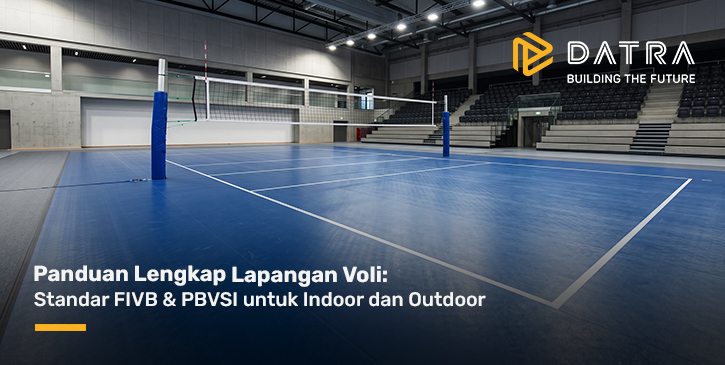
An indoor volleyball court is the preferred choice for professional leagues, school competitions, and structured training programs. Its biggest advantage is consistency — games and training sessions are not affected by weather conditions, allowing activities to run throughout the year.
The most critical factor in an indoor volleyball court, and one that is often overlooked, is the ceiling height (clear height). FIVB requires a minimum vertical free space of 7 meters above the playing surface, with no obstacles such as roof structures, lighting fixtures, air ducts, or suspended scoreboards. For official FIVB world-level competitions, the required free space increases to 12.5 meters.
The 7-meter requirement is not merely a formality. High serves, float serves, setting plays, and defensive actions can send the volleyball several meters into the air. A ceiling that is too low limits gameplay, makes the facility unsuitable for competitive use, and cannot be corrected through flooring upgrades alone.
In addition to ceiling height, an indoor volleyball court requires:
- Shock-absorbing flooring systems to protect players’ joints from repetitive jumping and landing movements.
- Uniform lighting without glare to ensure clear ball visibility during serves and rallies.
- Proper ventilation and air circulation to maintain player comfort during intense activities.
Outdoor Volleyball Court
Outdoor volleyball courts are commonly found in parks, schools, residential areas, and community facilities. They are ideal for recreational activities and community sports programs. However, outdoor volleyball courts are not used for professional indoor volleyball competitions because indoor volleyball requires consistent playing conditions that are unaffected by external factors such as sunlight, wind, and rain.
Exposure to weather conditions and tropical climate fluctuations in Indonesia creates several technical requirements:
- The surface material must be UV-resistant and weather-resistant to prevent fading, cracking, or surface deterioration.
- Proper drainage systems and surface slopes are required to prevent water accumulation.
- Court orientation should ideally face north–south to minimize sunlight glare during morning and afternoon games.
Recommended Volleyball Court Surface Materials
The playing surface determines three critical aspects: player safety, game performance, and long-term investment value. For volleyball court construction, Datra recommends two flooring systems based on facility requirements:
Datra Sports Vinyl Volleyball
Datra Sports Vinyl Volleyball is a specialized indoor volleyball flooring system designed with a gemstone-textured surface that provides optimal grip, player comfort, and durability for intensive use. Available in 1.8 × 15 meter rolls with a 6 mm thickness, this vinyl flooring system enables efficient installation while creating a clean, professional, and high-performance playing surface. It is an ideal solution for schools, sports halls, volleyball clubs, and commercial sports facilities that require a reliable flooring system for training, recreational activities, and competitive-level volleyball.
Vinyl flooring is the preferred choice for facilities where volleyball is the primary sport, especially for athlete development programs and competitive-level training.
Datra Sports Multisport SPUR
Datra Sports Multisport SPUR is a premium sports flooring system that combines a 7 mm prefabricated rubber layer with a 2 mm cast-in-place SPU (Silicon Modified Polyurethane) surface layer, creating a total thickness of 9 mm. This advanced flooring system delivers optimal impact absorption, consistent playing performance, seamless surface finishing, and high durability for long-term use.
Designed for indoor sports facilities that prioritize player comfort, safety, and performance, Multisport SPUR is an ideal solution for schools, universities, corporate sports facilities, and multi-purpose sports halls that require a versatile surface capable of supporting multiple sports activities.
Datra’s team can help determine the most suitable flooring system based on your facility location, user profile, and usage intensity.
Standard Volleyball Net Dimensions
The volleyball net is an equipment component with highly specific requirements regulated by FIVB — yet it is often underestimated during facility planning and procurement.
Element | Standard Size |
Net length | 9.5 – 10 m |
Net height (mesh width) | 1 m |
Men’s volleyball net height | 2.43 m (measured at center court) |
Women’s volleyball net height | 2.24 m |
Mesh size | 10 × 10 cm |
Antenna height | 1.8 m (extends 80 cm above the net) |
Net post height | 2.55 m (adjustable) |
Net post position | 0.5 – 1 m outside the sidelines |
A standard volleyball net post should feature adjustable height settings to accommodate different playing categories. This is essential because men’s and women’s volleyball require different net heights with a 19 cm height difference, while youth volleyball categories require lower net settings based on age and skill level.
To meet these requirements, Datra provides Datra Sports Portable Volleyball Post, an adjustable and portable volleyball net system designed to support various levels of play. Its flexible design makes it an ideal solution for multi-purpose sports facilities, allowing courts to be quickly converted for other sports activities without permanent posts becoming obstacles. This completes Datra’s comprehensive sports facility solution from high-performance flooring systems to professional-grade volleyball equipment.
Common Indoor Volleyball Court Installation Mistakes
Based on experience handling various sports facility projects across Indonesia, these are three of the most common — and costly — mistakes found during volleyball court installation:
1. Choosing Volleyball Equipment That Does Not Meet Industry Standards
Unstable net posts, inaccurate net dimensions, or poor-quality tension systems directly affect gameplay quality and player safety. Non-standard equipment can also prevent a facility from being approved as an official competition venue, limiting opportunities to host tournaments and generate additional revenue. Investing in industry-standard volleyball equipment from the beginning is significantly more cost-effective than replacing failed equipment after only 1–2 years of use.
2. Not Planning for Multi-Sport Usage and Space Optimization
Many sports facilities are designed with only one sport in mind, only to discover later that court utilization is limited during certain hours. With proper planning, an 18 × 9 meter volleyball court with adequate surrounding space can also accommodate other sports activities. A well-designed multi-purpose sports hall can support various activities, including volleyball, basketball, and futsal, maximizing facility usage and investment value.
This decision should be considered from the early planning stage. The selection of flooring systems such as Datra Sports Multisport SPUR, multi-color court markings, and portable equipment solutions should be integrated into the initial design process — not added after construction is completed.
3. Skipping Professional Installation Support
One of the most common challenges we encounter is sports flooring installation without proper technical supervision and expertise. This can lead to various issues, including uneven subfloors that create surface irregularities, incorrect ceiling height verification before construction, inaccurate court markings, and unsuitable material selection based on site conditions.
These problems often stem from one fundamental mistake: completing a sports facility project without the guidance of a specialized sports facility contractor. Addressing these issues after the project is completed is almost always more costly than investing in professional consultation, proper planning, and expert installation from the beginning.
Build Your Volleyball Court with Datra
Building a high-quality volleyball court is not simply about creating an 18 × 9 meter playing area. A successful volleyball court project requires a thorough understanding of FIVB and PBVSI volleyball court standards, free zone and ceiling height requirements, proper flooring selection based on location and usage, and industry-standard volleyball equipment.
With extensive experience in sports facility development, Datra Internusa has delivered volleyball and multi-sport facility projects across Indonesia, including commercial arenas, corporate facilities, educational institutions, and national athlete training centers.
Whether you are planning a new volleyball court construction project or renovating an existing facility — as a facility owner, corporate team, educational institution, coach, or architect — Datra provides comprehensive support from technical consultation and design planning to professional installation.
Contact us via email at sales@datra.id or WhatsApp for further consultation regarding volleyball court construction and renovation.
Related Blogs

FIBA-Standard Basketball Flooring: Why Wood Is the Standard, and How Junckers Meets It
Construction, Sports
October 14, 2026

World Athletics Standard Running Track: The Complete Guide to Specifications, Construction, and Certification
Education, Construction, Sports
July 22, 2026
Complete Volleyball Court Guide: FIVB & PBVSI Standards for Indoor and Outdoor Courts
Education, Construction, Sports
July 16, 2026
