One Court at a Time: Getting to Know Benson Kawengian, Owner and CEO of Datra
Stadium, Project Update
June 19, 2026
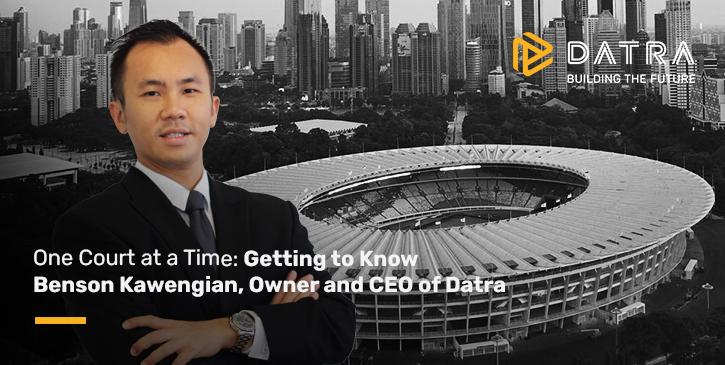
A candid conversation about five countries, a $3,000 first project, a near-empty bank account, and why a good sports facility might be the most human thing a city can build.
If you have visited a sports facility in Indonesia over the past decade and found it worth coming back to, there is a reasonable chance that Benson Kawengian and his team had something to do with it. As the Owner and CEO of PT Datra Internusa and Datra Sports, Benson has spent the better part of two decades building what is now Indonesia's most credentialed sports infrastructure company: one that has delivered work at Gelora Bung Karno for the 2018 Asian Games, at Indonesia Arena for the FIBA World Cup, across more than 22 provinces, and on everything from national stadiums to school playgrounds.
Despite the portfolio, Benson is not someone who actively seeks the spotlight. "We never really sought the spotlight," he says, "but we're proud every time people enjoy what we've built."
What follows is a candid look at the man behind the company — how he got here, what he believes about play and infrastructure, and where he sees Indonesian sport heading next.
Five Countries and a Childhood on Concrete
Benson grew up across five countries: Indonesia, Singapore, New Zealand, the United States, and Australia. Moving between them gave him something that a more conventional upbringing might not have: the ability to observe patterns across cultures, and a bone-deep understanding that sport is a language that does not need translation.
As a kid, he played basketball and then shifted to soccer. The social dimension of it always mattered more to him than the scoreline. He played between classes with friends, joined football camps during Jakarta holidays, and found that gathering eight people for a game was infinitely easier than gathering twenty-two for a full match. Later in life, before the pandemic changed everything, he took up running marathons and martial arts.
What he also noticed, growing up, was what was missing. There were not many good facilities. A lot of the time, you played on concrete and made do. That observation, stored quietly in the background, would eventually matter quite a lot.
"I think the humanity of play is why we do what we do," he reflects. "In a world where there is a lot of AI, people will want to find things that are more human, with more movement, more detached from digital toxicity. A good sports facility activates humanity and brings unity through laughter and play."
The Malaysia Holiday That Became an Industry
Benson's first move into the sports industry was not through construction. It was through a holiday trip to Malaysia, where he walked into a futsal facility and had a simple, immediate thought: Indonesia does not have this yet.
He was young, still finishing school, still moving between countries. But the memory of playing on concrete was fresh, and the logic of futsal was clean. You only needed six players, not twenty-two. In a city as dense and traffic-burdened as Jakarta, that mattered. Gathering was hard. Futsal made it easier.
In 2004, he co-founded Planet Futsal, which became Indonesia's first commercial futsal operation and eventually scaled to 14 locations. It was not a smooth road. He learned, the hard way, about rental costs per square metre, about sales activation, about what happens when enthusiasm carries you past the operational details a business cannot afford to ignore. He describes his younger self with good-natured honesty as youthful, perhaps a little arrogant in the way that young entrepreneurs often are.
What Planet Futsal gave him, beyond the commercial scars, was something more valuable: operator fluency. He learned what it felt like when the field surface was wrong, when the playing experience degraded, when people stopped coming back. That inside-out perspective would shape every project Datra took on years later.
An Unlikely Path
After Planet Futsal, Benson's career took several more unexpected turns before it arrived at Datra. He was working at Bloomberg when the 2007-2008 financial crisis hit. Wanting to understand what had just happened to the global economy, he went back to school for an MBA. He expected to return to banking or consulting. Instead, he found himself drawn toward things with less structure: nonprofit work, TEDx organizing, then an events activation agency, and eventually a working relationship with Pico, the global events and exhibitions company.
The introduction to Datra came through family connections and acquaintances, the kind of introduction that only happens when you have spent years moving between industries. The company he was introduced to was not the Datra people know today. It was a waterproofing business with a long trading history, hollowed out by the 1997-98 Asian financial crisis, operating as a licensed trading entity with operating history but not much else. Benson acquired it at a reasonable price and, with no master plan, started fixing what was in front of him.
"I never really knew what to do with it yet," he admits. "I just started experimenting with playgrounds and sports, one by one."
The first real project was a playground for an international school. The contract value was $3,000. He describes it without irony: that was the beginning. From there, it was one tennis court, one badminton court, one indoor sports hall at a time.
The Moment It Nearly Ended
Not long after taking over Datra, as the company began pursuing larger and more visible projects, things got very difficult. Benson was dismissed by more experienced players in the market as too young and too international. He was told he did not know the local decorum. There were occasions when he was physically threatened. Payments on projects were deliberately made difficult by those who did not want a new entrant to succeed in work they had long regarded as their territory.
"Some of these forces made payments really hard," he says. "At the time we couldn't really absorb it."
There came a point when Datra had approximately $1,000 in available funds before hitting its credit limit, and payroll was due within days. He describes the moment without drama: he worked through how he was going to solve it and kept going. The show had to go on.
That experience marked him permanently. Today, Datra's commercial discipline on cash flow, its insistence on proper payment terms, and its careful selectivity about which clients and projects to take on are not policies from a textbook. They are the direct product of that near-miss, and the choice to persist anyway.
"The market, at times, didn't really want us to exist," he says quietly. "But we persisted."
The Asian Games and the Turn
The breakout arrived with the preparations for the 2018 Asian Games at Gelora Bung Karno. Datra earned its place at one venue, delivered well, and was trusted with another scope. By the time the Games opened, the team had contributed to more than twelve venues across the complex.
Benson is candid about what drove him through that period. It was not purely commercial ambition. "I really meant what I was selling," he says. "I wanted to get the best projection of the facility out there for the international world to see that Indonesia is capable of having international venues."
The success of the Asian Games work served as a turning point. A young team, doubted by much of the established market, had navigated some of the biggest and most scrutinised infrastructure projects in the country's recent history. From that point, the company's positioning became clear: Datra would be the technically rigorous, compliant, auditable name in a market where trust was scarce. It would not compete on price. It would compete on what it built and how it operated.
"In an ecosystem where trust is very rare," Benson reflects, "we decided to be a compounding value proposition of trust."
What Owners Consistently Miss
Walk into a sports facility in Indonesia with Benson and he will not look at the signage, the café, or the entrance lobby first. He will look at the subbase, the elevation, the playing surface, the air circulation. These are the things most developers and owners get wrong.
"A lot of the time, what these people tend to focus on is the extra fringes," he explains. "They forget about the basics: the substrate, the elevation, the subbase, good circulation. Your field of play is supposed to be the core anchor of everything. That's what people are actually paying to use."
His advice is consistent: spend more on the core product you are selling, then build the environment around it. Going cheap on the playing surface to fund a more impressive entrance or a well-fitted café is a trade-off that looks reasonable in a budget meeting and becomes a serious regret within two or three years. The surface degrades, maintenance becomes difficult, the experience suffers, and users stop coming back.
"Sports facilities are only as good as the way they're maintained," he says. "Plan for that from day one, or pay for it later."
The civil and subbase costs also catch owners off guard. Many clients reach the midpoint of a project and realise they have underestimated these foundational costs, and then, as Benson puts it, they start to act funny: cutting corners, stretching timelines, and putting the specialist contractor in an impossible position. The solution is not a larger contingency budget. It is engaging the right professionals early, taking the time to properly scope and engineer the full project from the ground up, and respecting the process enough to follow through on agreed terms.
A Boom with a Warning Inside It
Right now, Benson watches Indonesia's padel and racket sports surge with a mix of genuine excitement and real concern. The appetite is there. Younger Indonesians are shifting toward active, social, health-driven leisure in significant numbers, and the market demand for well-built courts is real and growing.
The problem is that not everyone entering the market to serve that demand is building well. He has seen padel courts installed with untempered glass, poor substrates, off-specification materials, and installation that would not pass basic safety scrutiny. He is not surprised. Every boom attracts people looking for a quick margin, and the courts that get built badly in the next two years are the courts that will be damaging reputations, endangering players, and closing their doors in four.
He draws a direct parallel to the futsal boom of the early 2000s: the same excitement, the same wave of new operators, the same gap between enthusiasm and operational discipline. "If people are not careful, many of them can lose a lot of money. That brings in a lot of contractors who think it is going to be a quick buck, and they take compromises."
For operators and investors entering padel, pickleball, or any new court sport now, the most consequential decision is who builds the facility — not just who sells the surface materials, but who takes full responsibility for the civil substrate, drainage, playing surface specification, glass installation, and long-term maintenance. Getting that decision right at the start is the difference between a venue that grows a loyal community and one that quietly fades.
The Part the Website Doesn't Show
Despite Datra's name being most visibly associated with national stadiums and international tournaments, the company's history is actually built from smaller, steadier work. Benson is clear about this.
"We started off with one tennis court at a time, one badminton court at a time," he says. "We would go to industrial townships and start renovating their shared facilities one scope at a time: the track, then the indoor hall, then the multi-purpose hall, then the auditorium. That's how the relationship builds."
For smaller or earlier-stage projects, Datra Sports exists to bridge the gap, providing quality materials, products, and installation support without requiring the full engagement of a complex EPC project. For those whose ambitions have grown to involve meaningful civil works, specialist flooring, custom equipment, seating systems, and multi-scope delivery in the billions of IDR, that is where PT Datra Internusa is built to serve.
The company is not for everyone, and Benson says so honestly. But no project is too small to be worth a conversation. "Never hesitate to learn from us, and for us to learn from you," he says. "Drop us a WhatsApp message. Have a conversation."
What He Is Building Toward
Beyond any single project or contract, Benson's longer vision for Datra is to be the definitive technical name for sports infrastructure in Indonesia: not just for construction, but for materials sourcing, product specification, maintenance planning, and eventually public-private partnership structures that bring quality sports spaces to communities the market might otherwise underserve.
He is proud of the team Datra has built, describing them as the most professional group of sports infrastructure specialists in the country, assembled deliberately, because a sustainable company requires people who take the craft seriously. He is equally proud of Datra's relationships with international principals across Europe, the United States, and China, including its exclusive representation of Junckers, the Danish hardwood flooring brand, for the Indonesian market. These are not just vendor arrangements. They are the infrastructure beneath the infrastructure.
His personal philosophy on why all of it matters comes back to something simpler than strategy or market position.
"I think people who can play together fight less," he says. "We focus more on what unites us than on our differences. There was a time when Indonesia played Malaysia in football, and even at a moment of very divisive national narrative, everybody paused and focused on the game together. Sports has always done that. It unites people. We don't have to go to war; we can have rivalry and competition and fun."
He grins when he describes the moments he values most: the national anthem at the opening of the Asian Games, a venue full of people celebrating something together, the joy of watching Indonesians play and cheer and laugh in a space that Datra built.
"At the end of the day, we are driven by the humanity of play," he says. "And I believe a good sports facility activates humanity and brings unity through laughter and play."
That is what Benson Kawengian built Datra to do. One court at a time.
If you are planning a sports venue, a school facility, a padel or pickleball court, or a corporate sports space, Datra is the place to start the conversation. Reach the team at sales@datra.id or connect directly via WhatsApp through datra.id.
Related Blogs
FIBA-Standard Basketball Flooring: Why Wood Is the Standard, and How Junckers Meets It
Stadium
October 14, 2026

One Court at a Time: Getting to Know Benson Kawengian, Owner and CEO of Datra
Stadium, Project Update
June 19, 2026