
Field Hockey Pitch Dimensions According to FIH and FHI Standards
Education, Construction, Sports
July 8, 2026
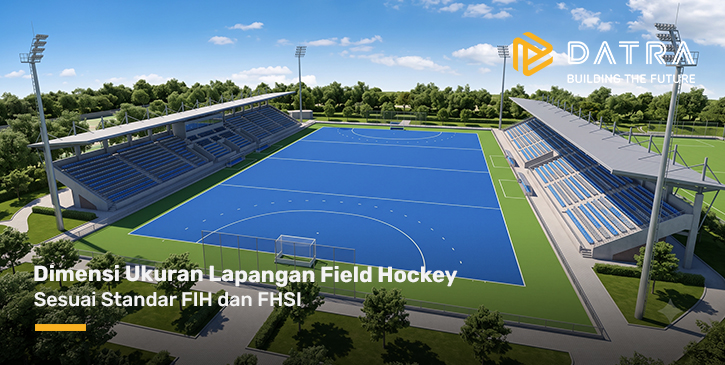
For school administrators, sports hall (GOR) managers, and investors planning a sports facility development, understanding the correct field hockey pitch dimensions is a step that cannot be skipped. Mistakes at the planning stage can have long-lasting consequences, ranging from non-compliance with competition standards and player safety issues to inflated repair costs down the line.
Field hockey, often referred to simply as "hockey" in many countries, is a team sport played with sticks and a ball on a synthetic turf surface, governed by very specific rules and dimensions. It is frequently confused with ice hockey, yet the two sports differ significantly — from the playing surface and equipment to the governing federations. Ice hockey is played on ice using skates and a puck, while field hockey is played on an open or indoor pitch surfaced with turf, using a small, hard ball.
Pitch dimensions are a critical factor in field hockey facility construction because they directly affect the quality of play, athlete safety, and the legality of hosting official matches. A pitch that does not meet the standard risks being rejected for competition certification and may even pose an injury risk to players.
This article covers everything you need to know: what field hockey is, official pitch dimensions according to the International Hockey Federation (FIH), goal dimensions, pitch surface materials, and other technical aspects such as markings and run-off areas that must be considered when building a standard-compliant hockey facility.
What Is Field Hockey?
Field hockey is a team sport played by two teams of 11 players each, including a goalkeeper. Each player uses a curved stick to direct a small, hard ball into the opponent's goal. The game is played on a rectangular pitch surfaced with specialized synthetic turf, engineered so the ball rolls and bounces with consistent speed across the entire playing surface.
Historically, field hockey has been played since the 19th century in England and grew into an international sport featured at the Olympics since 1908. It was originally played on natural grass, but since the mid-1970s, the use of artificial turf has become mandatory for international competitions, as it produces a faster, more consistent game with a lower risk of injury from uneven surfaces.
The sport is governed by the International Hockey Federation (FIH), the international governing body responsible for setting all rules of play, including pitch dimension standards, goal specifications, and turf material specifications approved for official competition. At the national level, hockey in Indonesia is currently governed by the Federasi Hockey Indonesia (FHI). It is worth noting that this organization was previously known under different names during different periods, but its current official name is Federasi Hockey Indonesia (FHI), which follows and adopts FIH's international standards for domestic competitions.
Field Hockey Pitch Dimensions According to FIH Standards
Based on the official rules set by the FIH and followed by national federations including FHI, field hockey pitch dimension standards are differentiated by category of use, including competition fields and training fields, as detailed below:
Aspect | Competition Field | Training Field |
Field of play | 91.40 m x 55.00 m | 91.40 m x 55.00 m |
Minimum inner run-off | 2.0 m x 1.0 m | 2.0 m x 1.0 m |
Minimum outer run-off | 1.0 m x 1.0 m | 1.0 m x 1.0 m |
Operational margin | 1.0 m x 1.0 m | - |
Minimum total size | 101.40 m x 61.0 m | 97.40 m x 59.0 m |
Field orientation | North / South | Preferably North / South |
Hockey turf type | Non-filled, Wet | Non-filled, Wet / Sand dressed, Wet |
Required FIH field certification category | Global Elite / Global | Global or National (with irrigation) |
These dimensions are applied uniformly worldwide for official matches at both international and national levels, including the Olympics and competitions organized by FHI in Indonesia. For schools or training facilities with limited land, the training field dimensions above can serve as the minimum reference, but it's important to understand that a pitch built below these dimensions cannot be used for officially certified matches.
Why Field Hockey Pitch Standards Matter
Compliance with field hockey pitch dimension and specification standards is far more than an administrative formality. There are several fundamental reasons why this should be a priority in facility planning:
Ball bounce consistency. A pitch surface and dimensions that meet the standard ensure the ball rolls and bounces consistently across the entire playing area, preserving the quality of play and preventing either side from gaining an unfair advantage.
Player safety. Adequate run-off dimensions, clear markings, and turf material that meets FIH specifications all play an important role in reducing the risk of injury from player collisions or unsuitable surfaces.
Competition hosting requirements. Pitches used for official matches — whether at school, regional, or national level — must meet specific dimension and certification standards to be approved by the organizing federation.
Pitch longevity. Construction that follows correct technical specifications — from the base layer and drainage system to the turf layer — significantly extends the pitch's usable lifespan compared to one built without regard for standards.
Maintenance cost efficiency. A pitch built to standard from the outset will be more cost-efficient to maintain over the long term, as it reduces the risk of premature damage to the surface, drainage system, and underlying structure.
Field Hockey Goal Dimensions
Beyond pitch dimensions, goal dimensions are also specifically regulated by the FIH and followed by national federations:
- Goal width: 3.66 meters (measured from the inner edge of the goalposts)
- Goal height: 2.14 meters (measured from the underside of the crossbar)
- Goalpost and crossbar width: 50 mm, with a depth of 50–75 mm
- Backboard: spans the full 3.66-meter width with a height of 460 mm
- Sideboards: minimum length of 0.92–1.2 meters with a height of 460 mm
Goals must be white, made of materials that pose no danger to players or umpires, with rounded corners and edges designed to reduce injury risk in the event of impact.
To meet these procurement needs, Datra Sports provides the Datra Sports Hockey Goal Post, designed to meet FIH's dimension and safety specifications, ready for use in both training and official matches.
Field Hockey Pitch Surface Materials
Since the mid-1970s, the use of synthetic turf — known as hockey turf — has become mandatory for official international matches and most national-level competitions. There are three main types of turf surface commonly used:
- Water-based turf: a sand-free turf surface that requires regular irrigation before and during matches to allow the ball to roll quickly and smoothly. This type is the primary choice for international competitions and national leagues because it produces a high-speed game.
- Sand-dressed turf: sparser synthetic fibers with a partial sand infill to support the fibers, producing a slightly slower game but with lower water maintenance requirements.
- Sand-filled turf: synthetic fibers with sand filling the full pile depth, generally used for training facilities or schools because it is simpler to maintain.
The choice of turf type should be tailored to the pitch's intended use — whether for FIH-certified official competition, club training, or educational facilities — since each type has different characteristics in terms of ball speed, maintenance needs, and investment cost.
Datra Internusa also offers a synthetic turf collection for a range of sports facility needs. You can check our synthetic turf collection to find the specification that best fits your field hockey project requirements.
Beyond turf type, the color of the field of play is also part of the FIH standard. The approved colors for the playing surface are blue or green, with markings in white or another contrasting color to remain clearly visible against the turf surface.
Other Important Aspects of Field Hockey Standards
Field hockey pitch markings. All lines on the pitch must be white (or a contrasting color if the turf surface is dark) with a width of 75 mm, covering the boundary lines (side line and back line), the center line, the 23-meter lines, the shooting circle, as well as penalty spots and corner marks positioned according to the Rules of Hockey.
Run-off areas beyond the playing lines. The FIH requires a minimum run-off of 2 meters on the side lines and a minimum of 3 meters behind the back lines. These areas must be kept free of any permanent or temporary obstructions, such as advertising boards or camera equipment, to protect player safety when moving close to the pitch boundary.
Safety fencing. For competition facilities, FIH standards recommend safety fencing at least 7 meters high behind the goal areas and at least 1 meter high along the side lines, to contain balls that are lifted high out of the playing area and to protect spectators around the pitch.
Build a Quality Field Hockey Pitch with Datra Internusa
Building a field hockey pitch that meets FIH and FHI standards takes more than simply installing turf — it requires careful structural planning, drainage design, pitch gradient control, and precise marking work to ensure the facility is truly ready for training and official competition.
Datra Internusa is a sports facility construction partner with a track record as main contractor on a number of national-scale sports infrastructure projects, including Gelora Bung Karno, Indonesia Arena, and Jakarta International Stadium. This experience gives Datra a deep understanding of the complexities involved in building sports facilities that prioritize technical precision, user safety, and long-term cost efficiency.
For schools, sports halls (GOR), and investors currently planning the construction or renovation of a sports facility, Datra's team is ready to help — from project planning consultation through to on-site construction. Every project is assessed based on the specific needs of the location, budget, and intended use of the facility.
Contact the Datra team via sales@datra.id or WhatsApp for a consultation on your sports facility construction needs.
Related Blogs
FIBA-Standard Basketball Flooring: Why Wood Is the Standard, and How Junckers Meets It
Construction, Sports
October 14, 2026

World Athletics Standard Running Track: The Complete Guide to Specifications, Construction, and Certification
Education, Construction, Sports
July 22, 2026
Complete Volleyball Court Guide: FIVB & PBVSI Standards for Indoor and Outdoor Courts
Education, Construction, Sports
July 16, 2026
