
Your Venue Is on a Clock - and the Clock Runs Faster Here
Construction, Sports
June 17, 2026
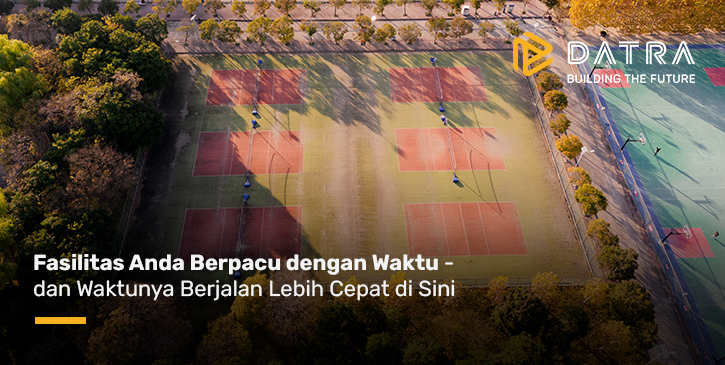
By Datra Internusa | Sports Infrastructure Engineering & Renewal
There is a mental model that quietly governs how most venue managers think about the surfaces under their athletes' feet. The model goes something like this: build it well once, and it's done. The floor, the court, the track - these are infrastructure. They are fixed. They are permanent. And because they feel permanent, they go into a category of decisions that only get revisited when something looks visibly broken.
That model is wrong. And the gap between the model and reality is where the money goes. A sports surface is not permanent infrastructure. It is a consumable with a service life, closer in nature to a set of tyres on a car than to the columns holding up the building. The building's columns may never need replacing in your lifetime. The surface you play on will. And like tyres, the condition of a sports surface at any given point sits on a curve from new and high-performing, through a long middle period of gradual degradation, to a zone where the damage is no longer cosmetic but structural. Also like tyres, the timing of renewal is not arbitrary. There is a window. Act inside it and renewal is fast, inexpensive, and restorative. Miss it and you are no longer maintaining an asset. You are salvaging one.
This is particularly true in Indonesia. The equatorial climate, the wet and dry seasons, the heat that bakes into outdoor surfaces every afternoon, and the humidity that rises through indoor slabs at night all put pressure on sports surfaces that the European and American specification sheets do not fully account for. Understanding that pressure, and what it means for your maintenance schedule, is the difference between a venue that ages gracefully and one that quietly falls apart.
Start Here: The Field of Play Is the Asset
Before the maintenance clock, the service cycles, and the cost comparisons, there is a principle that everything else depends on.
If your venue exists for sport, then the field of play is the most important thing in the building.
This sounds obvious, but the decisions made in most venue projects tell a different story. A great deal of money and design attention goes to the facade, the reception, the lighting in the car park. These are the things visitors pass through on the way in. They are memorable for approximately four minutes. What people actually experience for the hour or two they spend at your venue is the surface under their feet: whether it grips correctly, whether it is smooth and even, whether it feels fast and safe or sluggish and uncertain. Whether it looks like a place that takes sport seriously.
The same principle applies to spectators. What they remember is not the exterior cladding. They remember the court, the track, the floor, and what happened on it. A refreshed, well-maintained surface announces that a venue is serious. A faded, slippery, line-free surface announces the opposite, and that announcement travels fast in communities where word of mouth and social media govern which facilities people book.
This is the foundation for everything that follows. If the field of play is the primary asset, then the maintenance of that field is the primary operational responsibility of every venue manager reading this.
Why Surfaces Fail: Two Root Causes, Everything Else Is a Symptom
In over four decades of specifying, building, and renewing sports surfaces across Indonesia, the same two root causes appear behind almost every premature failure. All the other explanations - the weather, the usage intensity, the material choices, the budget cuts somewhere in the supply chain are symptoms of one or both of these.
The first is the subbase. A sports surface is only as good as what lies beneath it. The concrete slab or asphalt base on which any coating, rubber, turf, or hardwood system sits is not a neutral substrate. It is an active structural variable. If that subbase has drainage problems, if the concrete was poured too quickly or cured in the tropical heat without the moisture management that tropical conditions require, if the soil beneath it was never properly tested for load-bearing capacity or reactivity to moisture changes, then everything installed on top of it is building on a problem that is simply waiting to express itself.
The science here is clear. Most failures of hard-court sports pavements arise due to a combination of highly reactive or moisture changes in the subgrade, poor compaction of subgrade and pavement layers, and inadequate drainage. In Indonesia, the compounding factor is that using cheaper, lower-quality concrete or neglecting proper mixing and curing severely compromises court integrity and this is far more common than it should be, because general construction contractors are frequently asked to prepare subgrades and pour slabs for sports facilities without specialist knowledge of what those surfaces require.
The slope is one example. A sports court slab needs to be graded at precisely 1% in one direction to shed water efficiently. Too flat, and water pools on the surface after rain and sits against the coating. Court surfaces should be sloped at 1% in one direction, which is 1 inch of fall in every 10 feet. This helps to keep water flowing off the court and ensures fast drying surfaces and less standing water. Get it wrong by a fraction, and you create micro-drainage failures that over a wet season progressively undermine the coating from below.
The curing is another. If temperatures are hot, water will leave the wet slab quickly, and this could lead to surface cracking. Many curing compounds applied in hot weather leave a residue on the concrete surface that can cause a bond breaker and lead to failure of the acrylic sport coatings. In Indonesia's heat, a concrete slab poured by a contractor who does not understand this specific interaction will be setting up the venue for coating failure years before anyone understands why.
Soil testing is perhaps the most consistently neglected step. The load-bearing characteristics of Indonesian soil vary significantly by location, and highly reactive soils that expand and contract with changes in moisture content will transfer that movement directly upward through any surface sitting on top of them. This is not a corner that can be cut and compensated for later. By the time the surface is cracking, the problem is structural, not cosmetic, and the remediation cost rises accordingly.
For indoor venues, the variable is water vapor. In a country with the humidity levels of Indonesia, vapour transmission through concrete slabs is a real and underappreciated force. A hardwood sports floor installed over a slab that was never properly waterproofed will be absorbing moisture from below, evening by evening, until the wood responds as wood does when it gets wet. This is why engineered floor systems that include a dedicated moisture barrier are not a premium option for Indonesia. They are a basic requirement.
The second root cause is the absence of planned renewal. This is the one most venue managers have some awareness of and most consistently defer. A surface that was perfectly installed on a well-prepared subbase will still degrade with use. Coatings wear thin. UV energy breaks down polymer chains. Infill materials compact and displace. Line markings fade. The wear is gradual enough that it rarely feels like an emergency, and that is precisely the problem.
The Wear Clock: Surface-by-Surface
The useful corrective to gradual wear is to stop experiencing it as gradual and start treating it as scheduled. Every surface type has a predictable cycle. Knowing that cycle converts a vague maintenance anxiety into a date on a calendar, which is infinitely more manageable.
In temperate climates, the standard benchmarks from global industry practice are as follows. Acrylic hard courts (outdoor tennis, basketball, multi-sport) typically require resurfacing every four to eight years. Acrylic courts typically last fifteen to twenty years, with regular resurfacing every four to eight years. Indoor polyurethane systems, under heavy use, warrant assessment at three to five years and a top coat as needed to prevent the body coat from eroding to the point where the subbase becomes vulnerable. Running tracks, which carry significant load and UV exposure, typically need resurfacing every eight to twelve years, depending on the amount of use and environmental factors. Synthetic turf systems for futsal, football, or padel have a turf lifespan of six to eight years, but their infill requires active ongoing management from the day they open.
In Indonesia, compress those timelines by roughly twenty to thirty percent for outdoor surfaces. The reason is not dramatic. The equatorial climate does not produce the freeze-thaw cycles that destroy temperate-zone courts in winter. What it produces instead is relentless UV bombardment and a wet-dry cycle that puts constant pressure on drainage and waterproofing. Near the equator, UV exposure is intense and sustained. Sealants and coatings without adequate UV stabilizers become brittle, discolored, and cracked within two to three years instead of the fifteen to twenty year lifespan expected from quality products. The same dynamic applies to the protective coatings on sports surfaces. A product specified for a Dutch indoor facility and an outdoor tennis court in Jakarta are not operating in the same environment, regardless of what the data sheet says.
The subbase connection also creates an additional Indonesia-specific risk. Where drainage is imperfect and water is allowed to pool seasonally, the wet-dry cycle can produce the kind of subgrade reactivity that pushes moisture up through an inadequately waterproofed slab, accelerating the delamination of any coating sitting above it. This is a technical failure with very pedestrian origins: a slope that is two millimetres too shallow, a drain that fills with debris and is never cleared, a subgrade soil that was never tested for reactivity.
The Cost Cliff: Why "One More Year" Is the Most Expensive Decision a Venue Makes
Here is the economics of surface renewal, stated plainly.
If a sports surface shows visible wear, fading, or early surface degradation but the structural subbase is intact, the cost of renewal is a fraction of the cost of full replacement. The intervention is essentially a preparation and a top coat: a professional clean, any crack or spot repairs, and the application of a fresh surface layer with new line markings. The subbase has not been touched. The structural investment you made in the original build is preserved and leveraged. Based on Datra's project experience across Indonesia, a timely renewal typically costs in the range of ten percent or less of a full new build.
If the same surface is left until water has infiltrated the base layers, until the substrate has begun to fail, until the damage has become structural rather than cosmetic, the intervention required is a different project entirely. The failed material has to come out. The subbase has to be assessed and often repaired. The full build sequence starts again. You are paying the full cost of a new facility, and paying it for a venue that you could have renewed years earlier for one tenth of the investment.
This is not a hypothetical. A running track that was only two years old once came to our attention in a state of near-total failure: water had penetrated the subbase during the monsoon seasons following its build, and the rubber had disintegrated throughout. The facility had to be fully excavated and reconstructed from scratch. The subbase work that was skipped on the original build, and the monitoring that would have caught the water ingress before it became catastrophic, together cost the venue operator an entire replacement budget plus years of disrupted programming.
The lesson is blunt: "we'll deal with it next year" is the single most expensive sentence a venue manager says. A surface that is showing wear but has not yet failed structurally is in the renewal window. Every season that passes without action narrows the margin between a cheap top coat and a full excavation.
The good news is that this is almost always a recoverable situation as long as the subbase is intact. The visual signals of a surface that can still be renewed are fading colour, loss of surface grip, disappearing line markings, and minor surface crazing. The visual signals of a surface that has passed into structural failure territory are delamination, water pooling beneath the surface, pervasive mold growth, and large-scale cracking that compromises the evenness of the play area. The former is a maintenance event. The latter is a construction project.
If your facility is in the first category, the window is open. Act in it.
The Hidden Accelerant: Wrong Materials, Wrong Methods
There is a third way that venues quietly accelerate their own degradation, and it has nothing to do with weather or age. It has to do with what the building staff use to maintain the surface between renewal cycles.
A specialist sports surface is a chemistry-specific system. The cleaning agents, the line paints, the infill materials, and the top-up coatings that touch it need to be matched to that system. When they are not, the damage is invisible at first and then suddenly isn't.
A high-quality hardwood sports floor is one of the most sensitive to this. The correct care of a hardwood floor uses minimally damp mopping with purpose-formulated sports floor cleaners. What actually happens in many venues is that the cleaning staff use large quantities of soap water applied wet, which seeps into the joints between boards and introduces sustained moisture to the wood structure. A Junckers solid hardwood floor, for example, is engineered to handle a broad humidity range and is specified for Indonesian conditions when installed correctly over a moisture-protected subbase, and with the right air conditioning maintaining humidity within tolerances. That same floor can be damaged by the cleaning staff before the first year of use is complete if wet-mopping is standard practice. The floor appears fine until it doesn't, and then the damage is already done.
Rubber and synthetic flooring faces a different version of the same problem. Cleaning agents formulated for ceramic tiles or bathroom surfaces are chemically incompatible with synthetic rubber and can degrade the surface structure over repeated applications. The damage expresses itself as loss of elasticity, surface discolouration, and eventually a surface texture that no longer performs as designed.
Padel courts and synthetic turf systems have their own supply-chain sensitivities. Sand maintenance is crucial for the longevity and playability of a padel court. Over time, sand can become compacted or displaced, affecting ball bounce and shock absorption. Regular sand top-ups and full replacements help maintain the court's performance over time. When operators try to substitute generic silica sand from hardware suppliers for the correctly specified infill, the particle size and shape are wrong: sands break into fine particles over time, so that the fine particles fill between other particles, causing the infill to become gradually hard. The play quality degrades, the drainage suffers, and the turf fibers are put under abnormal stress. This is a problem that costs almost nothing to prevent and accumulates quickly when ignored.
Line paint is perhaps the most casually mishandled maintenance supply in sports venues. The paint used on a sports surface is not decorative paint. It is a formulated coating that contains grit for traction, elasticity to move with the surface without cracking, and adhesion properties calibrated for the specific substrate it is going onto. Applying a generic paint product over a sealed acrylic court surface creates a film that does not bond correctly, produces an uneven texture, and flakes away within months. The result is worse than unpainted lines and the remediation requires stripping the incorrect paint before proper line marking can be applied.
These mistakes are not made out of neglect. They are made out of the entirely understandable assumption that basic maintenance is basic. The reality is that sports surface maintenance requires the same product specificity as the original installation. A venue that is kept stocked with the correct cleaning agents, correct infill top-up materials, and correct line paint for its specific surface system will reach its full service life intact. A venue that is not will arrive at renewal time earlier, in worse condition, and with warranty complications.
The Competitive Stakes: Who Needs to Read This Most
Indonesia's sports facility market is in the middle of a significant expansion phase. In 2025, Indonesia saw a 295% increase in padel clubs and over 1,580 new courts built. The Indonesian sports industry grew from IDR 37.3 trillion to IDR 39.4 trillion in 2024. New venues are opening in Jakarta, Banten, Bali, Bandung, and Surabaya at a pace that was unthinkable five years ago. For operators in that market, the surface renewal question is not abstract. It is a competitive variable.
The private sports facility operator is perhaps most directly exposed. Unlike public utilities, private clubs and courts depend on customer preference. The decision to book at one facility over another can hinge on whether a court looks and plays like a premium experience. When resurfacing is delayed too long, surface fatigue spreads beyond the coating layer. Cracks widen, moisture penetrates deeper, and repairs become more involved. For a padel club competing against a newer venue that opened six months ago, the difference between a surface that looks tired and one that has been refreshed can be the difference between a full booking calendar and one that is half-empty.
The hotel with a sports facility faces a version of this problem that touches the property's overall brand perception. A five-star property with a tennis court where the acrylic is fading and the lines have disappeared is not showing guests a five-star amenity. It is showing them evidence of a standard of care that does not match the room rate. A resurfaced court is a marketing event, not just a maintenance one. It can be communicated to guests, promoted on social channels, and positioned as evidence of the property's commitment to guest experience. It costs a fraction of a new build and has an outsized effect on perception.
Schools that compete on the quality of their sports and physical education infrastructure understand this instinctively. International and premium private schools in Indonesia's major cities have increasingly invested in branded European sports flooring systems, running tracks, and multi-sport courts as part of their pitch to prospective families. A Junckers hardwood floor in a school gym, or a certified acrylic multi-sport court, signals something about the institution's standards that families understand. But that signal decays as the surface ages. A school that invested in quality five years ago and has not maintained it is no longer presenting the same message it was on opening day.
The operator who handles this best is the one who thinks about their surface not as a capital expenditure to be depreciated and eventually replaced, but as an ongoing presentation of standards. The cost difference between these two approaches, across the lifecycle of a well-maintained facility versus one that is allowed to degrade until replacement is forced, is substantial. A properly maintained wooden sports floor, renewed at the right intervals, can have a documented lifespan in excess of sixty years, with sanding and refinishing extending it through multiple surface generations on a single structural system. A rubber floor intended for a two-to-five year service life can be extended to ten or fifteen years with correct maintenance and timely renewal. These are not marginal improvements in asset economics. They are multiples.
What the Indonesian Market Is Catching Up To
It would be unfair to suggest that Indonesian venue operators alone are behind on this. The underinvestment in surface maintenance and renewal is a global pattern, not a local one. What makes Indonesia's situation specific is the pace of growth in the market. Over a thousand new padel courts built in a single year, nearly 800 of them concentrated in the urban centres of Jakarta, Bali, Surabaya, and Bandung. A sports industry that grew by IDR 2 trillion in a single year. A government sports regulation framework, recently consolidated under Permenpora Regulation 9 of 2026, that is formalising standards and compliance expectations across the sector for the first time in a systematic way. The market is maturing quickly. The facilities that were built in the early rush of this growth phase are now entering the age range where renewal decisions need to be made, and most of their operators have not yet built the institutional knowledge to make those decisions well.
There is also a historical dimension that is specific to this country. Some of the facilities that Datra's teams have been called to assess in recent years have been in continuous use for thirty or forty years without a meaningful renewal. Not because they were built badly, in every case, but because the institutional knowledge of renewal was simply not there: nobody told the venue manager that a running track had a service clock, or that the polyurethane floor in the gym could be extended another decade with a sand and top coat rather than a full demolition. The accumulated cost of that absence of knowledge, measured in what those facilities have now had to spend to return to serviceable condition, is significant.
This is why the conversation matters now. Indonesia is building its sports infrastructure estate at scale. The decisions being made today about surface specifications, subbase quality, and maintenance programmes will determine whether that estate is in good condition in ten years or whether it is facing a wave of costly remediation. The knowledge to make those decisions well exists. It needs to become standard practice.
A Conversation Costs Nothing
If you are reading this and mentally checking your own facility, you are already ahead of the majority of venue operators in this country. The next step is simpler than most people assume.
There is a consistent pattern that Datra encounters: venue managers who see our project portfolio, which includes Indonesia Arena, Gelora Bung Karno, and Jakarta International Stadium, and assume that Datra is a company for large national projects rather than for their school gymnasium or their padel club in South Jakarta. That assumption is wrong in a way that is worth correcting directly.
Datra operates at every scale of the market. The same technical expertise that delivered the FIBA-certified Junckers floor at Indonesia Arena, the same understanding of subbase preparation, surface chemistry, and product compatibility that comes from four decades of installation and renewal across this country, is available to a venue operator who needs a single court assessed, a running track recoated, or a hardwood floor sanded and refinished. The first conversation is always the same: send photos, describe what you are seeing, and let the technical team tell you honestly what you are dealing with and what your options are.
Most venue managers who have that conversation are surprised by two things. The first is that the renewal option exists at all, when they had assumed replacement was the only path. The second is what it costs, which is almost always significantly less than they expected.
The assumptions you are carrying about your surface, about what it would take to renew it and what it would cost, are very likely wrong. The only way to find out is to start the conversation.
For renewal assessments, resurfacing enquiries, or supply of specialist maintenance materials, contact the Datra sales team at sales@datra.id or via WhatsApp.
Datra Internusa is Indonesia's foremost specialist in sports infrastructure, with over 44 years of project history across stadium construction, court systems, synthetic turf, running tracks, hardwood sports flooring, and venue renewal. The company operates under the Datra Internusa brand for large and complex projects and the Datra Sports brand for smaller, faster-turnaround requirements.
Related Blogs
FIBA-Standard Basketball Flooring: Why Wood Is the Standard, and How Junckers Meets It
Construction, Sports
October 14, 2026
World Athletics Standard Running Track: The Complete Guide to Specifications, Construction, and Certification
Construction, Sports
July 22, 2026
Complete Volleyball Court Guide: FIVB & PBVSI Standards for Indoor and Outdoor Courts
Construction, Sports
July 16, 2026
