
Why (and How) Remote Industrial Zones in Indonesia Must Build International-Standard Sports Facilities
Construction, Sports
June 11, 2026
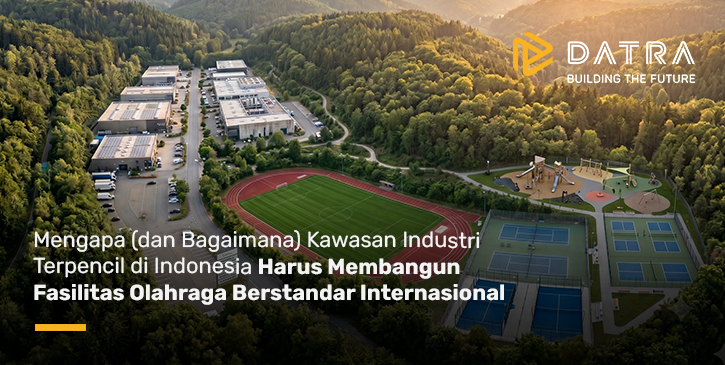
From the specialists who are doing it right now — alongside companies like Pupuk Kalimantan Timur — in locations with some of the toughest logistical challenges in the archipelago.
There is a quiet conviction held by the best facility managers at Indonesia's remote industrial companies: that their employees deserve more than what they currently have.
Employees working in Bontang, Bula, North Aceh, or Mimika do not complain loudly. They show up, work hard, and when their shifts end, they return to residential compounds that are, in many ways, self-contained.
But self-contained does not necessarily mean complete.
The nearest public sports center might be a two-hour drive away. The indoor sports hall (GOR) in the company complex was built in the 1980s and has not been touched since. Outdoor courts are cracked, lines are faded, and basketball rims have been bent the wrong way for so long that nobody notices anymore. The gym features equipment that wobbles during use.
And the children — the sons and daughters of engineers, operators, and technicians who keep the plant running — play on surfaces that were never designed for play.
Realizing international-standard sports facilities in Indonesia's remote areas is possible. Employees may live far from the city, but that does not mean they should play on substandard facilities. This article explains why that investment matters, what it looks like in practice, and how to build it right from the start.
Why Remote Industrial Zones Have the Strongest Case to Invest in Sports Facilities
Your Employees Have No Other Option
In cities like Jakarta or Surabaya, if employees want to play badminton after work, there are plenty of options. There are commercial sports clubs, public sports halls, and private courts within reach. In Bontang, there are none. The company’s residential compound is the community. The facilities inside the gates are not an extra perk — they are the only facilities available.
This completely changes the calculation. When a company in a remote industrial location asks, "should we invest in sports facilities?", the real question is: "are we giving employees a place to live a full life, or simply a place to work?" Those are two very different propositions — and employees know the difference.
Employee Well-being and Retention Are Directly Linked to the Physical Environment
Remote assignments are tough. Employees and their families accept geographical isolation as part of the deal. What they expect in return is a quality of life that matches that distance. When sports facilities are old, unsafe, or simply inadequate, that expectation goes unmet.
The consequences are measurable. Skilled employees who have options will leave. Families who feel neglected will push their spouses to transfer or resign. New hires from the city weigh the offered quality of life before signing a contract. And experienced people who stay but feel undervalued become a silent drag on morale that no survey will ever capture.
Investing in a complete, well-designed sports complex is not a soft HR program. It is a retention strategy backed by an infrastructure built to last twenty years.
Aging Facilities Are an Active Liability
A typical sports complex in a remote industrial zone was built during Indonesia's industrial expansion era decades ago. Back then, it was enough. Today, by any standard, it is not.
Synthetic flooring that has lost its cushioning reduces player safety. Court surfaces that have warped or peeled affect ball bounce in ways that seem minor until someone sprains an ankle or suffers a ligament injury. Gym equipment that has long passed its lifespan becomes a source of injury rather than fitness. And playground equipment installed over concrete without a certified safety rubber surface is a risk that responsible management simply cannot accept.
Renovation is not just about aesthetics. It is a safety obligation. In a company residential compound where the employer is also responsible for the health of the employees, preventable injuries on damaged sports surfaces are issues that could — and must — be avoided.
What a Complete and Proper Industrial Zone Sports Complex Looks Like
The goal is not renovation for the sake of renovation. The goal is a self-contained and complete sports ecosystem — one that serves employees, their spouses, and their children, from morning till night.
A complete sports complex for this context typically includes:
- Indoor Sports Hall (GOR) with a Multifunctional Court: This is the heart of any serious sports complex. A certified indoor building with the correct ceiling height, the right flooring surface, proper lighting, and correct court layouts can accommodate badminton, basketball, volleyball, futsal, and martial arts. The keyword is multifunctional: the room must be usable for all of them, not just a few. This requires a flooring system, not just a floor. Polyurethane sports surfaces or sprung wooden floor systems installed to federation standards are the foundation of a court where balls bounce correctly, players pivot safely, and athletes at any level can perform optimally.
- Gym and Fitness Area: A well-equipped, well-ventilated, and well-maintained gym serves different needs: individual fitness, recovery, and the daily physical movement that maintains physical and mental health during long assignments. Gym equipment specifications matter — commercial-grade machines designed for high-use environments will last much longer than consumer-grade equipment.
- Outdoor Courts: Outdoor basketball, futsal, tennis, and volleyball courts expand the complex's capacity and allow for use during cooler parts of the day. The right outdoor court surface — acrylic or polyurethane systems over a well-prepared base course — withstands tropical climates, retains its colors and lines, and provides a consistent bounce that makes playing enjoyable. A cracked concrete court without a proper surface is not a court. It is a hazard with lines drawn on it.
- Children's Playground Area: This is often the most overlooked element, and arguably the most important for long-term retention. Employees' families are also residents of the area. When a child has a safe, stimulating, and international-standard play area, their parents' quality of life improves in ways that no salary adjustment can replace. Playground equipment must be installed over a certified safety rubber surface — never on concrete or ceramic tiles — with fall zones calculated based on the maximum height of each piece of equipment. This is not an option. It is the minimum standard that a responsible design must meet.
Sports Infrastructure Has Its Own Science
This is where many industrial companies make their most expensive mistakes. A sports facility is not a civil project with flooring slapped on at the end. Every element — surfaces, equipment, structures, lines — has standards, certifications, and technical specifications that are usually unknown to and unasked by general contractors.
A badminton court is not just a flat surface. There are specific deflection requirements, specific friction coefficients, and specific light reflectance standards. Ceiling height matters. The direction of natural light matters. Court orientation relative to windows matters.
A basketball hoop is not just a rim at the correct height. The backboard must meet specific rebound standards. The post must be engineered to absorb impact. Installation must be anchored to a load-bearing structure, not just a floor slab.
When these specifications are not met — and this often happens when work is handed over to general civil contractors unfamiliar with sports — the consequences are immediate and costly. The ball does not bounce correctly. The surface degrades faster than it should. Players suffer injuries that would not occur on a certified surface. And ultimately, the facility has to be rebuilt.
Rebuilding in a remote location like Bontang is not a minor inconvenience. It means mobilizing logistics, specialists, and materials all over again — at the same or higher cost, plus the burden of explaining to management why the first build failed.
The right specialist, involved from the start, is cheaper in the long run than the wrong contractor chosen based on price.
Why Building in Remote Industrial Zones is Harder — and What is Required from Your Contractor
Four challenges that differentiate a remote industrial zone project from a standard corporate sports facility project in Jakarta are: logistics, procurement, specialist expertise, and schedule access.
- Logistics in places like Bontang, Bula, or remote refinery complexes mean that every material must be planned months in advance. Certified sports flooring — Mondo vinyl, Junckers wood, Datra Sports polyurethane systems — is made-to-order or imported. Lead times can reach 4 to 12 weeks. A contractor without an established supply chain and import experience will delay your project just when everything else is ready.
- Procurement in remote industrial sites often involves navigating internal corporate procurement processes alongside the complexities of specialist materials not carried by general suppliers. A sports flooring specialist who is also an ISO-certified contractor — capable of producing compliant documentation for every material, every installation method, and every test result — is not a commodity. They are your protection against failed inspections, warranty disputes, or a project that looks complete but lacks certification.
- Specialist expertise cannot be improvised in the field. Installing sprung wooden floor systems, laying polyurethane sports surfaces, anchoring certified gym equipment, constructing IFSC-certified climbing walls — all of these require trained technicians who have done it before, under supervision, on projects that were subsequently inspected and passed. Sending a general civil crew to do this work produces results that look adequate to an untrained eye but fail as soon as someone who knows sports surfaces takes a closer look.
- Schedule access in active industrial facilities is restricted in ways that standard construction projects never experience. Production schedules, safety zones, access gates, shift rotations — all of these affect when work can be done and in what sequence. An experienced sports contractor understands how to schedule work around operational realities. Unexperienced ones will request access, get denied, fall behind schedule, and ultimately ask for extensions that the facility cannot grant.
What Datra is Doing in This Context
Datra is currently working as the main contractor in the revitalization of the Pupuk Kalimantan Timur (PKT) sports complex in Bontang — one of the largest industrial zones in East Kalimantan and one of the most strategic SOE (BUMN) complexes in Indonesia.
The mandate includes both new construction and renovation. The goal is the same one that every company in this position should hold: better, more standardized, and safer spaces for employees and their families to play, compete, and thrive. This includes the children. The playground area is included in the scope of work because families are part of the community, and the community deserves the same quality as the workforce.
This follows Datra's work on the Toyota Astra Motor corporate sports complex — where the mandate was to design and build a workplace wellness ecosystem, not just fix surfaces — and decades of work meeting the standards of the National Sports Week (PON), FIBA championships, the FIFA World Cup, and international athletics competitions.
The technical credibility earned at Gelora Bung Karno (77,187 seats, 2018 Asian Games), Indonesia Arena (2023 FIBA World Cup), Jakarta International Stadium (79,000 seats, FIFA-certified), and the Jakarta International Wall Climbing Park (the largest IFSC-certified wall climbing facility in Southeast Asia) is exactly what remote industrial zone projects need: the assurance that the people executing the project have done it at every scale, under demanding conditions, to standards that withstand inspection.
How to Get Started — and Why It’s Simpler Than You Think
The procurement process for a project like this can feel complicated. But the first step is not a tender document. It is not a bill of quantities. Nor is it a site visit.
The first step is a conversation.
A facility manager or owner looking at aging infrastructure, thinking about what their employees and families deserve, wanting to understand what exactly goes into a sports complex renovation or new build — that person needs to speak with a team that has done it before. Not to immediately receive a proposal, but to understand what is possible, what it takes to do it right, and what questions to ask before the procurement process even begins.
The Datra team can guide you through it all: from initial needs assessment, design, and scope definition, to procurement, installation, certification, and maintenance.
The conversation that kicks off this entire process can start with a WhatsApp message or a phone call. The complexity is Datra’s problem to manage, not yours to navigate alone.
Frequently Asked Questions
- What sports facilities are typically built in remote industrial zone complexes? The most complete setup includes a multifunctional indoor sports hall (for badminton, basketball, volleyball, and futsal), a gym and fitness area, outdoor courts, and a children's play area. Some companies also add a jogging track, an outdoor gym, and dedicated rooms for martial arts or gymnastics.
- Why can't general civil contractors build sports facilities in remote industrial zones? Sports infrastructure has its own science — technical specifications, safety standards, and federation certifications that govern everything from floor deflection to equipment anchoring. General contractors lack this specialized knowledge, meaning they deliver facilities that look complete but fail in performance and safety. In remote locations, rework is incredibly expensive.
- What are the main challenges of building sports facilities in remote industrial zones in Indonesia? The four main challenges are logistics (long supply chains for certified materials), procurement (specialist products with import lead times), specialist expertise (trained installation crews rather than general civil labor), and schedule access (working within the operational constraints of an active facility).
- How does investing in sports facilities help with employee retention in remote assignments? In company residential compounds where the employer controls the living environment, the quality of recreational infrastructure directly impacts the quality of life. Employees and families who see a tangible investment in their daily well-being are more likely to stay, perform well, and recommend the assignment to others.
- How long does it take to build or renovate a sports complex in a remote industrial zone? The timeline depends on the scope and site conditions, but a complete sports complex renovation project typically takes 3 to 12 months. Projects in remote locations require extra planning time for logistics and material procurement. Early engagement with a specialist contractor is the most effective way to shorten the schedule.
- Can international standards be applied to sports facilities in remote areas like Bontang or North Aceh? Yes. Distance from Jakarta is no excuse for accepting lower standards. Certified sports surfaces, the right equipment, and safe playground installations can be realized in Bontang just as they are in Senayan — provided the contractor has the supply chain, technical capability, and operational experience to execute outside major urban centers.
Ready to Build Something Your Employees Deserve?
If your company operates in a remote industrial zone and you are considering upgrading, renovating, or building a new sports complex — the best next step is to speak with a team that has done it before, at every scale, under the exact conditions you face.
Tell us where you are, what you have, and what you want to achieve. We will guide you through the rest.
PT Datra Internusa has been working on sports facility projects across Indonesia since 1981, including Gelora Bung Karno (77,187 seats, 2018 Asian Games), Indonesia Arena (2023 FIBA World Cup), Jakarta International Stadium (FIFA-certified), Jakarta International Wall Climbing Park (the largest IFSC-certified climbing facility in Southeast Asia), Banten International Stadium, the Pupuk Kalimantan Timur sports complex, Toyota Astra Motor's corporate courts, and hundreds of school and community facilities throughout the archipelago. Clients include national SOEs, local governments, international schools, and leading private corporations.
Related Blogs
FIBA-Standard Basketball Flooring: Why Wood Is the Standard, and How Junckers Meets It
Construction, Sports
October 14, 2026
World Athletics Standard Running Track: The Complete Guide to Specifications, Construction, and Certification
Construction, Sports
July 22, 2026
Complete Volleyball Court Guide: FIVB & PBVSI Standards for Indoor and Outdoor Courts
Construction, Sports
July 16, 2026
