
Pickleball Court Measurements: International Standards, Playing Zones, and Land Guidelines
Construction, Sports
June 19, 2026
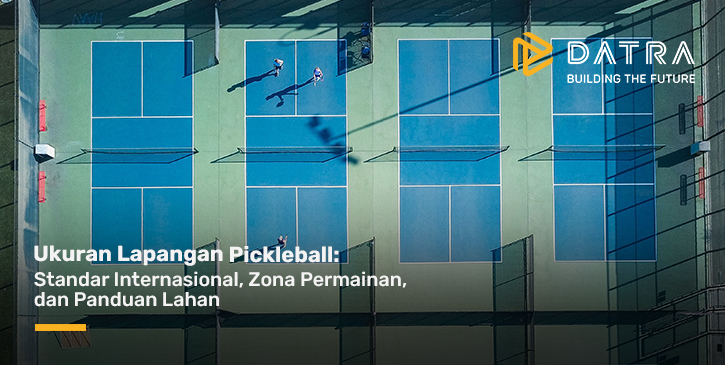
Pickleball is one of the fastest-growing sports in the world—and it is now making its way into Indonesia. Before building or converting a facility, understanding the exact pickleball court measurements is a crucial first step that cannot be skipped.
This article discusses the standard dimensions of a pickleball court, its playing zones, applicable international standards, and how much land you actually need—including comparisons with other relevant sports in Indonesia.
Standard Pickleball Court Dimensions
A pickleball court has one universal size that applies to all game formats, both singles and doubles:
- Length: 13.41 meters (44 feet)
- Width: 6.10 meters (20 feet)
- Playing Area: ±81.8 m²
Unlike tennis, which has different sizes for singles and doubles, a pickleball court uses the same dimensions for both formats. The only difference lies in which lines are used during gameplay.
Essential Zones Within the Court
A pickleball court is divided into several zones, each with specific rules and functions.
Non-Volley Zone (The Kitchen)
The most distinctive zone in pickleball is the non-volley zone, commonly called "the kitchen." This zone extends 2.13 meters (7 feet) from both sides of the net, spanning the width of the court. Players are not allowed to volley (hit the ball before it touches the ground) while standing inside this zone. This rule shapes the tactical character of pickleball and distinguishes it from tennis or badminton.
Service Areas
Outside the kitchen, the court is divided into four symmetrical service areas:
- Service area depth: 4.57 meters (15 feet) from the kitchen line to the baseline.
- Width of each service box: 3.05 meters (10 feet).
- Centerline: Divides the court vertically into the left and right sides to determine the serve direction.
Baseline and Sideline:
- Baseline: The rearmost line of the court, parallel to the net.
- Sideline: The right and left sidelines of the court.
All boundary lines are recommended to be 5 cm wide and must be a contrasting color to the court surface.
Pickleball Net Standards
Pickleball nets have slightly different specifications compared to other racket sports:
- Net width: 6.40 meters (21 feet 9 inches)—slightly wider than the court width so the net extends past the sidelines.
- Net height at the sidelines: 91.4 cm (36 inches).
- Net height at the center: 86.4 cm (34 inches).
The lower net height in the center is one of pickleball's unique characteristics. This makes the game more dynamic, as shots toward the center are easier to clear than those aimed at the sides.
Governing Bodies and International Standards
Pickleball court measurement standards are set by two main bodies:
- USA Pickleball (formerly USAPA): The governing organization that sets official rules and court standards used globally. Almost all international tournaments refer to this standard.
- World Pickleball Federation (WPF): An emerging international body aiming to promote the standardization and development of pickleball on a global level toward the Olympics.
The main difference between tournament and recreational standards is not in the court dimensions—the size remains the same—but rather in the specifications for surface materials, lighting, and the clearance zones around the court.
Total Land Requirements: Court + Clearance Area
The playing area size (6.10 × 13.41 m) is not the only thing to consider. A safe area outside the court lines (clearance zone) is crucial for player safety when chasing the ball.
Recommended land requirements per court:
Specification | Total Width | Total Length | Total Land per Court |
Recreational | 9.14 m | 18.29 m | ±167 m² |
Tournament | 10.36 m | 19.51 m | ±202 m² |
The minimum recommended clearance zone is 1.52 m on the sides and 2.44 m behind the baseline for recreational standards, and wider for tournament standards.
How Many Pickleball Courts Fit in My Land?
One of the main advantages of pickleball from a facility business perspective is its high land efficiency. Here are relevant comparisons for the Indonesian context:
- Conversion from a Tennis Court: One standard tennis court (23.77 × 10.97 m) can be converted into 4 pickleball courts. This makes converting underutilized tennis facilities a highly attractive business option.
- Conversion from a Badminton Hall: A pickleball court is almost identical in size to a badminton doubles court (6.10 × 13.40 m). Existing badminton halls can function as pickleball courts with very minimal changes—simply replacing the net and remarking the lines.
Empty land capacity estimation:
Land Area | Court Estimation (Recreational Standard) |
500 m² | 2–3 courts |
1,000 m² | 5–6 courts |
2,000 m² | 10–12 courts |
Court Surface Material Options from Datra Sports
The court surface greatly affects ball speed, player comfort, and facility durability in Indonesia's tropical climate. Playing on asphalt or concrete without the proper coating system can increase injury risks and accelerate court degradation.
Datra Sports provides three of the best surface solutions for various pickleball facility needs:
- Acrylic System
A coating system that is the standard for various international tournaments, offering consistent ball bounce, an anti-slip texture, and high durability for intensive use. - Datra Sports Acrylic Standard: An ideal choice for clubs, commercial facilities, and competition venues requiring professional performance and long-term durability.
- Datra Sports Acrylic Lite: A more economical solution for schools, recreational facilities, and residential areas while maintaining good playing quality.
- SPU System (Datra Sports Pickleball SPU)
A seamless polyurethane system that provides higher playing comfort through a more elastic surface and impact-absorbing capabilities. Suitable for facilities prioritizing player comfort without sacrificing game performance. - Vinyl System (Datra Sports Pickleball Vinyl)
A vinyl-based court mat system for both indoor and outdoor courts that offers effective shock absorption, good grip, and consistent ball response. Available in various colors and suitable for mid-to-premium class pickleball venues, whether for competition or recreational play.
Why Are Pickleball Court Measurements Attractive to Facility Investors?
From a sports facility business perspective, pickleball court measurements offer several structural advantages:
- High Land Efficiency: You can build 4× more pickleball courts compared to tennis courts on the same plot of land—meaning more hourly rental slots and higher potential revenue.
- Lower Construction Costs: The compact court size means requirements for materials, labor, and construction time are far more efficient.
- Easy Asset Conversion: Old badminton halls and tennis courts can be converted into premium pickleball facilities with a highly rational investment.
- Premium Market Segment: Pickleball attracts a demographic of players aged 30–60 who are financially established and willing to pay for high-quality facilities.
Build Your Pickleball Court with Datra
Datra Internusa is Indonesia’s leading sports infrastructure specialist, with more than 44 years of project experience in stadium construction, sports court systems, synthetic turf, running tracks, hardwood sports flooring, and facility upgrades. The company operates under the Datra Internusa brand for large-scale and complex projects, and under the Datra Sports brand for smaller, faster-turnaround requirements.
For pickleball court surfacing materials, equipment packages, and installation support across Indonesia, contact Datra Sports at sales@datra.id or visit datra.id to connect via WhatsApp.
Related Blogs

World Athletics Standard Running Track: The Complete Guide to Specifications, Construction, and Certification
Construction, Sports
July 22, 2026
Complete Volleyball Court Guide: FIVB & PBVSI Standards for Indoor and Outdoor Courts
Construction, Sports
July 16, 2026
7 Things You Must Know Before Building a Tennis Court
Construction, Sports
July 14, 2026
