
What Is the Difference Between a Pickleball Court and a Tennis Court?
Education, Sports
May 11, 2026
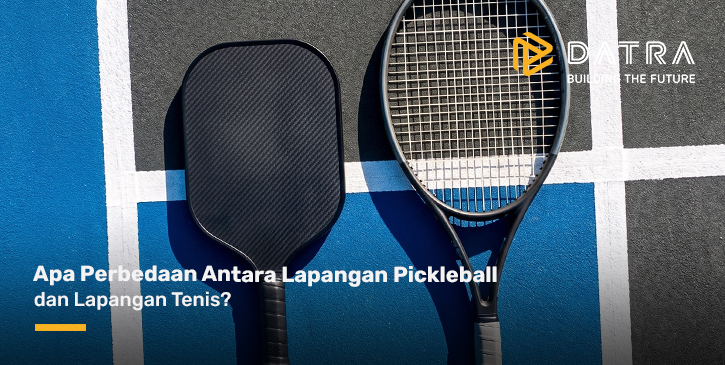
A facility planning guide for Indonesian investors, property developers, schools, and sports venue operators — written with four decades of court-building experience across Indonesia.
Pickleball arrived in Indonesia quietly. A few years ago it barely registered in conversation. Today, venue owners in Jakarta, Surabaya, and Bali are fielding the same question almost weekly: can we add pickleball courts to our facility? Or its variant: we have an existing tennis court — can we convert it?
These are reasonable questions, and the answers matter more than most people expect. Pickleball and tennis look superficially similar — a rectangular court, a net, a racket, a ball, and a set of lines. But the two sports have meaningfully different facility requirements, and the decisions you make when building or converting a court will affect utilisation, player experience, budget, and long-term return for decades. This guide covers everything you need to know before committing to either sport — or, increasingly, both.
The Number That Changes Everything: Court Size
This is where any honest comparison must begin. A standard tennis court is 23.77 metres long and 10.97 metres wide for doubles play — a total playing surface of approximately 261 square metres. When you add the required runback at each end (a minimum of 5.49 metres, with 6.4 metres recommended for competitive play) and the side clearance on each side (a minimum of 3.05 metres), the total land envelope for a single enclosed tennis court reaches roughly 34.75 metres by 17 metres, or about 591 square metres of ground area.
A pickleball court is considerably smaller. The official court dimensions per USA Pickleball and IFP standards are 13.41 metres long by 6.1 metres wide — a playing surface of approximately 82 square metres. With the recommended minimum clearance of 1.83 metres at each end and 0.91 metres on each side, the total ground envelope is roughly 17.07 metres by 7.92 metres, or around 135 square metres.
To put that in direct terms: you can fit approximately four pickleball courts into the total ground footprint of a single standard tennis court. This is the single most important fact for any facility planner to internalise, because it completely changes the economics of land use — particularly in Indonesian cities where land costs are significant.
A Side-by-Side Comparison of Court Specifications
Specification | Tennis (Doubles) | Pickleball |
Playing length | 23.77 m | 13.41 m |
Playing width | 10.97 m | 6.10 m |
Playing area | ~261 m² | ~82 m² |
Total ground envelope (with clearances) | ~591 m² | ~135 m² |
Net height at centre | 0.914 m | 0.864 m |
Net height at posts | 1.07 m | 0.914 m |
Net length | 12.8 m | 6.7 m |
Courts per tennis court footprint | 1 | 4 |
Ceiling height (indoor) | 8 m minimum | 6 m minimum |
The differences in net height are subtle but meaningful. Pickleball uses a net that is lower at the centre (0.864 m) than a tennis net (0.914 m). This is not interchangeable — using a tennis net on a pickleball court changes how the ball responds and compromises the game. If you are planning a multi-use space that hosts both sports at different times, you will need dedicated net systems for each sport, or adjustable net posts capable of holding both specifications.
Surface Requirements: Where the Specifications Diverge Most
Both sports are played on hard court surfaces — acrylic-coated asphalt or concrete is the global standard for outdoor play in both disciplines, and this is also where most Indonesian facilities are built. But the specifications within that broad category diverge in ways that matter.
For tennis, the International Tennis Federation (ITF) classifies court surfaces on a pace scale from 1 (slow) to 5 (fast). In Indonesia, the most common outdoor tennis surface is an acrylic hard court in the mid-range pace category. The surface must be durable enough to withstand the sliding, pivoting, and high-impact footwork that tennis generates across a large area. Products like the Greenset Grand Slam — an ITF-certified acrylic system with cork-based cushioning beneath the colour coat — provide the kind of shock absorption that protects joints during intensive play and tournament use. At the professional end, systems like Herculan TC Pro deliver a seamless, highly durable surface without joints that could affect ball bounce.
For pickleball, the surface requirements are similar in principle but different in practice. Because pickleball involves a harder composite ball (not a felt tennis ball), the surface texture matters enormously for consistent bounce. A surface that is too rough or too heavily textured slows the ball unpredictably. A surface that is too slick creates traction problems for players. The ITF and USA Pickleball both recommend a medium-textured hard court finish, and the most widely used international standard is an acrylic surface applied at a slightly finer grit than competition tennis.
One surface option that pickleball uniquely accommodates — and tennis does not — is modular interlocking sports tiles. Systems like the Datra Sports modular court surface allow pickleball courts to be installed over virtually any flat, compacted sub-base, including existing concrete, asphalt, or even well-prepared compacted soil, with no adhesive bonding required. This makes modular systems particularly attractive for venues that want pickleball capacity without committing to a permanent poured surface — a corporate campus that wants to convert a parking area on weekends, or a school that wants to mark temporary courts on an existing multi-sport area.
For venues that want both sports on the same surface — whether as shared use or as converted lines — an acrylic hard court system is the natural answer. The surface chemistry is compatible with both sports, and the only change between configurations is the net, the court lines, and the ball.
Lighting: More Courts Mean More Fixtures
Lighting design for a pickleball facility is not simply a scaled-down version of tennis court lighting. It is a different calculation entirely, and the difference matters for both budget and player experience.
A single tennis court of approximately 260 square metres requires a lighting system capable of delivering 300 lux for recreational play and 500 lux for competitive play across the full court area. Because the court is large and the ball travels fast over long distances — serves can exceed 200 km/h at professional level — the lighting design must eliminate shadows across a wide span and provide excellent vertical illumination so players can track the ball throughout its arc.
Four pickleball courts occupy roughly the same ground area as one tennis court, but each must be individually lit. The ball in pickleball is heavier, travels faster off the paddle, and is typically hit at a lower trajectory than a tennis ball — meaning the vertical illumination requirement is actually higher per unit area. USA Pickleball recommends a minimum of 200 lux for recreational play and 500 lux for competitive and televised events, with uniformity ratios (the ratio between the brightest and darkest points on the court) tightly specified.
In practical terms: a four-court pickleball facility requires more individual lighting poles or fixtures than a single tennis court, and the total installed cost of the lighting system may be comparable or higher despite the smaller total ground area. This is a calculation that frequently surprises venue owners who assume smaller courts automatically mean lower infrastructure costs. They do not — they mean more courts, and more courts mean more fixtures, more electrical capacity, and more cable runs.
In Indonesia, all outdoor court lighting must also account for the tropical climate: LED systems with IP65-rated waterproofing are the minimum requirement, and fixtures should be specified with heat tolerance for ambient temperatures that regularly exceed 35 degrees Celsius. Salt-air resistance is an additional specification requirement for coastal facilities in cities like Surabaya, Makassar, and Bali.
Indoor vs Outdoor: The Climate Question for Indonesia
This is a dimension of court planning that matters far more in Indonesia than it does in Europe or North America, and it deserves separate treatment.
Tennis has traditionally been an outdoor sport in Indonesia, and most existing tennis facilities are outdoor or semi-covered. The sport has a long enough rally time and slow enough pace of play that brief interruptions for weather are tolerable, and covered structures over tennis courts — while ideal — are expensive to build at the scale required.
Pickleball is considerably more weather-sensitive. The plastic composite ball used in pickleball is affected by wind in ways that a tennis ball is not — even a moderate breeze measurably changes ball trajectory and creates an inconsistent experience for players. Rain renders an outdoor pickleball court effectively unplayable. In Indonesia, where afternoon rain is a near-daily occurrence from October through April across most of the country, an outdoor-only pickleball facility faces genuine commercial risk: courts that sit empty during peak afternoon hours because of rain directly affect session booking revenue and member satisfaction.
The conclusion that serious operators are reaching is this: pickleball in Indonesia is best built with cover as a baseline expectation, not an upgrade. A steel roof structure over four pickleball courts adds meaningful cost — typically between IDR 200 million and IDR 500 million depending on span, design, and materials — but it is a cost that pays for itself in operational days gained across the rainy season.
For indoor courts, the ceiling height requirement of 6 metres minimum (compared to 8 metres for tennis) means that pickleball can fit into existing covered structures that are too low for tennis — a category that includes many corporate building basements, warehouses converted for sports use, and existing multi-purpose halls. This opens a range of building types for pickleball conversion that tennis cannot access, and it is one reason why pickleball has spread rapidly into corporate and residential building amenity programmes across Indonesian cities.
Converting a Tennis Court to Pickleball: What It Actually Involves
The most common question Datra receives on this topic is also the most practically urgent one: we have an existing tennis court — what does it take to convert it?
The answer depends on what you want to achieve and how thoroughly you want to do it.
At the most basic level, a tennis court can be marked with pickleball court lines and fitted with portable pickleball nets to create a playable pickleball court immediately. A standard doubles tennis court can accommodate two pickleball courts side-by-side without any structural modification. The lines are simply painted or taped over the existing surface. The nets are wheeled in and out as needed. Total cost: modest. Result: functional, though not optimal.
The complication is that dual-use courts with overlapping line systems become visually confusing. Players — particularly beginners — struggle to distinguish the active court lines from the inactive ones. A multi-coloured line system (tennis lines in one colour, pickleball lines in another) solves the visual problem but requires careful resurfacing to maintain a clean finish, and it still leaves the courts feeling like a compromise rather than a purpose-built experience.
The higher-quality conversion involves resurfacing the tennis court with a fresh acrylic coat in a neutral base colour, then marking the pickleball courts cleanly in their own colour system, with tennis lines either eliminated or retained in a clearly subordinate colour. If four pickleball courts are being marked onto one tennis court, the entire court area will be used, and the resulting product — while technically "converted" — looks and plays like a purpose-built pickleball facility.
The sub-base condition of the existing tennis court is the critical variable in all of this. Acrylic surfaces applied over cracked, uneven, or delaminated concrete will fail within twelve to eighteen months regardless of product quality. If a tennis court is being converted for a serious commercial pickleball programme, the sub-base should be assessed — and where necessary repaired — before the new surface is applied. Datra's team conducts sub-base assessments as part of the conversion planning process and can advise on whether the existing foundation is adequate for a long-life resurfacing, or whether more significant remediation is required first.
Building New: Pickleball Courts from the Ground Up
For venues that are starting from scratch, the construction sequence for pickleball courts is broadly the same as for any outdoor hard court: sub-base preparation and compaction, reinforced concrete slab, waterproofing where applicable, acrylic surface system application, line marking, net and post installation, and lighting.
The sub-base is, as always, where the long-term quality of the court is determined. A concrete slab for pickleball courts must be level to within 3 millimetres over any 3-metre span — a tighter tolerance than many general contractors appreciate. Improper slope affects drainage and creates puddles that accelerate surface degradation and create slip hazards. Curing time must be respected before any surface system is applied. These are not optional standards. Facilities that economise on sub-base specification almost invariably regret it.
For a new four-court outdoor pickleball facility with basic covered structure and LED lighting, the total investment range in Indonesia currently sits between IDR 800 million and IDR 2.5 billion, depending on site conditions, roof design, surface specification, fencing, and finishing. The widest variable is civil works: a facility built on a well-prepared flat site costs significantly less than one requiring ground-levelling, drainage engineering, or structural footings for challenging soil conditions.
Indoor pickleball — retrofitting four courts into an existing building — is typically less expensive on civil works and more expensive on ventilation and lighting, since indoor environments require mechanical airflow and more precisely engineered lighting systems than outdoor courts.
The Economics of Pickleball vs Tennis in Indonesia
The commercial case for pickleball over tennis in the Indonesian market currently rests on three structural advantages: density, accessibility, and growth momentum.
Density is the clearest. Four pickleball courts generate four simultaneous revenue streams from the same ground area that one tennis court generates one stream. At a typical session rate of IDR 100,000 to IDR 200,000 per person per hour, and with four players per court, a four-court pickleball facility can gross IDR 400,000 to IDR 800,000 per hour at full occupancy. A single tennis court at comparable session rates — typically IDR 150,000 to IDR 300,000 per hour for the court — generates less revenue per square metre at equivalent utilisation.
Accessibility matters because pickleball has a gentler learning curve than tennis. A beginner can have a genuinely enjoyable game within their first session; tennis typically requires weeks of coaching before recreational play feels rewarding. This means pickleball venues can attract and retain a broader participant base, including older adults and corporate wellness programmes, that tennis venues often struggle to serve.
Growth momentum is harder to quantify but very real. In major Indonesian cities, pickleball court bookings have shown consistent growth for three consecutive years. Tennis, while still a significant market, is a mature one. Pickleball is still in its expansion phase in Indonesia — and for venue operators, it is generally better to build in the expansion phase than after saturation sets in.
That said, the risk of building a facility that relies entirely on pickleball's growth trajectory is also real. The sport is growing, but it is not guaranteed to maintain its current growth rate. The most commercially resilient approach — and the one Datra consistently recommends to venue operators thinking carefully about this decision — is a diversified court system that accommodates multiple sports from the same footprint. A facility designed with dual-purpose courts, proper line systems, and interchangeable net equipment can host pickleball today and pivot to a different sport mix tomorrow without structural investment.
What to Demand from Your Court Contractor
Whether you are converting an existing tennis facility or building pickleball courts from the ground up, the quality of the contractor relationship will determine whether the facility performs as planned — or becomes an expensive problem within its first three years.
The questions worth asking before signing any contract are these. Does the contractor have direct experience building courts for the specific sport, not just general construction experience? Can they produce documented case studies of completed pickleball or tennis court projects, with references from facility operators who can speak to the surface condition two to three years post-installation? Do they understand the sub-base specification requirements, and will they provide a written surface levelness guarantee before resurfacing? Are the surface systems they propose internationally certified — ITF for tennis, USA Pickleball or equivalent for pickleball — or are they proprietary systems without independent performance verification?
The detail that separates a performing facility from a regretted one is almost never visible to the naked eye on the day of handover. It lives in the sub-base preparation, the surface thickness and cure, the drainage slope, the fixture anchoring, and the quality of the line marking. The cheapest contractor on paper is rarely the cheapest contractor over the life of the facility.
Datra's team has been building and restoring tennis courts across Indonesia since 1981 — including full tennis court systems at The Pakubuwono Residence and the Komplek Stadion Kebun Bunga in Medan — and has delivered pickleball and padel court systems for commercial venues including Sampoerna Strategic Square, where a Spanish professional coach assessed the completed facility as a ten out of ten. That combination of long experience with tennis courts and direct execution capability on new-format court sports gives Datra's team an unusual ability to advise on both conversion and new-build scenarios with firsthand knowledge rather than estimation.
The Practical Checklist Before You Decide
Before committing to either a new-build or a conversion, five questions are worth answering clearly.
First: who is the primary user, and what is their experience level? A corporate amenity programme serving first-time players needs different specifications from a competitive training facility.
Second: how much land is available, and what is its current condition? The sub-base under an existing surface, and the soil conditions beneath a new build, are the most important variables in determining both cost and long-term quality.
Third: will the facility be indoor, outdoor, or covered? In Indonesia's climate, the answer to this question has a larger effect on revenue potential than almost any other single decision.
Fourth: what is the revenue model — court hire, membership, coaching, events, or a combination? Each model implies different court quantities, lighting levels, ancillary facilities, and booking system requirements.
Fifth: what is the realistic budget, and has it been tested against actual contractor quotes rather than estimated from online sources? Court construction costs in Indonesia vary enormously by location, site conditions, and product specification. A detailed scope review with a contractor who has delivered comparable projects is the only reliable way to establish a budget that will not collapse during execution.
A Note on the Broader Opportunity
The most interesting conversations happening in Indonesian sports facility planning right now are not about choosing between pickleball and tennis. They are about designing facilities that accommodate both — and badminton, and futsal, and padel — within a single coherent investment.
A well-designed multi-court outdoor facility in Indonesia, built with quality acrylic surfaces, covered structure, proper lighting, and interchangeable net systems, can genuinely serve all four of these sports from the same physical space. The line systems are colour-coded. The nets are changed in under five minutes. The booking calendar rotates between sport types by day or hour. The result is a facility that maximises asset utilisation, hedges against any single sport's demand fluctuation, and serves a far broader community than any single-sport facility could reach.
This is the direction the most sophisticated Indonesian facility operators are moving — and it is a direction that Datra is well-positioned to help plan, specify, and build. The team's four-decade track record across venue types from national stadiums to school gyms to residential sports amenities means that the advice you receive reflects experience across the full range of scenarios, not theoretical principles applied to a situation that has never actually been built.
Ready to Plan Your Court?
If you are planning a pickleball facility, a tennis court conversion, or a multi-sport complex anywhere in Indonesia — or if you simply want to understand what a realistic budget and timeline look like for your specific situation — the most useful starting point is a direct conversation with people who have done it before.
Datra's team offers an initial consultation at no cost. The conversation typically covers your site conditions, your user profile, your revenue model, and what a realistic budget should include. It is not a sales presentation. It is a planning conversation, and most operators find it significantly clarifies their thinking before they commit to anything.
Contact Datra at sales@datra.id, via WhatsApp at 0811 1061 6565, or visit www.datra.id to explore completed projects and product systems.
Datra has delivered sports facility projects across Indonesia since 1981, including Indonesia Arena (FIBA World Cup 2023), Gelora Bung Karno (Asian Games 2018), Jakarta International Stadium, the Jakarta International Wall Climbing Park (the largest IFSC-certified facility in Southeast Asia), The Pakubuwono Residence tennis courts, Sampoerna Strategic Square padel courts, and multi-sport facilities for The British School Jakarta, Sekolah Pelita Harapan, and the Pusat Pelatihan Olahraga Pelajar at Ragunan. PT Datra Internusa handles large-scale and complex projects. Datra Sports serves smaller venues, schools, and faster-turnaround needs across the country.
Related Blogs
FIBA-Standard Basketball Flooring: Why Wood Is the Standard, and How Junckers Meets It
Sports
October 14, 2026

World Athletics Standard Running Track: The Complete Guide to Specifications, Construction, and Certification
Education, Sports
July 22, 2026
Complete Volleyball Court Guide: FIVB & PBVSI Standards for Indoor and Outdoor Courts
Education, Sports
July 16, 2026
