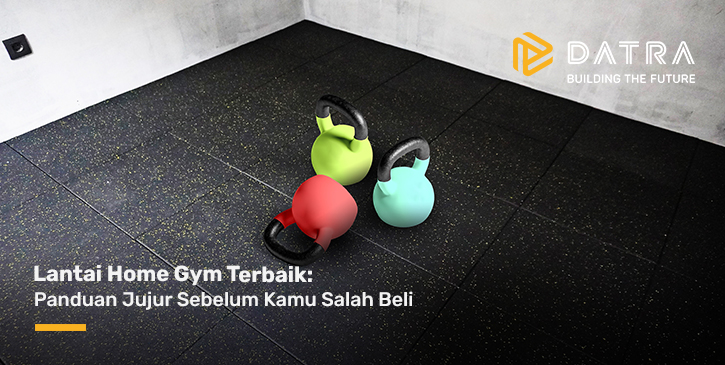
The Best Home Gym Flooring: An Honest Guide Before You Buy the Wrong Thing
Lifestyle, Sports
May 11, 2026
By the Datra Sports team — Indonesia's sports flooring specialists
You already have the space. Maybe a spare bedroom, an idle garage, or a corner of the house that's been used as storage for years. Now it's time to turn it into a home gym.
The first thing most people do? Go straight to an e-commerce site or ask in a WhatsApp group.
But there's one question that needs to be answered first — and almost everyone skips it:
What activities will you actually do in that space every week — honestly, not ideally?
Not what looks good on Instagram. Not what's in the training program you've never actually followed. What will genuinely happen there, every week, over the long term.
That answer is what every flooring decision should be based on. And most people do it completely backwards.
The First Mistake: Thinking "Gym Flooring" Is One Category
It isn't.
Gym flooring is not just a product. It's a performance system. The right floor affects your safety, joint longevity, equipment lifespan, room noise levels, and — subtly but genuinely — the quality of every training session you put in there.
The second common mistake: assuming you can just lay a mat or gym carpet over whatever flooring is already there. Sometimes you can — but in many cases, you ideally want to start with a clean, dry, level concrete surface before installing any gym flooring at all. Skip that step and the problems show up a few months later.
Home Gym Flooring Options: Which One Is Right for You?
Here's an honest breakdown of what's available:
Rubber tiles / rubber mats are the most common choice — and usually the most practical. Dense rubber withstands barbell impact, resists sweat and cleaning fluids, doesn't slip, and holds up for years with minimal maintenance. This is the most sensible starting point for most home gyms.
Foam mats / EVA mats are comfortable for floor exercises, yoga, or light training — but they compress over time under heavy equipment. Don't make this your only option if you have fitness machines or barbells.
Sports vinyl delivers a cleaner, more professional look with solid durability. Good for those who want the space to feel like a studio rather than a garage.
Wood flooring, particularly quality sports parquet, works well for spaces that also get used for dance, pilates, or mobility work. Pair it with rubber in the lifting area.
Epoxy over concrete is a functional budget option for those who like an industrial aesthetic. No impact cushioning, so all equipment still needs a mat underneath. Straightforward, honest, no pretension.
Polyurethane (SPU/PU) multisport is a seamless premium option — great performance, durable, professional finish. The tradeoff is a higher price point and minimum order requirements, which makes it less practical for small-scale home gyms.
Why Protective Padding Under Heavy Equipment Is Non-Negotiable
Skipping protection under barbells or fitness machines is one of the most expensive mistakes you can make. The damage isn't always immediate — sometimes it builds slowly, quietly, and by the time you notice it, it's too late.
Here's what actually happens when you skip it:
Immediate surface damage. Ceramic and granite tiles crack under heavy point loads. Parquet and laminate flooring develop permanent indentations under the feet of barbell racks or weight benches. This isn't an aesthetic issue — it often means replacing entire sections of flooring.
Wear from vibration. Treadmills, rowing machines, and stationary bikes generate constant micro-vibrations during use. Without a dampening layer, the machine effectively "walks" across the floor, grinding its base against the surface like sandpaper. More importantly: those vibrations feed back into the machine itself — loosening bolts, damaging electronic components, and shortening motor lifespan. The wrong floor can destroy equipment that costs far more than the flooring would have.
Structural stress. In garages, repeated impact from heavy deadlifts can eventually crack or chip concrete over time. On upper floors, the impact energy travels into the building frame — creaking floors and cracked ceilings in the room below are a classic sign of an under-protected home gym.
Moisture and chemical reactions. Some rubber equipment feet can react with polyurethane finishes on wood flooring, leaving permanent cloudy white stains. Sweat and lubricating oil absorbed into unprotected carpet or wood creates stains and odors that no cleaning product can fully remove.
Specific to Indonesia: What Foreign Guides Don't Cover
Most home gym flooring guides online are written for temperate climates. Indonesia is not that.
Heat and humidity affect every material differently. Moisture in the concrete sub-base — especially in garages where the slab sits close to the ground — can destroy adhesion, cause rubber to smell, and accelerate the degradation of any material regardless of how good the surface product is.
What to confirm before installing any gym flooring in an Indonesian home:
- Make sure the room has adequate air circulation — windows, ventilation, or air conditioning
- Make sure the concrete sub-base is dry with no moisture or seepage
- Don't install in flood-prone areas — not just for the flooring, but for all the equipment
- Plan your cleaning frequency, because tropical humidity accelerates the buildup of sweat and bacteria
None of this is dramatic. But this is exactly what separates flooring that lasts five years from flooring that starts failing at month eighteen.
Four "Force Profiles" That Determine the Best Floor for You
Here's the question that actually drives your flooring choice:
What kind of force will your body and your equipment put into the floor?
There are four distinct force profiles, and each requires a different floor response:
- Impact force (dropping force) — Weightlifting, deadlifts, Olympic lifting. You need density and impact resistance. Counterintuitively, a floor that's too soft is not ideal — it creates instability under the barbell and under your feet. For serious lifting, a dedicated platform with dense rubber zones is the right answer.
- Jump force (jumping force) — HIIT, plyometrics, functional training. You need impact absorption and reliable traction. Too hard and your joints absorb the load. Too soft and movement slows down or becomes dangerous on direction changes.
- Ground contact force — Yoga, pilates, mobility, stretching. You need comfort, cleanliness, and controlled grip for bare feet. Thick black rubber may technically work — but practically and psychologically it feels wrong for yoga. The floor is part of the experience, not just the mechanics.
- Falling and throwing force — Judo, BJJ, MMA, wrestling, martial arts. This is its own category. You need mats designed for human impact, not equipment impact. Rubber gym tiles are not a substitute for martial arts mats. This is a safety issue, not a preference.
Understanding which force profile applies to your training is the step that makes every subsequent decision easier and more accurate.
The Zone Approach: A Home Gym That Actually Works
The wrong floor doesn't always fail dramatically. Sometimes it fails slowly.
Lifts feel unstable. Knees ache after jumping. The mat starts to smell within a week. The room looks right but doesn't perform right. And gradually, training there becomes less and less appealing — without knowing why.
The best home gyms solve this by thinking in zones, not materials. Rather than covering the entire floor with one product and hoping it works for everything, the space is divided according to how it will actually be used.
Here's the practical sequence:
Step 1: Write down your real weekly training habits. Not the ideal ones. The ones that actually happen. Three days of lifting, two days of HIIT, daily stretching, kids using the room on weekends — whatever will genuinely take place. This tells you what the space actually needs.
Step 2: Rank activities by impact and risk. Your floor should be designed for the activities most likely to cause damage, injury, or noise — not the easiest ones. For most home gyms, the hierarchy is: dropping weights → martial arts/falling → jumping and HIIT → machines and racks → yoga and mobility.
Step 3: Divide the space into 2–4 zones. Usually no more than four are needed:
- Strength zone — barbell rack, bench, dumbbells, machines. Dense rubber, lifting platform, impact pad.
- Movement zone — HIIT, kettlebells, skipping, bodyweight training. Rubber roll or tile with impact absorption.
- Flow zone — yoga, stretching, pilates, warm-up and cool-down. A cleaner, more comfortable surface for bare feet, or a foldable mat system.
- Martial arts / kids zone — martial arts, rolling, play. Tatami, EVA, roll-out mats, wall padding if needed.
Step 4: Place zones based on logic, not aesthetics. Weightlifting near the most solid wall or the most structurally stable floor area. HIIT needs the most open space. Yoga in the quietest corner. Equipment storage near its corresponding zone. Mirrors help with movement form — they're functional, not decorative.
Step 5: Only then choose the flooring. Once the zones are clear, product selection becomes straightforward — and makes sense.
Rubber tiles are a product. Training zones are a solution. A well-designed home gym is a system.
How Much Does Home Gym Flooring Cost? Real Numbers, Not Vague Estimates
For home gyms, Datra Sports provides flooring that is available in stock, quick to install, and suited to smaller-scale projects.
Datra Sports Fitness Tile — dense granular rubber tile, 2cm thick, anti-slip, and high-performance under heavy equipment. Easy to install, removable if you ever need to move the space, and built for real training loads. Available in black and black-yellow speckle.
Price: from IDR 450,000 per m² (excluding VAT and shipping)
As a real-world reference:
Room Size | Estimated Flooring Cost | Total Setup Including Equipmentz |
|---|---|---|
20 m² (small) | ± Rp 9 juta | Rp 25–35 juta |
50 m² (medium) | ± Rp 25 juta | Rp 50–75 juta |
80 m² (serious) | ± Rp 36 juta | Rp 75–120 juta |
These are not cheap numbers. But a properly built home gym is an asset that lasts for years — a premium gym membership in Jakarta alone can run IDR 3–5 million per month. If you train consistently, this investment pays for itself faster than you'd expect.
For spaces that want a seamless, premium finish without joints, Herculan MF polyurethane is worth it — with the caveat that there is a minimum order and a higher price per square meter.
For spaces that also function as a yoga or movement studio, Datra Sports Vinyl delivers a cleaner aesthetic with solid durability.
If your home gym is on an upper floor and noise is a consideration — that's a separate conversation before you buy anything, because the subfloor strategy is different.
One Rule Before You Spend a Single Rupiah
Design the training first. Buy the floor second.
Ask yourself: what will genuinely happen in that space, every week, honestly? Identify the dominant force profile. Define the zones. Then let the product choice follow logically.
That's the difference between a gym you use for the next five years and one that starts feeling wrong within the first six months.
Want a Flooring Recommendation Tailored to Your Space and Training?
The Datra Sports team can help — even for a project as small as a single room. We have supplied and installed sports flooring from international stadiums to school gyms and private training spaces across Indonesia.
Tell us your room dimensions, your planned activities, and your budget range. We'll point you in the right direction — no pressure, no jargon.
→ Chat with Datra Sports on WhatsApp → Browse flooring products at datra.id
Datra Sports is the accessible product line of PT Datra Internusa — Indonesia's specialist in sports facility design, construction, and flooring, with projects including Indonesia Arena (FIBA World Cup 2023) and hundreds of venues across the archipelago.