
FIBA-Standard Basketball Flooring: Why Wood Is the Standard, and How Junckers Meets It
Construction, Sports, Stadium
October 14, 2026
By Datra Internusa, the official Junckers distributor in Indonesia, with hands-on experience installing international-standard sports flooring at landmark venues across the country.
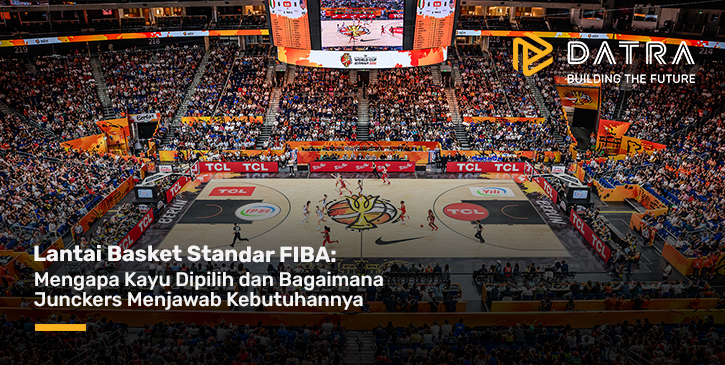
Every top-level basketball match depends on a court that performs the same way, point after point. One of the most important elements in that equation is the sports floor itself. At the FIBA Basketball World Cup 2023, part of which was held in Jakarta, the best players in the world competed on a wooden surface. That choice was not about aesthetics. It reflects the specific technical characteristics and requirements that high-level basketball demands of a floor.
For the architects, facility consultants, venue operators, property developers, schools, and government agencies planning a new basketball court or a renovation, the questions tend to be the same. Why is wood used at the highest level of competition? What does a basketball floor actually need to meet FIBA standards? And among the many sports flooring options available, why is Junckers so often part of the conversation for professional facilities?
This article looks at the foundation of any professional basketball court: its flooring system. We start with the technical reasons wood is used in basketball, move through the requirements for a FIBA-standard floor, and explain how professional sports flooring differs from conventional timber. Along the way, we cover fixed and portable systems, the factors worth weighing when choosing a wooden basketball floor, and how to identify a supplier capable of meeting both the technical and operational needs of a venue.
In Indonesia, Junckers systems are available through Datra as the Official Distributor of Junckers Sports Flooring. With extensive experience in sports flooring installation across various sports facilities, including Indonesia Arena for the FIBA Basketball World Cup 2023, Datra provides professional flooring systems tailored to the needs of sports facilities in Indonesia. Explore Datra’s track record through the Datra project portfolio.
Why FIBA Chooses Wood for Basketball Courts
The decision to use wood at the highest level of competition is grounded in engineering, not tradition or appearance. Hardwood combines a set of properties that are difficult for any other material to deliver at the same time. It is flexible enough to protect an athlete's body, rigid enough to return energy, stable enough to keep the surface consistent, and durable enough to last for decades with the right maintenance.
To understand why wood is so dominant, it helps to look at what a professional basketball floor is actually asked to do.
Balancing shock absorption and energy return
A good basketball floor has to absorb part of the impact when a player lands, so that joints and ligaments are not overloaded. At the same time, it needs to return enough energy for players to run, jump, and change direction responsively. A floor that is too hard is tiring and raises the risk of injury; a floor that is too soft wastes a player's effort.
A professional wooden flooring system resolves this tension by working as a single unit. The surface boards are supported by a resilient layer and a batten framework beneath them, so the whole structure flexes in a controlled way across a wide area when it takes a load. This property is known as area-elastic behaviour, and we explore it further in the section on floor requirements below.
Athlete safety and performance
Consistency is central to safety. A wooden surface installed with the correct system delivers uniform friction across the entire court, so players can rely on the same grip wherever they are. A surface that is too slick invites slipping, while one that is too grippy can catch the foot abruptly and strain the knee.
The ability of a wooden floor to flex also lowers the peak load on joints during repeated landings. For a sport built around jumping and rapid changes of direction, this has a direct bearing on long-term injury risk.
Consistent ball bounce
A basketball needs to rebound to a predictable height everywhere on the court. Sports flooring performance standards set a minimum ball-bounce threshold so that play stays fair and controlled. A professional wooden system is engineered to meet that threshold evenly, including over the resilient layer, so there are no dead spots where the bounce feels different.
Durability, maintenance, and broadcast value
A solid wood floor can be sanded and refinished many times over its service life, giving it an exceptionally long economic lifespan when properly cared for. The surface is also a visual medium: court lines, sponsor logos, and team branding render sharply on wood — one of the reasons internationally broadcast venues favour it.
Requirements for a FIBA-Compliant Basketball Floor
This is the heart of the question we are asked most often. A wooden floor does not automatically meet FIBA standards simply because it is made of wood. Compliance is determined by measurable system performance, not by the surface material alone.
International sports flooring performance standards are based on the European standard EN 14904, which tests a number of key parameters. FIBA then assigns competition-level classifications to floors that meet specific requirements. The most decisive parameters are the following.
Shock absorption (force reduction). Measures how much impact energy the floor absorbs compared with a rigid surface such as concrete. The higher the value within the required range, the better the protection for the athlete.
Vertical ball behaviour (ball bounce). Measures the rebound height of a ball on the sports floor compared with concrete. The standard sets a minimum threshold to keep the bounce consistent and fair.
Vertical deformation and area-elastic behaviour. Measures how far and how widely the floor flexes under load. An area-elastic floor deflects across a broad area around the point of impact, distributing energy evenly. This characteristic is precisely what makes it the first choice for professional basketball.
Surface friction (slip). Measures the grip of the surface so that it is neither too slippery nor too resistant. Friction values must sit within a safe and uniform range.
Area-elastic versus point-elastic
Two categories of sports flooring are worth understanding. Area-elastic systems flex across a wide area — characteristic of professional wooden floors — and suit sports with high dynamic loads, such as basketball. Point-elastic systems flex only at the point of contact and are more common in synthetic floors. For competition-level basketball, the area-elastic behaviour that wooden systems provide is the primary benchmark.
What the FIBA competition levels mean
FIBA classifies sports floors into several competition levels. Understanding these levels helps facility owners match their investment to what they actually need.
FIBA Level | Typical use |
Level 1 | The highest international and professional competition, including international broadcast |
Level 2 | National competition and professional clubs |
Level 3 | Regional competition, training, schools, and community facilities |
A Wooden Basketball Floor Is a System, Not Just a Species of Wood
The most common mistake in procurement is judging a basketball floor by its wood species alone. In reality, performance is determined by the entire system — from the subfloor, resilient layer, and battens through to the surface boards and finish. Choosing a basketball floor means choosing an integrated system, not a single sheet of timber.
Conventional wood flooring versus a professional sports flooring system
Aspect | Conventional wood flooring | Professional sports flooring system |
Design purpose | Aesthetics and general use | Measurable sporting performance |
Structure | Boards over a simple frame | Layered system with engineered resilient layer and battens |
Shock absorption | Not purpose-designed | Engineered to meet the standard threshold |
Ball bounce | Not guaranteed | Tested and consistent |
Certification | Generally none | EN 14904 and FIBA level |
Sporting lifespan | Limited | Long, and refinishable |
Fixed versus portable wooden basketball flooring
Wooden basketball floors come in two main forms. The choice between them depends on how the venue is used, not on which is superior in absolute terms.
Aspect | Fixed (permanently installed) | Portable (demountable) |
Installation | Permanent, over a subfloor | Panels assembled and dismantled |
Best suited to | Dedicated basketball venues | Multipurpose venues and travelling tournaments |
Installation time | Longer, one-time | Fast and repeatable |
Spatial flexibility | Low | High |
Storage | Not required | Requires racks and storage space |
Example use | School and permanent club gyms | International tournaments and multipurpose arenas |
A competition-grade portable floor may look like a simple set of panels, but it carries the same serious engineering as a permanent installation. Modern panels are designed to be lightweight and quick to assemble while still meeting the same performance thresholds as a fixed floor.
How to Choose the Best Wooden Basketball Floor
When a facility owner goes looking for the "best" brand of wooden basketball flooring, the more useful question is really: which system is the right fit for your competition level, your venue's function, and your budget — with evidence you can verify? The following factors determine the quality of a wooden basketball floor.
System completeness and control. A manufacturer that controls every component of the system — surface boards, resilient layer, battens, and finish — can guarantee consistent performance. A system assembled from mismatched components with no single point of control risks inconsistency.
Verifiable certification. Confirm that the system holds EN 14904 certification and a clear FIBA level classification, backed by documents you can check. Avoid verbal claims with no supporting evidence.
Material stability. The wood species and drying method affect how dimensionally stable the boards remain as humidity changes — a particularly relevant consideration in Indonesia's humid climate.
Certified surface finish. The surface coating determines friction, durability, and appearance. A finish tested for sport delivers grip that is both safe and consistent.
Service support and warranty. Competition-grade floors require precise installation and periodic maintenance. A manufacturer and distributor that provide end-to-end service, from site survey through to after-sales support, offer long-term assurance.
Alignment with competition level. Not every venue needs Level 1. Choosing the right level avoids both over-investment and under-specification.
Junckers Pro Complete 44: A FIBA-Standard Wooden Basketball Floor
With the technical requirements in mind, the practical question becomes straightforward: which system has proven it can meet all of them on the biggest stage? This is where Junckers Pro Complete 44 serves as the reference point.
Junckers is a Danish manufacturer of solid wood flooring and is the Official Technical Supplier and Global Supplier of wood flooring to FIBA for the 2021–2028 period. In other words, Junckers flooring is trusted to serve as the official floor at the world's most prestigious basketball tournaments. The system supplied for those tournaments is Pro Complete 44.
A track record on the world stage
Pro Complete 44 has been used at some of the world’s leading international basketball events, including the Olympic Basketball Tournaments in Paris 2024, the FIBA Basketball World Cup 2023 in Manila, Okinawa, and Jakarta, FIBA EuroBasket 2022, and FIBA EuroBasket 2017. As part of Junckers’ latest partnership with FIBA, the system was also used at FIBA EuroBasket 2025 and the FIBA Women’s Basketball World Cup 2026 in Berlin, Germany. Junckers’ partnership with FIBA continues through 2028.
This track record demonstrates how Pro Complete 44 has been used across international basketball competitions where high performance is essential. For venue owners, developers, educational institutions, and sports facility operators in Indonesia, this experience can be an important consideration when selecting a sports flooring system for professional basketball facilities.
Pro Complete 44 technical specifications
Parameter | Specification |
Type | Portable sports floor, demountable panels |
Surface | 22 mm solid hardwood (beech, Junckers press-dried) |
Construction height | 44 mm |
Substructure | Birch batten framework with soft polyurethane foam as the resilient layer |
Reinforcement | Aluminium-reinforced panel edges |
Joints | Longitudinal tongue and groove, loose tongue at the ends, locked with a metal bracket |
Installation option | CenterRow panels for faster two-directional installation |
Performance | Area-elastic to EN 14904 class A4 and FIBA Level 1 |
Finish | Junckers HP800 Sport, a FIBA-certified high-performance polyurethane lacquer (available in Ultra Matt, Matt, and Silk Matt) |
Why Pro Complete 44 meets the FIBA requirements
Every element of the system answers the floor requirements set out earlier. The combination of solid wood boards, a birch batten framework, and a resilient foam layer produces area-elastic behaviour with shock absorption and ball bounce that meet FIBA Level 1. Lightweight panels and a precise locking system allow fast installation without compromising performance, making the floor well suited to multipurpose venues and travelling tournaments alike. The FIBA-certified HP800 Sport finish ensures surface friction that is safe and consistent.
For the sake of technical honesty, it is worth noting that Junckers' entire range of sports flooring systems is FIBA-accredited for competition Levels 1, 2, and 3. Alongside Pro Complete 44 for top-tier portable needs, then, there are other systems available for different requirements and budgets. The right choice depends on how your venue is used.
One-stop service, fast installation, and custom branding
At international events, Junckers works as a single-source provider. They recommend suitable portable flooring options, install the complete system with lines and logos to the event's branding, and dismantle it again once the tournament ends. To give a sense of scale, the FIBA Basketball World Cup 2023 and FIBA EuroBasket 2022 each used around 3,700 square metres of Pro Complete 44 together with 500 litres of Junckers line marking.
Court lines and logos are prepared in advance at the factory and then assembled quickly on site, ready for play. This approach allows the surface to be fully customised with sponsor branding, so the floor doubles as a visual stage for an event without slowing installation.
Because it is made of solid hardwood, a single set of Pro Complete 44 can be installed and dismantled repeatedly — a sensible choice for temporary arenas and for venues that change function. For portable flooring, Junckers provides a 10-year warranty.
Choosing an Indoor Basketball Flooring Contractor and Supplier
Selecting the contractor is as important as selecting the flooring system. A product that meets specification still depends on proper subfloor preparation, installation, finishing, and quality control for its performance to be realised in a given facility.
For that reason, do not compare on price per square metre alone. Evaluate technical competence, system specification, scope of work, project experience, and post-installation service as well.
Questions to ask a contractor
- Does the flooring system offered hold a FIBA classification or approval that can be verified?
- Does the contractor handle the full scope of work, from subfloor preparation through to finishing, or only part of it?
- What is the procedure for moisture control and subfloor preparation before installation?
- What is the scope and duration of the warranty, both from the manufacturer and from the installation provider?
- Is maintenance and refinishing available once the project is complete?
- Can the contractor demonstrate a track record on projects with similar systems and requirements?
Common procurement mistakes
- Judging a floor on price per square metre alone, without accounting for performance and service life.
- Overlooking subfloor condition and moisture control, both of which affect the stability of a wooden floor.
- Treating ordinary wood flooring as equivalent to a tested, approved sports flooring system.
- Choosing a system with a classification that does not match the facility's needs.
- Separating product supply from installation services without clear accountability for the final result.
Datra: The Official Junckers Distributor in Indonesia
Choosing the right basketball flooring system needs to be followed by the right procurement and installation process. The performance of a sports floor is determined not only by the material but also by subfloor preparation, installation accuracy, finishing, and maintenance throughout its service life.
As the Official Distributor of Junckers Sports Flooring in Indonesia, Datra provides support from needs consultation and site survey through to material supply, installation, and line marking. This approach helps coordinate the product and installation work in line with both the system specification and the facility's requirements.
Junckers project experience in Indonesia
Datra's experience delivering Junckers sports flooring projects spans a range of facilities with different needs, including:
- Indonesia Arena, Jakarta — a FIBA Basketball World Cup 2023 venue
- Dewa United Arena, Tangerang
- Mahaka Square, Jakarta
- RGE Community Center (RGE CC), Riau
- PT Pupuk Kaltim, Kalimantan
This record reflects Datra's experience in delivering Junckers sports flooring systems for a variety of facility needs across Indonesia. For further documentation and project information, visit the Datra projects page.
Installation, cost, and maintenance
Stages and quality control. A well-executed indoor basketball floor installation follows a controlled sequence: consultation and planning aligned to the target competition level; subfloor preparation and inspection; moisture control; installation of the flooring system; line and logo work; and a final inspection before handover. Each stage should be accompanied by quality-control documentation so that the promised performance is genuinely measurable on site.
Factors that affect flooring cost.
Factor | Effect on cost |
Target competition level | The higher the level, the tighter the specification and the higher the cost |
Fixed or portable system | Affects material, installation method, and storage requirements |
Initial subfloor condition | A problematic subfloor adds preparation work |
Floor surface area | Determines material volume |
Finish and branding choices | Lines, logos, and specialised coatings add cost |
Service and warranty | Comprehensive service and warranty affect long-term value |
Build Your FIBA-Standard Basketball Court with Datra
A good basketball court is more than the place where a match happens. It is where athletes test their abilities, teams build their chemistry, and defining moments are made. Every decision that goes into building one, including the choice of flooring system, is therefore an investment in the quality of play over the long term.
With Datra, you can plan a basketball flooring system suited to your facility's needs, usage intensity, and the character of your venue, with official access to the full range of Junckers Sports Flooring solutions and local technical support from planning through to installation.
Because the right court does not only support today's game. It becomes part of a sporting story that unfolds over many years.
Discuss your project plans with the Datra team at sales@datra.id or via WhatsApp.
Related Blogs
FIBA-Standard Basketball Flooring: Why Wood Is the Standard, and How Junckers Meets It
Construction, Sports, Stadium
October 14, 2026
World Athletics Standard Running Track: The Complete Guide to Specifications, Construction, and Certification
Construction, Sports
July 22, 2026
Complete Volleyball Court Guide: FIVB & PBVSI Standards for Indoor and Outdoor Courts
Construction, Sports
July 16, 2026
