
How Much Does It Cost to Build a Padel Court in Indonesia? An Honest Guide for 2026
Construction, Sports
May 11, 2026
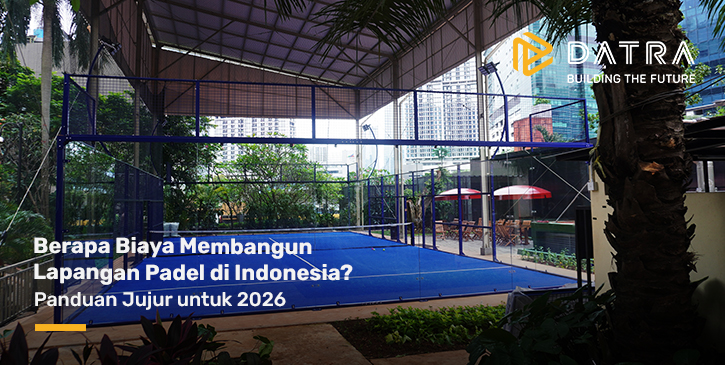
From the team that built five panoramic courts at Sampoerna Strategic Square — rated 10 out of 10 by a professional coach from Spain.
If you've been searching for this information and keep ending up with numbers too vague to actually use, you're not alone. Most padel court cost guides in Indonesia are written by suppliers who want to sell a product, or manufacturers who want to ship a unit. This guide is different.
We are a team with over 40 years of direct involvement in the planning, procurement, and construction of sports facilities in Indonesia — from school courts in regional cities to international-standard arenas that have hosted FIFA World Cup and FIBA events. And we have built padel courts across multiple cities, from central Jakarta to North Sulawesi.
What we'll give you here are real numbers. But more importantly, we'll give you honest context — including warnings that almost no supplier will ever tell you about the current state of Indonesia's padel market.
The First Mistake: Thinking You Only Need to Buy the Court
When someone contacts us about building a padel court, there is almost always the same pattern: they have budgeted for the court structure, but forgotten everything else.
The padel court system — the steel frame, tempered glass panels, synthetic turf, and lighting — is the visible part of the investment. It's the most heavily advertised, often at prices that look very affordable. But the court system is almost never the largest cost in a padel project.
The building itself, civil works, site preparation, drainage, supporting facilities — changing rooms, reception area, parking, an F&B space that makes the venue worth staying in beyond just playing — that is what determines the real budget.
A client who budgets IDR 600 million thinking that's enough to build a padel facility has, in reality, only budgeted for the court kit itself. Once you add the sub-base, concrete work, drainage, a roof or cover structure, supporting infrastructure, and any amenity space — a single court in the context of a real venue almost never comes in below IDR 1.5 to 2 billion in total. A four-court commercial venue in Jakarta — one that can realistically generate the returns you're imagining — should be planned in the range of IDR 6 to 12 billion or more, depending on site conditions, build quality, and the kind of experience you want to create.
These numbers are not meant to discourage you. They are meant to protect you from a project that runs out of money at the worst possible moment.
The Real Cost Breakdown
Here is an honest breakdown of what makes up the total investment in a padel facility in Indonesia.
The Court System (Structure, Glass, Turf, Lighting)
For a single panoramic padel court — now the modern standard, with full glass walls at the back and minimal structural obstruction — you're looking at a range of around IDR 450 million to IDR 800 million for the court kit alone, depending on product tier, material quality, and whether lighting is included.
The lower end of this range gets you a locally made semi-panoramic court with 10mm glass and standard turf. The mid-tier — where most serious commercial operators in Indonesia sit — delivers a full panoramic court with hot-dip galvanized steel structure, 12mm tempered glass, quality monofilament synthetic turf, and a proper LED lighting package. The upper end represents European-imported courts built to tournament specification.
The most important thing to understand about this range is not the price — it's what the price difference actually buys. Steel quality, coating thickness and type, glass specification, turf fiber system, and installation method are not cosmetic differences. In Indonesia's tropical climate — high humidity, high UV exposure, salt air in coastal cities — a court built with ungalvanized steel or untempered glass will show serious problems within two to three years.
On the glass: there have been actual injury incidents at padel courts in Indonesia caused by the use of glass that was not properly tempered. Tempered safety glass is not an option. It is a non-negotiable baseline.
Civil Works and Sub-Base
The foundation and sub-base can account for up to 50% of total project cost if you are building on a new site or challenging ground conditions. Reinforced concrete slab, proper drainage gradients, waterproofing — all of this is critical to the performance and longevity of the court system above it. If you are converting an existing tennis court or a well-prepared hardcourt, civil works costs drop significantly. If you are starting from raw land or difficult tropical soil conditions, budget for this from the very beginning.
Roof or Cover Structure
An outdoor padel court without a roof in Indonesia faces a real problem: rain. Heavy and frequent. A court without weather protection will lose a significant portion of bookable hours during the rainy season, which directly cuts into revenue. A proper roof or canopy structure — one that adds character to the venue rather than looking like an afterthought — adds IDR 500 million to IDR 1.5 billion depending on scale, but materially changes the commercial viability of the venue.
Supporting Facilities
This is what transforms a padel court into a padel destination. Changing rooms, showers, reception and lounge area, F&B space, parking, and adequate signage. Research from Deloitte found that 57% of padel players consume food or drinks after playing. Players who stay and spend are players who come back. A venue that provides nowhere to sit after a match is leaving money on the court.
Three Tiers of Padel Courts — Simplified
Indonesia's market is flooded with padel court options from local manufacturers, Chinese factories, and European importers. We have visited, audited, and validated our suppliers across these tiers, and we deliberately simplify the choice for clients — rather than overwhelming them with options. Here is how we see it.
Budget Tier (Local Fabrication) Locally made courts use standard steel and 10mm glass. Lower upfront cost, but galvanization quality is typically lower and structural lifespan is shorter in tropical conditions. Suitable only for low-load indoor environments where cost is the primary constraint.
Mid-Premium Tier (Chinese Import — Our Recommended Starting Point) This is where most serious commercial padel venues in Indonesia operate. Full panoramic design, hot-dip galvanized steel structure, 12mm tempered glass, quality monofilament turf, and proper LED lighting. These courts are manufactured to international standards — some are even exported to Europe — and their performance is not far behind Spanish-made products, at a significantly more accessible price point.
This is what we used at Sampoerna Strategic Square. A professional coach from Spain who led coaching sessions at the venue gave an unsolicited verdict: the installation quality, the precision of every technical element, ten out of ten. Better, he said, than anything he had seen in Spain. Those courts were built to world-class standards without requiring a European import budget.
Premium Tier (Spanish or European Import) The choice for flagship venues, tournament centers, and luxury hospitality projects where court credentials are part of the brand proposition. These courts carry FIP certification and long-term structural warranties. The cost is substantially higher, accounting for shipping, import duties, and European brand premium. For the right project, that investment is justified. For most commercial operators in Indonesia today, it is not necessary to achieve excellent results.
What People Frequently Forget (and What Derails Projects Mid-Build)
Based on our experience across many projects, here are the items most often underestimated or left out of the initial budget entirely:
- Permits and building approval (IMB) — in many cities, this process takes longer and costs more than expected, especially for venues operating in residential or mixed-use areas
- Electrical installation and lighting — an adequate power network for four LED-lit courts is not a minor undertaking
- Drainage and water management systems — particularly critical in Jakarta and cities with high rainfall
- Signage, branding, and fit-out — a venue that looks serious requires a serious visual investment
- Contingency buffer — construction projects in Indonesia almost always encounter unexpected variables. A budget without a 10–15% buffer is an unfinished budget
The Current State of Indonesia's Padel Market: Honestly
We won't hide it: Indonesia's padel market is in a phase that requires more caution than before.
A 295% growth in the number of clubs in a single year — as documented by the Indonesia Padel Report 2025 — is a remarkable figure. But growth of that kind is almost always followed by a correction. And that correction has already started to be felt in Jakarta and other major cities: venues closing, operators failing to break even, courts built without proper permits now facing legal problems.
What survives — and what will continue to grow — are venues built on real community, not on a passing trend.
Indonesia is not Sweden and it is not Denmark — the climate, culture, and market dynamics are different. But the underlying principle is universal: padel venues built on community will outlast those built on momentum by a wide margin.
What Does a Sustainable Padel Investment Look Like?
Based on global best practices and our direct on-the-ground experience in Indonesia, here is what we advise clients who are serious about building something that lasts.
Start with location, not the court. Your venue needs to be reachable as part of your target players' daily or weekly routine — not a destination that requires a special trip. Proximity to where players live, work, or already go for fitness matters far more than address prestige.
Plan for community from day one. Hourly court rental is a starting point, not a business model. Successful venues combine tiered memberships (which generate predictable monthly revenue), coaching programs for all levels, regular leagues and social sessions, and physical spaces that keep people on the premises longer than their booking. Global research consistently shows that 20–35% of a successful padel venue's revenue comes from non-rental sources — coaching, F&B, events, sponsorship.
Size your investment to demand you can verify, not demand you're hoping for. Build two to four courts initially. Prove the utilization. Grow from a position of confirmed success, not trying to justify an oversized initial investment. A four-court venue running at 70% utilization is far more valuable than an eight-court venue at 40%.
Don't choose the cheapest, but don't choose the most expensive either. The sweet spot for most Indonesian operators is a mid-tier panoramic court with proper galvanization, 12mm tempered glass, and quality turf — built and installed correctly. This protects your players, your investment, and your reputation. The quality gap between this tier and European imports is small. The price gap is large.
Think about what happens to this space in year five. The most durable padel venues are designed with flexibility — courts that can accommodate other sports or activities, spaces that can be used for events, layouts that allow for expansion or reconfiguration as the market evolves. Your exit options matter even before you open.
The Sampoerna Strategic Square Project: What It Took
When Sampoerna Strategic Square — a premium commercial complex in the heart of Jakarta — decided to transform its green area into a sports destination, the brief looked straightforward. The challenges were not.
They started with one court. The site had a complex garden landscape, a limited footprint, and a requirement for all-weather playability. We delivered an end-to-end solution: precision sub-base engineering, measured gradients and drainage, a roof design that added character to the venue rather than compromising its function. The court was built using the Datra Sports panoramic system.
Its commercial performance exceeded expectations. And when the client brought in professional coaches from Spain to run coaching sessions, one of them gave unsolicited feedback: the installation quality, the precision of every technical element, was ten out of ten. Better, he said, than anything he had seen in Spain.
The client immediately ordered four more courts.
Five panoramic courts now stand at one of Jakarta's most premium addresses. Built to world-class standards. Without requiring a European import budget.
One Honest Piece of Advice
If you are seriously considering building a padel court in Indonesia right now, here is what we will say before anything else: be careful about your location and your timing.
The padel boom in Indonesia's major cities has already been followed by a correction. Courts have closed. Many operators have not broken even. The venues that are surviving — and that will grow in the years ahead — are those built on community, not on trend.
If you want to invest in padel, do something practical. Choose a location where people genuinely want to play and can get there easily. Build a community around it. Invest in coaching. Create a space where people stay longer than their booking. Choose reliable quality — not the cheapest option, but not over-specified either. And work with a partner who will still be around five years from now when you need replacement components, renovation advice, or guidance on what to do with the space next.
Padel still has real potential in Indonesia — especially in cities where quality courts are genuinely scarce. The opportunity has not gone. It just requires more consideration now than it did two years ago.
Frequently Asked Questions
How much does it cost to build a padel court in Indonesia? The padel court system (structure, glass, turf, lighting) ranges from IDR 450 million to IDR 800 million per court, depending on tier and specification. However, the total project investment — including civil works, roofing, and supporting facilities — can reach IDR 1.5 to 2 billion for a single court in the context of a properly functioning venue.
What is the difference between a panoramic and a standard padel court? A panoramic court uses full glass walls at the back with no center post, creating open visibility and a modern aesthetic. This has become the standard for serious commercial venues. A standard (columned) court uses more support posts, is less expensive, but is more visually restricted.
Are Chinese-imported padel courts good quality? Yes, if properly selected, audited, and installed. Mid-tier courts from validated Chinese manufacturers — with hot-dip galvanized steel and 12mm tempered glass — perform on par with European imports in most commercial contexts, at a significantly more accessible price.
How long is the ROI on a padel court investment in Indonesia? With the right location, well-managed utilization, and a diversified revenue model, a realistic ROI falls between 18 and 36 months. Venues that rely solely on peak-hour court rental without a community and revenue strategy face significantly higher risk.
Is padel still worth investing in Indonesia in 2026? In tier-two and tier-three cities, yes — with the right strategy. In Jakarta and other major cities, the market is in a correction phase and competition is already intense. The opportunity still exists, but the margin for error is smaller than it was two years ago.
Datra has supplied and installed padel courts across Indonesia, from commercial destinations in Jakarta to venues in North Sulawesi. Through Datra Sports, we offer a complete all-in-one padel court package — structure, glass, turf, and lighting — with validated suppliers, certified installation, and a track record that speaks for itself. If you are planning a padel facility and want an honest conversation about what it will actually take, contact us here.
Published by Datra. For more information about our padel court products and projects, visit datra.id or contact us here.
Related Blogs
FIBA-Standard Basketball Flooring: Why Wood Is the Standard, and How Junckers Meets It
Construction, Sports
October 14, 2026
World Athletics Standard Running Track: The Complete Guide to Specifications, Construction, and Certification
Construction, Sports
July 22, 2026
Complete Volleyball Court Guide: FIVB & PBVSI Standards for Indoor and Outdoor Courts
Construction, Sports
July 16, 2026
