
Complete Guide to Badminton Courts: Dimensions, BWF Standards, Materials, and Construction Costs
Education, Construction, Sports
July 13, 2026
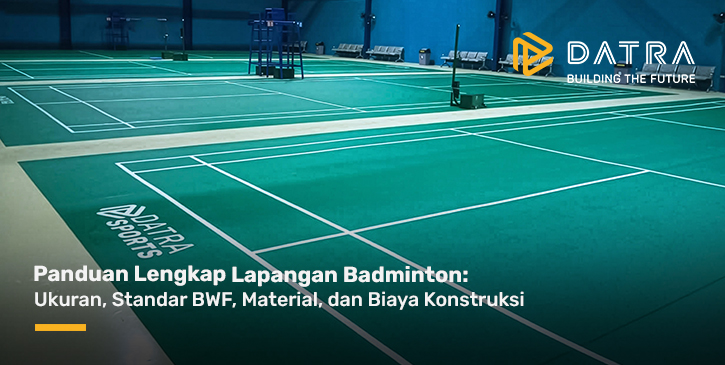
Experienced in delivering badminton court installations across Indonesia—from commercial sports arenas and corporate facilities to educational institutions and national athlete training centers.
Badminton is one of the most popular sports in Indonesia, played everywhere from neighborhood courts to national training facilities. However, building a badminton court that is truly suitable for recreational play, club training, or official tournaments is far more technical than it appears.
Many facility owners only realize problems after construction is complete: uneven flooring, ceilings that are too low for high lobs, or flooring materials that are unsuitable for indoor or outdoor environments. This guide covers everything you need to know from official BWF court dimensions and technical flooring specifications to ceiling height requirements, sub-base preparation, and realistic construction cost estimates.
Datra has delivered badminton court projects for schools, sports clubs, corporate facilities, and government sports venues throughout Indonesia. You can explore some of our completed projects on our Project Portfolio page. Based on that experience, this guide serves as a practical reference for anyone planning to build a badminton court.
Standard BWF Badminton Court Dimensions
The official badminton court dimensions are established by the Badminton World Federation (BWF) and serve as the global standard. Most badminton vinyl flooring systems, including those supplied by Datra, are manufactured according to these specifications.
Element | Dimension |
Court Length | 13.40 m |
Court Width (Doubles) | 6.10 m |
Court Width (Singles) | 5.18 m |
Net Height (Center) | 1.524 m |
Net Height (Posts) | 1.55 m |
Line Width | 40 mm |
Short Service Line | 1.98 m from the net |
Don't Forget the Run-Off Area
The dimensions above refer only to the playing lines—not the total floor area required.
Adequate run-off space around the court is essential for player safety. Under BWF tournament recommendations, a minimum clearance of 2 meters behind each baseline and 1.5 meters on each sideline should be provided. This means a standard doubles badminton court ideally requires approximately 15 × 8 meters of total floor space.
For recreational facilities, slightly smaller clearances may be acceptable, but players should never be positioned too close to walls or structural columns.
Court Surface Materials
Datra recommends different flooring systems depending on whether the facility is intended for indoor or outdoor use.
Datra Sports Badminton Vinyl
For indoor facilities such as sports halls, commercial badminton centers, and multipurpose halls, Datra recommends Datra Sports Badminton Vinyl, available in two thickness options:
- 5.0 mm — ideal for schools, training facilities, and regular use.
- 5.5 mm — provides additional cushioning, making it suitable for high-traffic facilities and competition-level courts.
Each court requires one complete set consisting of four vinyl rolls, with each roll measuring 1.8 × 15 meters. Court line markings compliant with BWF standards are already included in the product and do not require separate installation.
Datra Sports Multisport SPU
Vinyl flooring is not recommended for outdoor badminton courts because it is not designed to withstand prolonged UV exposure, rain, and extreme temperature fluctuations.
For outdoor applications, Datra recommends Datra Sports Multisport SPU with a 4 mm system thickness. This seamless surface can be installed both indoors and outdoors and is available in various color options to match a facility's branding or visual identity.
The Most Overlooked Step: Sub-Base Preparation
One of the most common misconceptions among first-time badminton court owners is that vinyl flooring can be installed immediately after the concrete slab has been poured.
In reality, proper sub-base preparation is one of the most critical factors affecting flooring performance and service life. Before vinyl installation, the sub-base must be clean, dry, structurally sound, and perfectly level.
The preparation process typically includes:
1. Surface Flatness Inspection
Surface flatness is checked using a 2-meter straightedge or laser level. For sports vinyl flooring, the commonly accepted flatness tolerance is no more than 3 mm deviation over a 2-meter span.
2. Self-Leveling Compound (SLC)
If depressions or high spots exceed the allowable tolerance, contractors apply a self-leveling compound (SLC) to produce a smooth and level substrate before installing the vinyl flooring.
3. Moisture Testing
Concrete moisture levels must also be checked before installation. Excess moisture can weaken adhesive bonding and lead to issues such as delamination over time.
Why Is This So Important?
If vinyl flooring is installed over an uneven sub-base, the finished surface will mirror every imperfection beneath it, resulting in visible waviness and reduced playing comfort.
Over time, uneven load distribution caused by player movement can accelerate flooring wear, open welded seams, weaken adhesive bonds, and create bubbles (bubbling).
Even the highest-quality sports vinyl cannot deliver optimal performance without a properly prepared sub-base. Investing in proper floor preparation is essential to achieving a durable, high-performance badminton court.
Ceiling Height: An Often Overlooked Design Requirement
Besides sub-base preparation, ceiling height is another factor frequently overlooked during indoor badminton court planning.
A shuttlecock can travel extremely high during lob and clear shots. If the ceiling is too low, gameplay will be interrupted and the facility may not qualify for official competitions.
Facility Type | Recommended Clear Height |
Recreational | Minimum 7 m |
Club & School Training | 7.5–9 m |
General BWF-Sanctioned Events | Minimum 9 m (12 m preferred) |
Olympics, BWF World Tour Level 1–5, Grade 1 & 2 | Minimum 12 m |
The measurement refers to clear height—the unobstructed distance from the finished floor to the lowest overhead element, including steel trusses, lighting fixtures, air-conditioning ducts, sprinklers, speakers, and suspended equipment.
Insufficient clear height can result in:
- Shuttlecocks striking the ceiling or overhead installations.
- Restricted lob and clear shots.
- Failure to comply with tournament standards.
- Reduced playing comfort for competitive athletes.
For architects and designers, clear height should be established during the earliest design stages—not treated as an afterthought.
Estimated Badminton Court Costs
Below is an estimated price range for the primary materials used in badminton court construction. Prices cover materials only and exclude installation and sub-base preparation.
Product | Specification | Estimated Price |
1 Court Set (4 Rolls @ 1.8 × 15 m) | IDR 34,500,000 | |
1 Court Set (4 Rolls @ 1.8 × 15 m) | IDR 39,850,000 | |
Per m² (Indoor/Outdoor, MOQ 500 m²) | IDR 700,000 | |
One Pair | IDR 10,550,000 |
These prices are indicative only and may vary depending on project location, existing sub-base conditions, and additional project requirements.
For a detailed quotation tailored to your facility, we recommend consulting Datra's technical team.
Build More Than Just a Court—Build a High-Quality Sports Facility
The success of a badminton court project depends on more than simply meeting BWF dimensions. Three factors that consistently have the greatest impact—and are also the most frequently overlooked—are proper sub-base preparation, adequate clear ceiling height, and selecting the right flooring system based on whether the facility is intended for indoor or outdoor use. Addressing these considerations from the outset helps ensure long-term performance, player safety, and lower maintenance costs.
Datra Internusa has delivered badminton court projects for commercial sports centers, corporate facilities, educational institutions, and national athlete training centers throughout Indonesia. Whether you're planning a new badminton court or renovating an existing one—as a facility owner, corporate organization, educational institution, coach, or architect—our team is ready to support you from technical consultation through installation.
Get in touch with our team at sales@datra.id or via WhatsApp to discuss your badminton court project and receive expert technical consultation.
Related Blogs
FIBA-Standard Basketball Flooring: Why Wood Is the Standard, and How Junckers Meets It
Construction, Sports
October 14, 2026

World Athletics Standard Running Track: The Complete Guide to Specifications, Construction, and Certification
Education, Construction, Sports
July 22, 2026
Complete Volleyball Court Guide: FIVB & PBVSI Standards for Indoor and Outdoor Courts
Education, Construction, Sports
July 16, 2026
