
The Indoor Sports Facility Design & Development Guide
Construction, Sports, Stadium
May 11, 2026
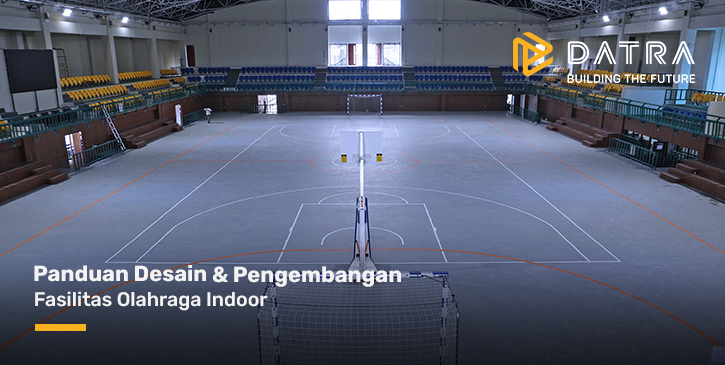
A Practical Reference for Owners, Developers, and Decision-Makers
Grounded in 40+ years of sports facility experience across Indonesia and informed by global best practice in venue design and construction.
A Note Before You Begin
The world's leading sports venue design firm, Populous, has produced what many consider the definitive professional guide to stadium design — a book used by architects, engineers, and government bodies across five continents. It is thorough, rigorous, and global in scope.
This guide draws inspiration from that body of knowledge. But it does something different: it translates the principles of world-class venue design into practical, honest guidance for those commissioning, planning, and managing indoor sports facilities — from a school gym in a regional city to a multi-purpose arena serving tens of thousands.
The lessons here come from both global expertise and firsthand experience building facilities that have hosted FIFA World Cups, FIBA World Championships, Asian Games, and national events across Indonesia. Where the theory meets reality — particularly in markets with developing sports economies, imported materials, and real contractor risk — this guide will tell you what the textbooks do not.
Part One: Before Anything Else — The Brief
1.1 Start With Purpose, Not Product
The single most consequential decision in any sports facility project happens before a single line is drawn or a single product is selected: deciding what the facility is actually for.
This sounds like a statement of the obvious. It is not. In practice, the majority of project failures, cost overruns, and post-completion disappointments trace back to this step being skipped or assumed rather than genuinely resolved.
A facility designed to host international competitions must comply with the relevant federation's technical requirements — FIBA for basketball, FIFA for football, BWF for badminton, World Athletics for track. These standards govern not just the field of play but spectator sightlines, lighting levels, changing room dimensions, warm-up areas, media infrastructure, and safety systems. A venue that fails these requirements cannot host sanctioned events, cannot record official results, and cannot attract the events that justify its investment.
A community sports hall for a school or municipality has a completely different design logic: maximising utilisable floor area, durability under high daily use, safety for young users, and cost-effective maintenance.
A commercial multi-purpose indoor arena designed for revenue generation needs a third logic entirely: flexible floor configurations, revenue-generating ancillary spaces, sightlines that work for multiple sports and non-sports events, and a commercial model that justifies the investment.
The brief must answer:
- What is the primary use? What sports, and to what standard?
- Who are the users — competitors, recreational participants, spectators, or all three?
- What non-sports events must the facility accommodate?
- What is the design life of the facility? (Ten years? Forty years?)
- What is the business model — government-funded, commercial, institutional, or hybrid?
Without clear answers to these questions, no design team and no specialist contractor can give you a valid cost estimate or a meaningful design proposal.
1.2 The Business Case: Do the Economics Honestly
Sports and entertainment venues are one of the great historic building types. They are also one of the most financially demanding. The Populous guide is explicit about this: even in the most affluent sporting markets in the world, with highly engaged audiences and skilled commercial operators, stadia routinely struggle to generate profit once the full capital cost is taken into account.
This is not a reason not to build. It is a reason to plan with clear eyes.
A comprehensive feasibility study should address three things before any design work begins:
Capital costs — the total investment including construction, fitout, specialist systems, consultancy fees, land costs, and contingency. In our experience, the single biggest mistake developers make is budgeting for the construction they imagine rather than the construction they will need.
Operating costs — the ongoing costs of running the facility: staffing, energy, maintenance, cleaning, insurance, security, and the periodic replacement of surfaces and equipment. Operating costs over a facility's lifetime typically far exceed the initial capital cost. The Populous guide notes that occupancy costs can reach ten times the capital cost over a 25-year lifespan. Under-budgeting maintenance is one of the most consistent patterns we see in failed or deteriorating sports facilities.
Revenue projection — an honest model of utilisation rates, ticket or court revenue, hospitality income, sponsorship, naming rights, non-event-day commercial use (conferences, weddings, exhibitions), and ancillary income from food, beverage, retail, and parking. These projections must be grounded in realistic local market data, not aspirational numbers.
The gap between projected revenue and projected cost — net of capital financing — defines whether the project is viable and what level of subsidy, if any, is required.
1.3 Budget and Timeline: Share Them Early
There is a persistent reluctance among developers and owners to disclose their budget or timeline to their design and construction team at the outset. The logic seems to be that withholding this information gives negotiating leverage.
In practice, it does the opposite. Without a known budget, no specialist can design an optimal solution for your constraints. Without a known timeline, no contractor can plan procurement, staffing, and sequencing properly.
Share your budget and timeline as early as possible. A credible specialist will use this information to recommend the best solution within your parameters — not to inflate the cost.
Part Two: Location, Masterplanning, and Site
2.1 Location Is a Property Equation
For any sports facility with a commercial dimension, location is arguably the most important variable — more important than the quality of the facility itself.
Sports participation and spectating are, in most markets, convenience-driven behaviours. People will not travel significant distances to train or recreate regularly. Catchment population within a viable radius, public transport access, road access, and the competitive landscape of existing facilities in the area all determine the viable utilisation rate of a new venue.
A brilliantly designed facility in the wrong location will underperform. A modestly designed facility in exactly the right location can thrive.
Before committing to a site, answer these questions:
- What is the realistic catchment population within a 15-minute travel radius?
- How will people arrive — car, public transport, motorcycle, on foot?
- What are the parking requirements and can they be met on or near the site?
- Are there competing facilities nearby, and how will this venue differentiate?
2.2 Masterplanning the Venue
Even the smallest sports facility benefits from a masterplan — a considered plan for the overall site, not just the building.
Key masterplanning considerations:
- Orientation: For indoor facilities, solar orientation affects energy performance and lighting. For venues with skylights or translucent roofing, orientation affects the quality of natural light on the playing surface.
- Vehicle and pedestrian separation: Access routes for spectators, athletes, media, and service vehicles should be planned separately from the outset.
- Phasing: Can the facility be built in phases, with later expansion planned from the start? Designing foundations and structural connections to allow future expansion is almost always cheaper than retrofitting later.
- Landscaping: A well-landscaped site softens the visual impact of a large building, improves the arrival experience, and increases the perceived quality of the venue. Landscaping is often treated as an afterthought and underbudgeted. It should be part of the masterplan from the beginning.
2.3 Zoning the Venue
Populous divides the spectator arrival experience into concentric zones, from the outer perimeter through to the playing surface. This zoning logic is equally applicable to indoor facilities:
- Zone 5: Public approach — streets, public transport, parking
- Zone 4: External precinct — the pedestrian area between parking and building entrance, where queuing, orientation, and pre-event atmosphere occur
- Zone 3: Concourse — internal circulation, toilets, food and beverage, commercial retail
- Zone 2: Seating bowl or spectator viewing area
- Zone 1: Field of play, court, or arena floor
Each zone requires specific design consideration. The quality of each zone contributes to the total experience of everyone who uses the building.
Part Three: Structure, Form, and Materials
3.1 The Structural Hierarchy
Every indoor sports facility has a structural hierarchy that determines both cost and performance:
Foundation and sub-structure: The most invisible and most consequential element. Poor foundation work creates problems that are enormously expensive to correct once construction is above ground. Geotechnical investigation — understanding what the ground actually consists of — is essential before finalising any structural approach. Sports facilities are sometimes built on challenging ground: reclaimed land, former industrial sites, areas with variable soil bearing capacity. A full geotechnical report should be commissioned before the construction budget is finalised.
Primary structure: The columns, beams, and frames that carry the loads of the building. In indoor arenas, the primary structure must carry not just the building itself but the loads imposed by large roof spans, suspended equipment (scoreboards, lighting rigs, speaker arrays), and the dynamic loads of crowds in motion.
Roof structure: For indoor facilities, the roof is the dominant structural challenge and often the largest single cost item. A roof must span the full width of the arena without internal columns that obstruct sightlines or interfere with play. Roof span requirements are determined by the playing area dimensions plus the required clearance on all sides — and this is one of the areas most commonly underestimated by clients who focus their budget on exterior architectural expression.
Building envelope: The external walls and roof cladding that enclose the space, manage weather, provide thermal and acoustic performance, and create the architectural identity of the building.
3.2 Materials: The Long View
Material selection is a life-cycle decision, not a capital cost decision. The Populous guide makes this point forcefully: savings made on materials at construction stage often result in maintenance costs that far exceed the initial saving over the building's life.
For indoor sports facilities:
Concrete is the primary material for the structural frame, seating tiers, and concourse floors. It is durable, fire-resistant, and suited to the wet tropical climates found across Southeast Asia. Poor quality concrete — inadequate mix design, insufficient curing time, absent or incorrect reinforcement — is one of the most common causes of premature deterioration in sports facilities.
Steel is typically used for roof structures. Its advantages include speed of fabrication off-site, lighter weight than concrete, and the ability to achieve the long spans needed for column-free indoor arenas. It requires appropriate fire protection and, in coastal or high-humidity environments, robust anti-corrosion treatment.
Cladding and finishes must withstand the specific environmental and use conditions of the site. In tropical climates, UV resistance, moisture resistance, and resistance to biological growth (algae, mold) are critical selection criteria. Materials that look good in European catalogues may not perform in equatorial conditions without specific treatment.
Part Four: The Field of Play
4.1 Flooring: The Most Important Specification
If there is a single element that defines the quality and longevity of an indoor sports facility, it is the floor. This is the surface on which athletes perform, on which records are set or broken, and on which injuries are either mitigated or caused. It deserves the most careful specification of any element in the building.
The sub-base is everything. Whatever surface material is chosen for the final floor, its performance depends entirely on what is beneath it. The concrete sub-base must be:
- Laid to the correct level with precise tolerances on flatness
- Sloped correctly for drainage (typically 1:100 for indoor sports, oriented to drainage points)
- Fully cured before any surface material is applied
- Waterproofed to prevent moisture migration that will cause adhesive failure or timber rot
- Structurally adequate to carry the loads without differential settlement
The most common cause of premature floor failure in sports facilities is inadequate sub-base preparation. Running tracks have had to be completely replaced within 18 months because of incorrect slope, failing adhesion, or product incompatibility with a poorly prepared base. Wooden floors have rotted within two years because moisture was not controlled in the sub-base. These failures cost the same as starting over — and produce the downtime that destroys venue revenue.
Permanent polyurethane systems are the most widely used surface for multi-sport indoor facilities. Correctly specified and installed, they provide excellent shock absorption, ball rebound consistency, and durability. They can be marked for multiple sports simultaneously and withstand the conversion demands of multi-purpose venues.
Engineered wooden flooring is the premium choice for serious basketball, volleyball, badminton, and multi-sport competition venues. The world's leading system — used in NBA arenas, Olympic venues, and FIBA-certified courts — is Junckers from Denmark, the global FIBA sponsor. The investment in a Junckers floor properly installed and maintained is an investment with a 40-50 year lifespan. Cheap wooden flooring improperly treated can deteriorate to an unusable state within 1-2 years in tropical conditions. The lifecycle economics of quality versus false economy are dramatic.
Synthetic turf for indoor football or multi-sport applications must be specified to the appropriate FIFA or relevant federation quality mark, and the shock pad beneath must be correctly matched to the pile height and density.
Modular and lay-on systems (portable hardwood, vinyl tiles, foam mats) are useful for temporary conversions or venues that change sport configuration frequently. They require exceptional sub-base quality and precision, as any variation beneath will be amplified at the surface.
On product selection: Floor systems come from Indonesia, Southeast Asia, China, and Europe. The differences in quality, certification, durability, and manufacturer support are significant. European products — particularly in wooden flooring and specialist track systems — carry established federation certifications, longer warranty periods, and a depth of technical support. The price premium is real; so is the difference in performance and lifespan. The calculation should be made on whole-life cost, not purchase price.
4.2 Court Dimensions and Federation Standards
Different sports have specific court dimension requirements. Key indoor sports dimensions:
Sport | Court Size (L × W) | Clearance Required |
Basketball (FIBA) | 28m × 15m | 2m all sides (min) |
Badminton (BWF) | 13.4m × 6.1m (singles) / 13.4m × 7.15m (doubles) | 2m all sides |
Volleyball (FIBA) | 18m × 9m | 3m all sides (min) |
Futsal (FIFA) | 38-42m × 18-25m | Varies |
Indoor Tennis | 36.57m × 18.29m | 6.4m baseline, 3.7m side |
Padel | 20m × 10m | Enclosed court |
Minimum ceiling clearances: basketball requires a minimum of 7m free height above the playing area; for competition events, 9m or more is preferable. Badminton requires a minimum of 9m, with higher preferred for international competition.
Multi-sport venues require careful dimensional planning to maximise the number of sports that can be accommodated on a single floor plate. The optimal configuration should be determined in the briefing stage, as it drives the structural grid, roof height, and mechanical systems.
4.3 Orientation and Environmental Conditions
Indoor facilities eliminate many of the orientation challenges of outdoor venues, but environmental conditions within the building are critical:
Temperature and humidity: For player performance and surface longevity, indoor temperature and humidity must be controlled. Wooden floors expand and contract with humidity changes — without proper climate control, even the best wooden floor will gap, cup, or buckle. Air conditioning design for indoor sports arenas is a specialist engineering discipline.
Air movement: Mechanical ventilation systems must be designed to avoid creating air currents at playing level that would interfere with badminton or similar precision sports. Air movement at high level can be substantially different from air movement at court level, and this requires careful diffuser and inlet positioning.
Acoustic environment: Indoor arenas amplify sound dramatically. Without acoustic treatment, a single-volume arena can become unusable for events that include public address systems, commentary, or crowd noise. Acoustic panels on walls and ceilings are not decoration — they are functional infrastructure.
Part Five: Spectators and the Viewing Experience
5.1 Sightlines: The Science of Seeing
Spectator enjoyment depends entirely on the ability to see the action. Sightline design — calculating the viewing geometry from each seat to the field of play — is a technical discipline with established standards.
The key measure is the "C value": the vertical distance in millimetres by which a spectator's line of sight clears the head of the person in front. A C value of 120mm represents a good viewing standard. Below 90mm, spectators must tilt their heads back to see over the row in front. Below 60mm, views are obstructed.
Achieving acceptable C values across a large seating bowl requires that each successive row be raised relative to the one in front by a calculated increment. This produces a curved rake profile that must be built in pre-cast concrete steps with precision — often requiring step riser variations of 10-25mm between rows.
In indoor arenas, the compact geometry typically produces steeper rakes than outdoor stadia, which is both an advantage (closer sightlines) and a risk (maximum rake angles of approximately 34 degrees for safety, beyond which spectators experience vertigo).
Additional considerations:
- Obstructions: Any column that obstructs a sightline is a design failure. Indoor arenas should be designed as column-free structures within the spectator bowl.
- Viewing distances: For small-ball sports like badminton or table tennis, the maximum acceptable distance from the front row to the far end of the court is significantly less than for basketball or football. Maximum viewing distances should be checked against federation guidelines.
- Upper tier sightlines: If the facility includes an upper tier, the sightlines from the back row of the upper tier and the front row of the lower tier require equally careful calculation.
5.2 Seating: Comfort, Safety, and Durability
Seating design involves reconciling four factors: comfort, safety, robustness, and economy. These are partially in tension — the most comfortable seats are usually the most expensive and least robust, while the cheapest are often uncomfortable and short-lived.
The worldwide trend is unambiguously toward higher comfort standards. Spectators who are comfortable stay longer, spend more money on food and beverage, and are more likely to return.
Seat types from lowest to highest cost and comfort:
- Bench seats (backless, moulded plastic or aluminium)
- Tractor seats (individual backless)
- Bucket seats with backs
- Tip-up seats (the current standard for serious venues)
- Upholstered tip-up with armrests (VIP and premium areas)
For any venue targeting repeat spectators, individual tip-up seats with backs are the minimum acceptable standard in the general seating bowl. The flip-up action provides a wider passage between rows, enabling better crowd flow and emergency egress.
Key seat dimensions (as recommended by international standards):
- Minimum seat width: 460mm (500mm recommended)
- Minimum row depth (tip-up): 760mm (800mm recommended)
- Maximum rake angle: 34 degrees
Seat materials: Polypropylene is the most widely used material, offering good UV resistance, colour availability, and durability. Seats must be tested for fire retardation to the applicable standard for the jurisdiction. In tropical climates, UV stabilisers and corrosion-resistant frame materials (hot-dip galvanised steel, or powder-coated galvanised steel) are particularly important for long service life.
Seat fixings: Riser fixing (attaching the seat frame to the vertical face of the concrete step) is generally preferable to tread fixing. It leaves the step floor clear for cleaning, reduces corrosion exposure, and produces a cleaner aesthetic.
Retractable seating: In multi-purpose venues where the floor must be cleared for non-sports events, telescopic retractable seating is a sophisticated but highly valuable solution. It allows a venue to shift from full-capacity sports mode to open-floor event mode and back, dramatically increasing the number of usable event days per year. Telescopic seating systems require precise structural interfaces and careful maintenance programmes to perform reliably over their operational life.
5.3 Private and VIP Viewing Facilities
In any venue that needs to be commercially self-sustaining, private and premium viewing areas are not luxuries — they are financial necessities. The revenue generated per seat from a private box or hospitality suite is a multiple of the revenue from a standard seat. Many new developments could not proceed without the income generated by premium facilities.
Private viewing areas include:
- Private boxes (10-20 persons, self-contained with food service and bar)
- Executive suites (shared premium space with superior catering)
- Club seating (premium seats with access to dedicated lounges and restaurants)
- General premium seating (better location, padded seats with armrests)
A critical design decision is whether premium viewers watch from behind a glass screen (common in the USA) or from open-air seats with the hospitality suite behind them. The latter provides full atmospheric immersion in the event; the former provides comfort at the cost of atmosphere. The best solution for most venues is open-air premium seats with the hospitality facility immediately behind, separated by a glass partition that can be opened.
Premium facilities also generate income on non-event days through corporate hire, conferences, and private events. This is only possible if they are designed with the appropriate flexibility — a hospitality suite that doubles as a conference room needs appropriate AV infrastructure, blackout capability, and catering facilities designed from the start.
Part Six: Circulation, Safety, and Services
6.1 Circulation: The Engine of the Venue
The ability of a large number of people to move safely, efficiently, and comfortably into, through, and out of a venue is a primary design challenge. Poor circulation design is not just uncomfortable — it is dangerous.
Populations move in predictable patterns: they arrive over a relatively long period before an event (up to 90 minutes for major events) and leave over a very short period at the end (often less than 15 minutes). The exit demand is therefore many times the arrival demand, and this is the critical design case.
Circulation design principles:
- Clear wayfinding: Signage must be legible, well-positioned, and unambiguous. Spectators arriving at unfamiliar venues must be able to find their seats without assistance.
- Sector organisation: Large venues should be divided into sectors of approximately 2,000-3,000 spectators each, with dedicated entry points, circulation routes, toilets, and food and beverage facilities for each sector. This prevents cross-flow and enables crowd management.
- Emergency evacuation: The facility must be capable of full evacuation within the time required by the relevant building code, typically 8 minutes in many jurisdictions. This requires circulation paths sized for the peak flow, with no bottlenecks.
- Accessibility: Facilities for wheelchair users and ambulant disabled spectators must be integrated into the design from the outset. Ramps rather than steps, designated viewing positions with appropriate sightlines, and accessible toilets and concessions are all required.
6.2 Toilets: Never Underestimate
Toilet provision is consistently underestimated in sports facility design. Inadequate or inaccessible toilets are one of the most common spectator complaints.
Key design principles:
- Provide a higher ratio of female facilities than male, particularly for events with mixed or female-heavy audiences
- Locate toilets so that no seat is more than 60m from the nearest facility, and preferably on the same level
- Design for peak demand (the 15-minute interval at half time, not the average demand over the event)
- Ensure accessibility for disabled users
6.3 Lighting Systems
Lighting in an indoor sports venue serves multiple functions and must be designed to serve each:
Playing area lighting is the most technically demanding. Federation standards specify the minimum horizontal illuminance (lux levels) at playing surface and the minimum uniformity ratio. FIBA requires a minimum of 1,500 lux for international events. Badminton and other precision sports have particularly demanding requirements for uniformity and glare control. Television broadcasting (if applicable) requires additional consideration of colour temperature and flicker frequency.
Spectator area lighting must provide adequate light for safe movement without causing glare that impairs viewing of the playing area.
Emergency lighting is a life safety system and must be designed and maintained to applicable standards.
Energy efficiency: LED systems have transformed indoor sports lighting. They offer dramatically lower energy consumption than older metal halide or fluorescent systems, longer service life, better dimming capability, and improved colour rendering. The capital premium over older technology is typically recovered within 3-5 years in energy savings. LED is now the unambiguous choice for any new indoor sports facility.
6.4 Sound Systems
A public address system is essential for safety announcements, event commentary, and atmosphere management. In a large indoor arena, the acoustic environment is complex — reflections and reverberation can make speech intelligibility very poor if the system is not properly engineered.
A quality sound system for an indoor arena is not simply a matter of amplifier power. It requires careful acoustic modelling of the space, correct loudspeaker selection and positioning to deliver even sound pressure levels across all seating areas, digital signal processing to manage time delays between speaker arrays, and integration with the emergency announcement system.
Budget for a professional acoustic and audio-visual consultant from the outset. The cost of professional AV design is small relative to the cost of retrofitting a system that does not perform.
6.5 HVAC and Air Quality
Heating, ventilation, and air conditioning (HVAC) is a major capital cost and the largest ongoing energy cost in an indoor sports facility. In tropical climates, air conditioning is essential for player safety, surface longevity, and spectator comfort.
HVAC design for sports arenas is a specialist discipline. The challenges include:
- Very high internal heat loads from spectators, lighting, and equipment
- High fresh air requirements for large occupied volumes
- Risk of condensation on cold surfaces (particularly relevant for refrigerated floors, less so for non-ice sports)
- Humidity control to protect wooden floors and other moisture-sensitive materials
- Air distribution that maintains comfort for spectators without creating disruptive air movement at playing level
A poorly designed HVAC system can consume twice the energy of a well-designed one. Commission an experienced mechanical engineering consultant and insist on energy modelling during design.
Part Seven: Operations and Financial Sustainability
7.1 The Revenue Model
Indoor sports facilities have several distinct revenue streams. The relative importance of each varies significantly by venue type, market, and location:
Participation fees: Court hire, membership, programme fees from recreational users. For community and club facilities, this is often the primary income source.
Spectator income: Ticket sales, season memberships, premium seating contracts.
Hospitality: Private boxes, executive suite hire, corporate event revenue.
Concessions: Food and beverage, merchandise, programme sales.
Non-event commercial hire: Conferences, exhibitions, private events, concerts. For venues with flexible floor configurations, this can represent a significant share of total revenue and is often the difference between financial viability and deficit.
Naming rights: For larger facilities, the sale of naming rights to a corporate sponsor can generate substantial income.
Advertising: In-venue signage, digital display boards, LED perimeter systems.
Parking: A reliable revenue source where parking is controlled.
The Populous guide notes that new covered European venues target up to 250 event days per year, of which only 5-10% are primary sport events. The remainder are commercial hires, concerts, conferences, and other events. Designing the facility to support this utilisation pattern — with appropriate floor systems, technical infrastructure, and hospitality spaces — is the key to financial sustainability.
7.2 Operating Costs: Plan for Them From the Start
The costs most consistently underestimated in sports facility planning are the ongoing operating costs:
Maintenance of building fabric, mechanical systems, and playing surfaces. Preventive maintenance is always cheaper than reactive repair. Build a maintenance budget into the business model from day one.
Cleaning: A large venue requires substantial regular cleaning effort. The Populous guide estimates 30-40 man-hours per 10,000 seats after each event. Design the facility to minimise cleaning cost: riser-fixed seats rather than tread-fixed, smooth concourse floors, easily accessible drainage.
Energy: Lighting, HVAC, and other services are substantial costs. Every dollar of capital invested in energy-efficient systems pays back through reduced operating costs over the facility's life.
Surface replacement: Polyurethane floors require recoating periodically and eventual full replacement. Running tracks have a finite service life. Equipment requires periodic inspection, servicing, and replacement. Budget for these items from the start.
Staffing: Administration, facility management, event day operations, catering, security, and cleaning all require dedicated staffing. A detailed staffing plan should be part of the feasibility study.
7.3 Maintenance: The Most Undervalued Investment
The Populous guide dedicates an entire chapter to maintenance — because neglected maintenance is the primary cause of premature facility deterioration.
For playing surfaces specifically:
- Wooden floors require regular cleaning with appropriate products (not water), periodic re-sanding and refinishing, humidity monitoring, and protection during non-sports events (using protective covering or staging systems)
- Polyurethane surfaces require regular cleaning and periodic re-marking of court lines; damaged areas must be repaired with compatible materials to maintain consistent performance characteristics
- Synthetic surfaces require regular brushing, infill replenishment, and cleaning; they are not maintenance-free
Beyond playing surfaces, the building fabric requires regular inspection of the roof (especially for leaks in tropical climates), drainage systems, structural connections, and envelope cladding.
A facility that is clean, well-maintained, and operating as intended is a venue people return to. A deteriorating facility is a declining commercial asset.
Part Eight: Sustainable Design
8.1 Sustainability Principles for Sports Facilities
The three core principles of sustainable design for sports facilities, as established in international practice, are:
Re-use: Before building new, consider whether an existing facility can be renovated and brought to the required standard. Renovation of existing infrastructure is almost always more carbon-efficient than demolition and new build, often more cost-effective, and preserves the community identity of established venues. Many older facilities across Indonesia and Southeast Asia could be transformed into high-quality venues at a fraction of the cost of a new build.
Reduce: Design to minimise the materials used in construction and the energy required in operation. Structural efficiency, natural ventilation where climate allows, high-performance insulation, and LED lighting systems all reduce the environmental footprint and operating cost of the facility.
Recycle: Specify materials with recycled content where technically appropriate, and design for the future adaptability or deconstruction of the building. Long-life, durable materials that do not require frequent replacement are inherently more sustainable than cheap materials with short service lives.
8.2 Life-Cycle Thinking
The most sustainable decision is usually also the most economically rational one: invest in quality materials and systems that perform well and last long, rather than cheap materials that require expensive replacement.
A facility built to last 40 years with appropriate material specifications and maintenance has a fundamentally different environmental and economic profile from one that requires major refurbishment after 10 years. The embodied carbon of the construction phase is amortised over a much longer period; the disruption, waste, and cost of premature replacement is avoided.
Part Nine: Choosing Your Specialist
9.1 Why Specialist Contractors Matter
Indoor sports facility construction is a specialist discipline. The field of play, the sports flooring, the spectator seating, the equipment, and the specific civil works that support them require technical knowledge that general contractors do not possess.
General contractors build buildings. They can manage structure, MEP, and architectural finishes. For the specialist elements that define a sports venue — the floor system, the seating, the field equipment — they will subcontract to specialist suppliers. This creates a situation where the party managing the contract has a different set of priorities from the party using the facility: the general contractor's margin comes from the structure; the specialist subcontractor is at arm's length.
A specialist sports facility contractor who directly controls the field of play, flooring, seating, and equipment — and who has direct relationships with validated global suppliers — provides a fundamentally different level of accountability and quality assurance.
9.2 What to Look For in a Sports Facility Specialist
When evaluating any contractor for an indoor sports facility project, ask these questions:
Track record: Has this contractor delivered facilities at the standard you require? Can they show you completed projects — not renderings, not proposals, but built facilities you can visit?
Product access: Does this contractor have direct relationships with certified, validated suppliers? Or are they reselling through intermediaries, with the margin and accountability diluted at each step?
Technical knowledge: Do they understand the sub-base requirements for your chosen flooring system? The sightline calculations for your seating configuration? The load requirements for your roof?
Process and compliance: For projects involving public funds or government clients, ISO certification, documented processes, and auditable procurement are not optional — they are essential. The accountability requirements of government and institutional clients demand a contractor who can demonstrate process, not just result.
Integrity: This is harder to measure but critical. In any market, there are contractors who will substitute inferior products inside branded casings, reduce material quantities on installation, or otherwise misrepresent what they deliver. The only protection is working with contractors whose long-term business reputation depends on not doing these things — and who have a track record of delivering on their promises even when circumstances are difficult.
9.3 A Framework for the Project Conversation
Before engaging any contractor or design team, prepare to answer — and to ask — these questions:
Questions you must answer clearly:
- What is the primary purpose of this facility, and to what standard?
- What is the total budget including all costs, not just construction?
- What is the realistic timeline, including design, permitting, procurement, and construction?
- What are the primary revenue streams, and what are the realistic utilisation assumptions?
- What is the maintenance budget in the operating model?
Questions you should ask any specialist:
- Show me three projects you have completed at a comparable scale. Can I visit them?
- Who are your direct supplier relationships for the key elements (flooring, seating, equipment)?
- What certifications do your products carry, and from which federation bodies?
- What is your quality management process, and are you ISO-certified?
- What happens when something goes wrong mid-project?
Conclusion: Build for Prestasi, Not Just Prestige
The world's great indoor sports venues — from the Olimpico in Rome to the Palau Sant Jordi in Barcelona, from Madison Square Garden to Indonesia Arena in Senayan — share a common quality. They were built with the clarity of purpose, rigour of planning, and quality of execution that creates buildings which work, which endure, and which become genuinely meaningful to the communities they serve.
The external architecture — impressive as it often is — is the container. What happens inside, on the court, in the seats, in the moments when sport creates its particular magic, is the point of the whole enterprise.
Invest in the interior. Get the sub-base right. Specify flooring that will last a generation. Choose seating that treats spectators with respect. Design circulation that keeps people safe. Plan operations and maintenance from day one, not as an afterthought.
And work with people who understand that they are not just building a building. They are building a place where people will compete, and watch, and cheer, and experience something together — for years and decades to come.
That responsibility deserves to be taken seriously.
This guide was developed by Datra, Indonesia's leading specialist in sports facility construction, flooring, seating, and equipment. With over 40 years of experience and a portfolio spanning Gelora Bung Karno, Jakarta International Stadium, Indonesia Arena, Stadion Internasional Banten, and hundreds of projects across Indonesia, Datra serves clients ranging from national government ministries to schools and corporate facilities.
For consultation on your indoor sports facility project:
www.datra.id | sales@datra.id | 0811 1061 6565
Related Blogs
FIBA-Standard Basketball Flooring: Why Wood Is the Standard, and How Junckers Meets It
Construction, Sports, Stadium
October 14, 2026
World Athletics Standard Running Track: The Complete Guide to Specifications, Construction, and Certification
Construction, Sports
July 22, 2026
Complete Volleyball Court Guide: FIVB & PBVSI Standards for Indoor and Outdoor Courts
Construction, Sports
July 16, 2026
