
A Complete Guide to Building Climbing Walls for Schools and Sports Halls (GOR) in Indonesia
Education, Construction, Sports
June 30, 2026
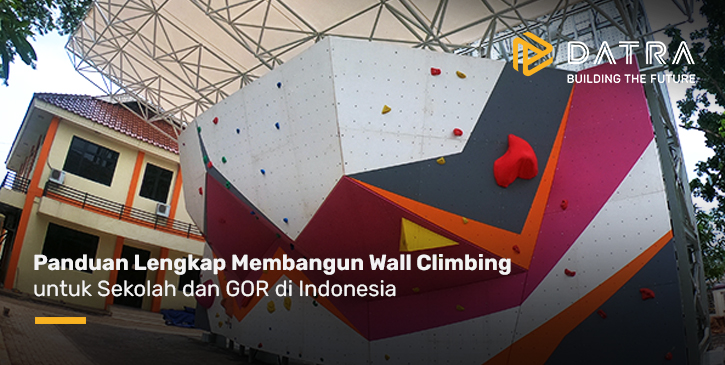
By Datra Internusa — main contractor on six climbing wall projects across Indonesia, including Jakarta International Climbing Wall Park, PPOP Ragunan, GOR Jalak Harupat, and Stadion Kebun Bunga in Medan.
Climbing is no longer a sport reserved for mountains or specialist clubs. Over the past few years, building a climbing wall has become a recurring item on the agenda for schools, athlete development centers, and sports halls (GOR) across Indonesia, driven by growing interest among young people and a wider recognition that climbing trains not just the body, but mental focus and problem-solving as well.
Behind that enthusiasm, though, plenty of facility managers and school principals get stuck on the same questions when they start building a climbing wall: how much land do you need, what does it cost, what's the real difference between indoor and outdoor, and where do you even start. This guide answers all of that, drawing on Datra's hands-on project experience (see our full project portfolio) and cross-checked against official international federation standards.
Three Types of Climbing Walls You Need to Understand Before Building
Before getting into land requirements or budget, it's worth understanding that building a climbing wall isn't a single, uniform job. There are three main types, each with its own function, dimensions, and level of construction complexity.
One note on terminology: the international governing body long known as IFSC (International Federation of Sport Climbing) officially rebranded to World Climbing in December 2025.
Speed Wall
Speed walls are used for the speed climbing discipline, where athletes race each other to the top. Because it's built for competition, this is the most standardized wall type by far:
- Height: 15 meters (the World Climbing/IFSC standard for top-tier competition)
- Angle: a continuous 5-degree overhang from vertical
- World Climbing also recognizes a 10-meter speed wall variant, intended for training or for facilities with limited ceiling height, though world records are only set on the 15-meter wall
If a school or sports center wants to host, or qualify as a venue for, official competitions, the speed wall needs to hit that 15-meter spec without compromise. For training facilities or extracurricular programs that aren't chasing competition homologation, the 10-meter option is a realistic fallback for buildings with height restrictions.
Lead Wall
Lead walls are used for the difficulty discipline, where climbers try to get as high as possible without falling, clipping into a series of anchor points along the route as they go.
- Minimum competition height under World Climbing (formerly IFSC) standards: 12 meters
- Minimum route specs: 15 meters long, 3 meters wide per route (routes can exceed the wall's raw height because they make use of overhangs and traverses, not just straight vertical climbing)
- Requires a belay system operated from the ground
- Can include varying degrees of overhang to increase difficulty
Worth flagging: 12 meters is the official minimum for competition, not a target. In practice, many national athlete development facilities build lead walls 15 to 18 meters tall to leave room for a wider variety of routes. That's standard practice for high-end facilities, not a binding minimum requirement.
Boulder Wall
Boulder walls are the most familiar entry point for beginners and work well for school programs, since there's no rope system involved. Safety comes from crash pads and a capped wall height instead.
- Height: typically 4.5 meters, consistent with common practice at World Climbing (formerly IFSC) competitions
- No rope system or vertical anchors needed
- The entire fall zone must be covered by quality crash pads
- Easier to fit into a smaller footprint
Worth noting: these dimensions apply equally to indoor and outdoor installations. There's no difference in scale between the two, only in the materials and structural treatment used.
The Space and Clearance Requirements Everyone Forgets
Plenty of facility managers arrive at a project with a wall size already fixed in their heads, but forget to account for the safety zone around the structure. This is one of the most common planning gaps in climbing wall projects.
Speed Wall
- World Climbing (formerly IFSC) standards call for at least 1 meter of flat, secured ground on each side of the wall
- The starting area must be completely free of obstructions
- Leave extra space on both sides for operator and staff access
Lead Wall
- Clear ground beneath the wall for belaying and a controlled fall zone
- The fall zone needs to expand to match the overhang profile, since a climber falling from an overhanging section lands further out from the wall's centerline
- Keep columns, railings, or any hard objects out of the area in front of the wall
Boulder Wall
- World Climbing (formerly IFSC) standards call for at least 1 meter of circulation space around the edge of the crash pad
- The entire fall zone must be covered by crash pads with no gaps
- No hard objects should be within reach of the fall zone
Ceiling Height for Indoor Installations
This tends to be the constraint nobody catches until the final planning stage. The ceiling height you need is always greater than the wall height itself, since it has to accommodate the steel structure, anchor system, the protection point above the wall, lighting, and space for installation and maintenance.
Wall Type | Wall Height | Minimum Ceiling Height |
Speed (15 m) | 15 m | 16.7 m (official World Climbing/IFSC spec for the top protection point); real-world projects typically add extra buffer, bringing it to 17-18 m |
Speed (10 m) | 10 m | 11.7 m (official spec), for facilities with limited ceiling clearance |
Lead | Min. 12 m (competition); 15-18 m in athlete development practice | Industry estimate: wall height plus 2-3 m for structure and overhang clearance; not explicitly set by the federation |
Boulder | 4.5 m | Industry estimate: 5.5-6 m |
If a sports center or school building doesn't have enough ceiling clearance for a speed or lead wall, a boulder wall or the 10-meter speed wall variant is a realistic first option, and still a genuinely valuable sports facility in its own right.
Panel Materials: Indoor vs Outdoor
The material question always comes up, largely because of legitimate concerns about durability in Indonesia's hot, humid, rain-heavy tropical climate.
Across Datra's projects, indoor and outdoor alike, including Jakarta International Climbing Wall Park and PPOP Ragunan, the materials used always reference international standards, adapted to the specific conditions of each installation.
For Indoor Installations
Birch plywood panels with an anti-slip finish are the industry standard for indoor installations. The material is lightweight, easy to customize in shape and color, and holds up well under the daily dynamic loads of regular use. Paint finishes should be water-based with high abrasion resistance.
As a technical reference point, World Climbing's (formerly IFSC's) own venue requirements document specifies plywood classifications under the EN636 standard, with EN636-3 (Exterior Environment) as the benchmark for outdoor conditions, and EN636-1 or EN636-2 for dry-to-humid indoor environments.
For Outdoor Installations
The requirements shift significantly here. In Indonesia's tropical climate, outdoor panels need to withstand UV exposure, heavy rain, and year-round high humidity. The recommended options are FRP (Fiberglass Reinforced Plastic) or marine-grade plywood rated to an EN636-3 equivalent, finished with a UV-resistant coating. Just as important: the steel frame needs a hot-dip galvanized coating to prevent corrosion.
One thing to avoid entirely: using untreated standard birch plywood for an outdoor installation. In Indonesia's climate, that material will warp, mold, and lose structural integrity within a short period.
How Much Does It Cost to Build a Climbing Wall?
This is the question that almost always comes up last in the conversation, even though it's usually the first thing on everyone's mind. Based on Datra's experience across climbing wall projects in Indonesia, installation costs for the wall structure alone (assuming the building and foundation are already in place) typically run around Rp 2 billion.
That figure reflects a construction standard that meets international safety requirements. Keep in mind it doesn't include civil works like subbase and foundation, or equipment such as belay mats; those need to be budgeted separately as part of the overall project cost.
This is a general estimate, not a fixed number for every project. The actual cost of building a climbing wall depends heavily on the wall type chosen, site conditions and location, accessibility, and the specific technical requirements involved.
Safety Standards and Certification
For facilities that students or developing athletes will actually use, safety standards aren't something to compromise on. Datra references two primary standards:
- World Climbing (formerly known as IFSC, the International Federation of Sport Climbing): the international technical benchmark for dimensions, materials, anchor systems, and safety across both competition and training facilities. Structures and holds at competition level also commonly reference the European EN 12572 standard, which specifically governs the structural safety of climbing walls and holds.
- FPTI (Federasi Panjat Tebing Indonesia, Indonesia's national climbing federation): local guidance that ensures facilities meet the needs of athlete development and competition within Indonesia, generally adapted from the international technical references above.
For government projects or athlete development facilities like PPOP Ragunan, the process includes design and technical review, periodic inspection during installation, structural testing, and formal sign-off from the project owner before the facility is cleared for use. This isn't bureaucratic box-checking; it's a layer of protection that keeps everyone who uses the facility safe.
How Long Does It Take to Build a Climbing Wall?
For the installation phase alone, once design and fabrication are complete, setting up a climbing wall takes around two months.
The full timeline from initial consultation to a ready-to-use facility runs considerably longer than that, since it also includes:
- Consultation and site survey, to determine wall type, dimensions, and whether the existing building structure is suitable
- Design and engineering, covering the steel structure, wall layout, overhang geometry, and anchor system
- Fabrication, producing the panels and steel frame to spec
- On-site installation (roughly two months)
- Testing and handover, the final inspection before the facility is handed over
Facility managers working toward a specific completion date should start planning well before they'd typically assume is necessary.
Three Common Mistakes When Building a Climbing Wall
Treating an Institutional Climbing Wall Like a Home Climbing Wall
This is the costliest mistake by far. Many schools and sports center managers have seen a home climbing wall in a private residence or small gym, and use that as their mental benchmark for cost when building a climbing wall of their own.
In reality, a climbing wall for a school or sports center is a commercial, institutional facility that requires purpose-engineered steel structure, high-strength panels, safety-rated anchor systems, quality climbing holds, and full compliance with safety regulations. When they see the actual cost estimate, the reaction is almost always shock, not because the contractor is overcharging, but because the initial expectations were never proportional to begin with.
Thinking a Climbing Wall Is Just "a Wall With Holds Bolted On"
A climbing wall isn't a plain wall with grips stuck to it. It's an engineered structure, purpose-built to handle the repeated dynamic loads of daily use.
Behind the visible panels sits a calculated steel frame, a precision fastening system, anchor points rated for specific loads, a wall geometry that shapes route design, a planned fall zone, and safety systems like auto-belays or quality crash pads. All of these components have to work as a single integrated system, not a collection of parts assembled on the fly.
Assuming Color Customization Works Like a Mural or Free-Form Illustration
Many facility managers picture climbing wall panels being painted with complex patterns, illustrations, or gradients, the way a mural would work. In reality, color customization on a climbing wall happens panel by panel, not across one continuous canvas, so it isn't designed to produce detailed images or complex gradients.
Panels can absolutely be matched to a school or facility's brand colors, but the color scheme needs to be planned at the design stage, not decided after the panels are already installed. Skip that planning step, and the finished wall risks looking disjointed rather than matching the intended concept.
The One Principle That Matters Most Before You Build
Across every climbing wall project Datra has built in Jakarta, Bandung, and Medan, there's one piece of advice that comes up with every client: start from the purpose, not the wall itself.
Before locking in size, type, or budget, figure out first who the facility is for and what it's meant to achieve.
- Extracurricular program at a primary school? A properly sized boulder wall is already more than enough.
- Athlete development aimed at national competition? Lead and speed walls built to World Climbing (IFSC) standards are non-negotiable.
- General recreational facility at a sports center? A combination of boulder and lead walls with an appealing design is the ideal choice.
That purpose shapes everything downstream: design, technical specifications, safety systems, and the total investment required.
Just as important: choose a contractor who understands climbing walls as a whole, not just the construction side. A climbing wall is a sports facility that combines three things at once, structure, safety, and user experience. Getting the planning right from the start is the best investment you can make before building a climbing wall.
Specification Summary
Parameter | Speed Wall | Lead Wall | Boulder Wall |
Height (competition) | 15 m (training option: 10 m) | Min. 12 m (competition); commonly 15-18 m for athlete development | 4.5 m |
Incline | 5-degree overhang from vertical | Variable, including overhang | Variable |
Indoor ceiling height | 16.7 m (official spec); 17-18 m in field practice | Industry estimate: wall height + 2-3 m | Industry estimate: 5.5-6 m |
Clearance | Min. 1 m on each side of the wall | Fall zone scales with overhang profile | Min. 1 m circulation space around the crash pad |
Safety system | Auto-belay | Rope + ground belay | Crash pad, no rope |
Ready to Build Your Climbing Wall?
Building a climbing wall is a long-term investment, and its success comes down to what happens at the planning stage: choosing the right wall type for your goals, matching it to your site and ceiling height, using the right materials for indoor or outdoor conditions, and meeting safety standards throughout.
Reach out to us at sales@datra.id or via WhatsApp to discuss your climbing wall needs for a school, sports center, or athlete development facility.
Related Blogs
World Athletics Standard Running Track: The Complete Guide to Specifications, Construction, and Certification
Education, Construction, Sports
July 22, 2026
Complete Volleyball Court Guide: FIVB & PBVSI Standards for Indoor and Outdoor Courts
Education, Construction, Sports
July 16, 2026

7 Things You Must Know Before Building a Tennis Court
Education, Construction, Sports
July 14, 2026
